Acne, dark marks and shallow scars are usually three stages of the same inflammatory process, so a suitable peel course can work on all three in the upper layers of the skin: it clears congested pores, helps marks fade faster and smooths the surface. The effect is not equal. A peel does most for comedones and mild inflamed acne, less and more slowly for marks, and little for scars; true atrophic scars need techniques that work deeper in the skin.
Why acne, marks and scars come as a chain
An inflamed spot is a pocket of inflammation inside a hair follicle. That inflammation prompts the surrounding pigment cells to make extra melanin, and once the spot has gone down, the excess pigment stays behind as a brown mark; on Vietnamese skin, these marks often last for months (why acne marks linger). When the inflammation is deep or long-lasting, it also destroys collagen in the dermis; as it heals, the lost tissue is not fully replaced and a depression is left behind (what atrophic acne scars are).
The practical consequence is simple: every new inflamed spot is a new source of marks, and possibly a new scar. Treating marks or scars while acne is still breaking out is like mopping the floor with the tap still running. Bringing acne under control has to come first, or at least alongside everything else.
What a peel course does for each problem
Problem | What the peel does | Current evidence | Realistic expectation |
|---|---|---|---|
Comedones, mild to moderate inflamed acne | Salicylic acid (BHA) dissolves in oil and gets into the follicle to clear blockages; some actives are anti-inflammatory | A review of 12 randomised trials (387 people): common peels work about equally well for mild to moderate acne; evidence quality very low to moderate | A support step alongside topical treatment; comedones clear fastest |
Brown post-acne marks | Speeds up the renewal of the pigment-carrying surface cells | A small trial in 25 people with skin types V–VI: 88% moderate to marked improvement after five salicylic acid peels, with hydroquinone used beforehand | Gradual fading over several sessions; peeling too often can create new marks |
Shallow scars, rough texture | Smooths surface texture | A 2017 systematic review: 20% glycolic acid peels gave no improvement in 25% of patients; TCA CROSS for narrow, deep scars worked far better | A smoother surface; deep scars are not filled |
Acne: the right tool, but a supporting one
Peels suit oily skin, whiteheads, blackheads and mild to moderate inflamed acne best. The evidence says they help, but it is not strong: a 2018 review of 12 trials found that common peels give similar results and are well tolerated, while the American Academy of Dermatology's (AAD) 2024 acne guidelines rate the evidence for chemical peels as insufficient to make a recommendation. The right way to see it is that a peel speeds up the surface side of a treatment plan, while topical treatment and inflammation control remain the foundation (what acne is and how it is treated).
Brown marks: faster fading, not gone after one session
For darker skin tones, the AAD says a spot a few shades darker than your natural colour usually fades within 6 to 12 months once the cause stops, and that treatment speeds this up. Data specific to peels on darker skin are limited: the most cited trial had only 25 participants, no control group, and used hydroquinone beforehand. Keep in mind that a peel is itself an inflammatory stimulus; done too often, it can create new marks, which makes spacing as important as the actives (how often you can have a chemical peel). Red marks are a different matter: they are a blood-vessel problem, and the options are compared in which treatment for acne marks.
Scars: a smoother surface, not a filled-in dip
A superficial peel works on the epidermis and the very top of the dermis, while the base of an atrophic scar sits deeper than that. A 2017 systematic review of non-energy scar treatments found that with 20% glycolic acid peels, one patient in four saw no improvement at all, whereas TCA CROSS, in which concentrated acid is applied into individual narrow scars, achieved more than 70% improvement in 73.3% of patients. What a peel can improve, then, is rough texture, visible pores and very shallow scars; true atrophic scars need other techniques.
Shallow texture or atrophic scars: where a peel stops
Many people call every mark left by acne a "scar". For treatment, it helps to split them into two groups:
Rough texture, uneven surface, very shallow scars: the skin does not feel smooth and pores look prominent, but there are no clear depressions when light falls across the skin from the side. This is the part a peel does well.
True atrophic scars: depressions that cast a shadow under side lighting, including ice pick, boxcar and rolling scars. Each type needs its own approach, such as TCA CROSS, subcision, microneedling, RF microneedling or fractional CO₂ laser (the three types of atrophic acne scars).
The two groups often sit on the same face. Then the peel is not dropped but put in the right place: the deeper techniques deal with the scars first, and peels smooth the surface and treat the marks that come with them (the order of acne scar treatments). At Eternal, true atrophic scars are assessed and treated in the E-Scar programme; Acne Peel does not replace those methods.
Acne Peel at Eternal: three jobs in one session
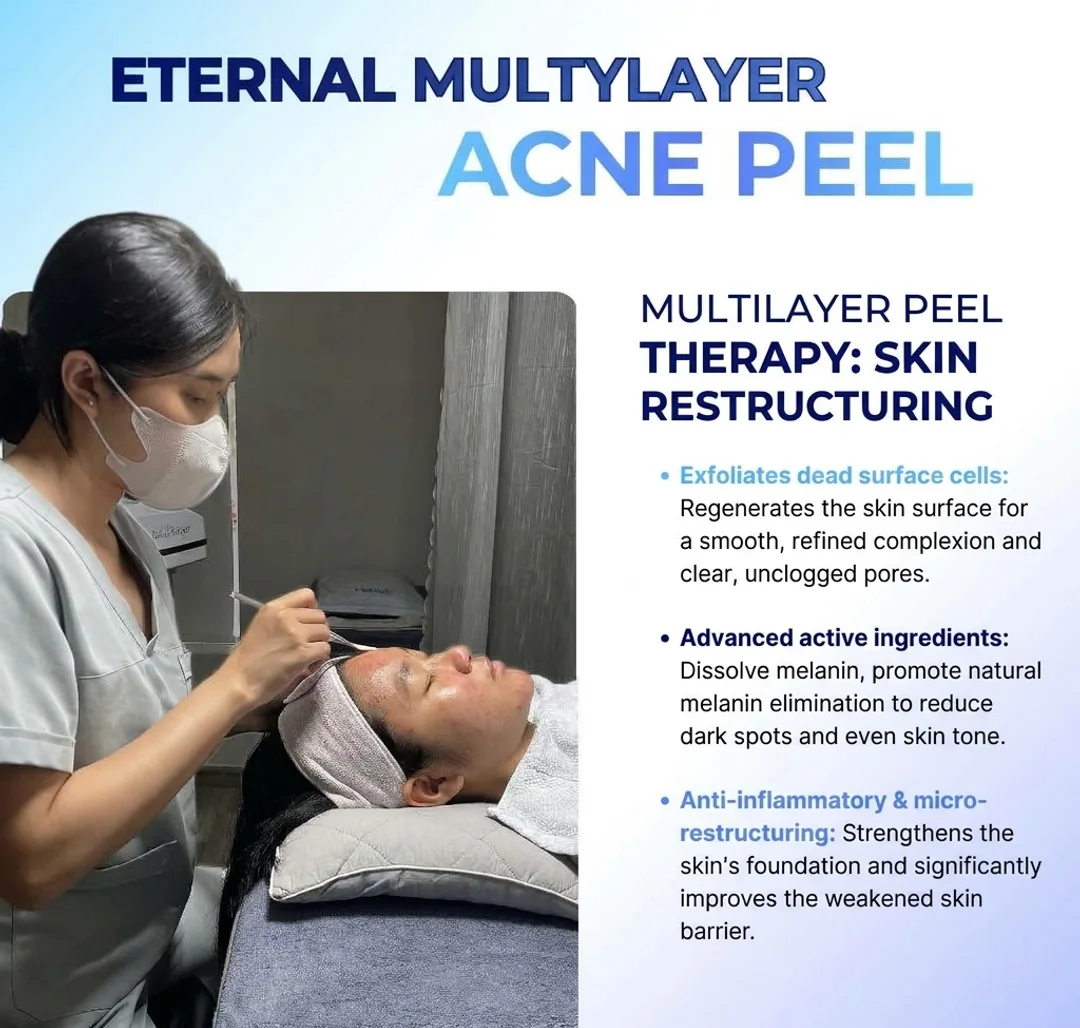
Acne Peel is a chemical peel that combines AHAs, BHA (mainly salicylic acid), PHAs and retinoids. The idea follows the chain described above: in the same session, the formula clears follicles and calms inflammation for the acne, and speeds up surface renewal for the marks and the texture. Concentrations and proportions are adjusted by the doctor for each person, based on the thickness of the outer skin layer, the degree of inflammation, sensitivity and the dominant type of acne, so the treatment has one name but a different formula for each skin.
Session length depends on your skin, from about 30 minutes up to 120 minutes. It is gentle and needs no downtime: the skin may flake slightly for 2 to 4 days, and you can go about your normal day from the next morning. The surface can feel clearer and smoother after the first session, depending on your skin; the acne, marks and texture themselves need several sessions.
Acne Peel suits these best:
Closed comedones, whiteheads and blackheads.
Oily skin with long-standing congestion across the T-zone.
Mild to moderate inflamed acne, without acute cysts.
Dull, rough skin with mild post-acne marks.
People already settled on a topical routine who want faster surface improvement.
The doctor will consider waiting or choosing another approach if your skin is acutely and severely inflamed, has open wounds, or has active eczema or rosacea; if you are taking, or have recently taken, prescription oral acne medication; or if you are pregnant and the formula contains vitamin A derivatives.
How many sessions, and when to judge the result
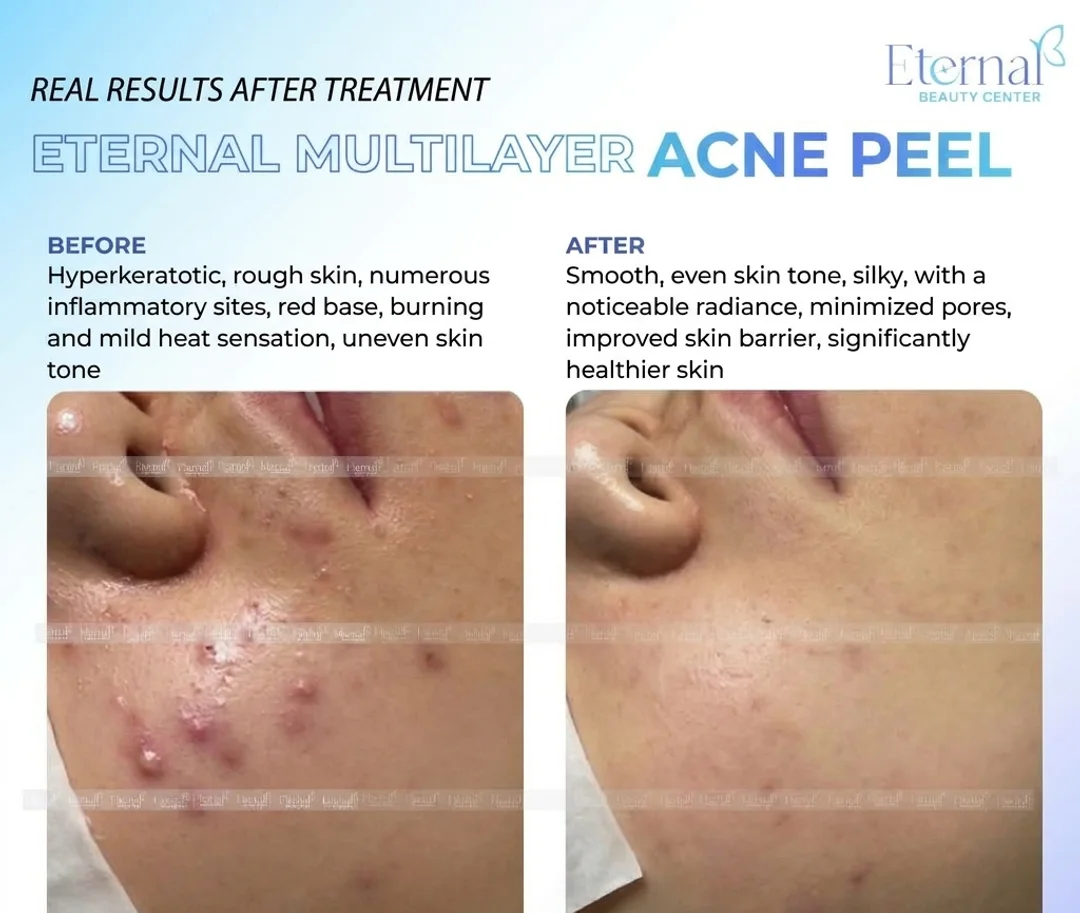
At Eternal, Acne Peel sessions are usually 3 to 4 weeks apart, depending on how severe the acne is and how your skin responds; the schedule is set by the doctor after your first assessment. The gap has a reason: the skin needs to rebuild its barrier before the next session, and back-to-back peels do not clear acne faster, they only raise the risk of marks.
Each problem is best judged on its own timescale. For acne, the AAD says it takes at least 6 to 8 weeks of treatment before you start to see fewer breakouts. For marks, photos taken in the same light and from the same angle after 8 to 12 weeks are more reliable than the mirror each morning (tracking skin changes with photos). For texture, surface changes show early, but if the depressions are unchanged after a few sessions, that is the sign you need a proper scar treatment.
After each session, avoid saunas, hot showers and intense exercise for the first few days, do not squeeze spots, and do not try new products. Sunscreen is essential, because freshly peeled skin darkens easily in the sun (aftercare after peels, microneedling and laser).
When you need more than a peel course
Cysts, nodules, or acne that is leaving new pitted marks: this needs a full acne treatment plan from a doctor, which may include medication; see E-Acne acne treatment.
Deep, long-standing brown marks, or marks on top of melasma: these need a treatment designed for pigment, such as Mela Peel.
Persistent red marks: a blood-vessel problem rather than pigment, so a peel is not the main option.
True atrophic scars: these need the scar type assessed and techniques that work deeper, in the E-Scar programme.