There is no single best treatment for acne marks, because what people call "acne marks" is usually two different problems: red marks, left by small blood vessels that stay dilated after inflammation, and brown marks, left by excess melanin. The right approach depends first on which kind you have and how deep it sits, then on your skin, whether acne is still active, your budget and your time. Peels, pigment-inhibiting actives, vascular lasers and picosecond lasers each aim at a different target, so matching the target matters more than picking the strongest option. At Eternal, post-acne marks are treated with Mela Peel and E-Mela.
Red marks and brown marks: two problems under one name
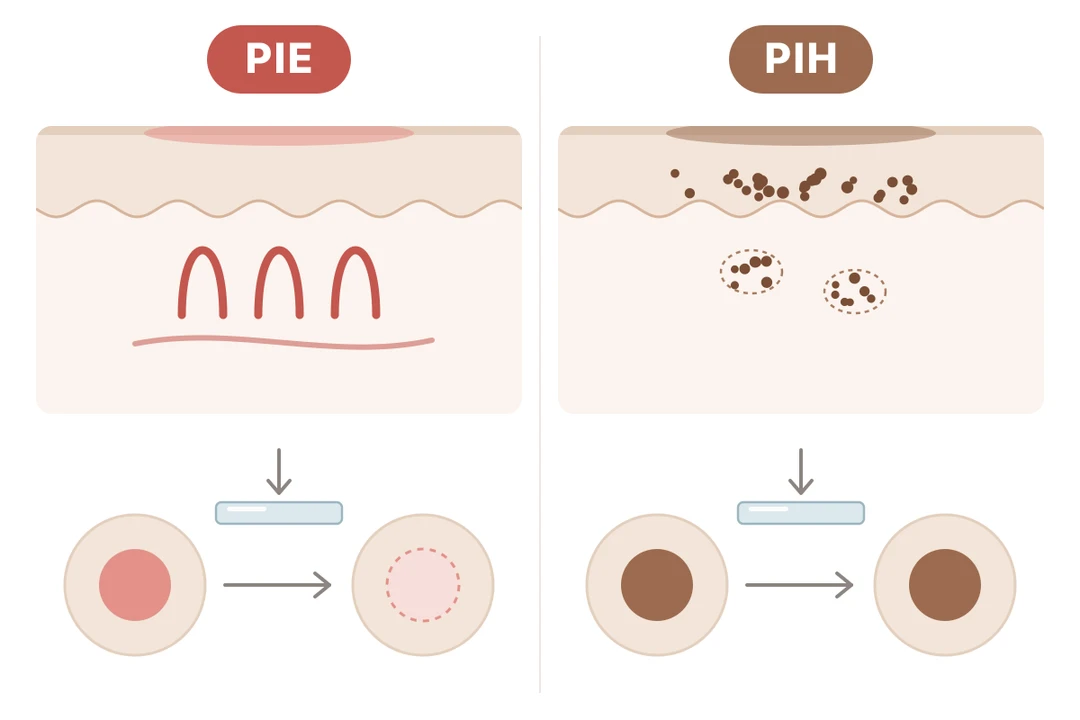
Once an inflamed spot heals, the skin can hold on to two kinds of trace.
Red marks, or post-inflammatory erythema (PIE), are pink, red or purplish. The cause is vascular: inflammation leaves the small capillaries in the upper dermis dilated and damaged, and they take time to recover. A red mark contains no extra pigment, which is why brightening creams and melanin inhibitors have almost nothing to work on.
Brown marks, or post-inflammatory hyperpigmentation (PIH), range from light to dark brown. They form when inflammatory signals push pigment cells to make more melanin than usual. Pigment confined to the epidermis looks clearly brown; once some of it drops into the dermis, the mark turns greyish or blue-grey and fades far more slowly. The mechanism, and why Vietnamese skin is more prone to it, is covered in why acne marks linger after a spot has healed.
Brown marks are particularly common in Asian patients with acne. In a survey of 324 acne patients across 7 Asian countries, 58.2% had post-acne brown marks, and more than half of them said their problem with marks had lasted a year or longer. On darker skin, red and brown marks also tend to appear together, sometimes within the same mark. They blur into each other so easily that when seven experts from the Asian Acne Board rated the same 64 photographs, their calls on brown marks differed by about 24%, and while acne was still inflamed, pigment was easily read as redness.
A rough test you can do at home. Colour is the first clue: pink, red or purple points to a red mark; brown or grey points to pigment. A clearer test is to press something flat and transparent, such as the smooth base of a clear glass or a glass slide, onto the mark for a few seconds. Pressure pushes blood out of the vessels, so the red component fades or disappears under the glass while pigment stays exactly as it was. If the mark fades only partly, what remains is pigment: a mixed mark, which is very common. The test is good enough to point you in a direction, not to make a diagnosis.
Dermatologists use the same principle, called diascopy, as a quick check alongside imaging with polarised light that separates the vascular layer from the pigment layer and estimates how deep the pigment sits, something the naked eye cannot judge. What a skin analysis shows explains what each lighting mode reveals.
One case to rule out first: if what you are calling a mark is actually a dip in the skin that casts a shadow under side lighting, it is an atrophic scar, not a mark. None of the options in this article fills a scar; for that, start with what atrophic acne scars are.
Three things to settle before choosing a treatment
Before comparing treatments, three questions can change the whole plan.
Is acne still active? Every new inflamed spot is a new mark. Treating marks while acne is uncontrolled is like mopping the floor with the tap still running: an old mark fades just as a new one takes its place. If breakouts continue, controlling inflammation comes first; the groundwork is in what acne is and how it is treated.
Is there melasma too, or does your skin darken with heat? Melasma and brown marks are both melanin, but melasma responds badly to heat: treatments that rely on heat or strong light energy can make it darker. When a face has both, the choice leans towards heat-free options. When laser for melasma is and isn't a good idea explains why.
Can you wear sunscreen every day? UV, and on darker skin visible light as well, keeps stimulating pigment cells. Without consistent sun protection, any treatment for brown marks keeps slipping backwards. See how to choose and use sunscreen properly.
Recent expert consensus puts the order fairly consistently: acne control and sun protection first; for brown marks, topical treatment is the first-line option, with peels and lasers as add-ons or for marks that respond slowly; some marks need nothing more than time. All of the treatments below sit in that add-on tier. They help marks fade faster on a foundation that is already right; they do not replace it.
Only after these questions come the practical factors: budget, how many sessions you can fit in, and how long you are willing to wait. They are not minor. A plan you can follow to the end usually achieves more than an aggressive protocol abandoned halfway.
Four groups of treatment, and what each one targets
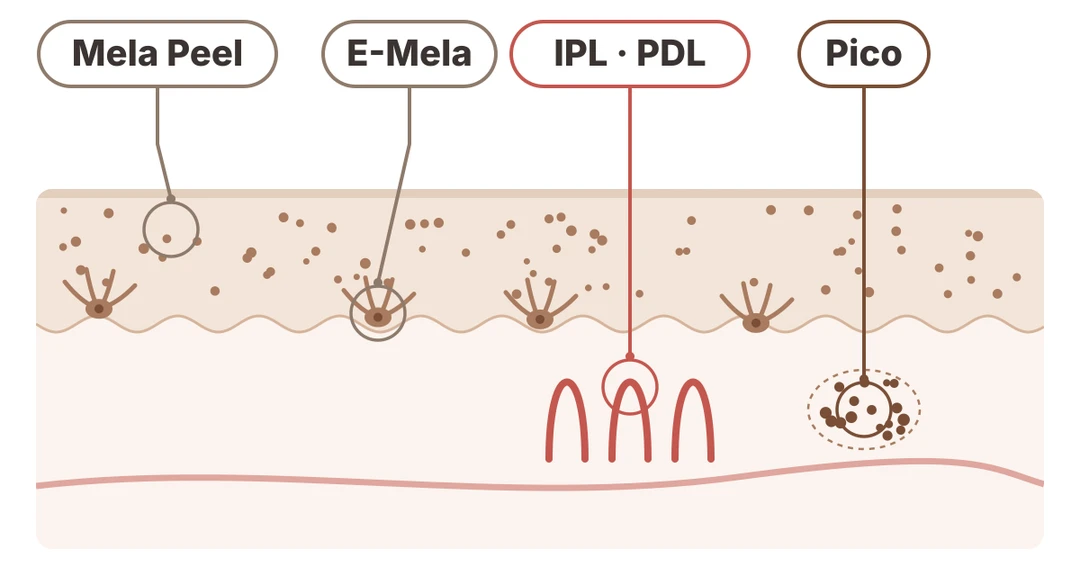
Four groups of treatment come up most often for post-acne marks: chemical peels, actives that inhibit pigment production, light or laser aimed at blood vessels, and picosecond laser. Each acts on a different target in the skin: the surface cell layers, the production of melanin, the blood vessels, or the pigment particles already formed. At Eternal, the first two are delivered as Mela Peel and E-Mela.
Mela Peel: shallow brown marks and newer marks
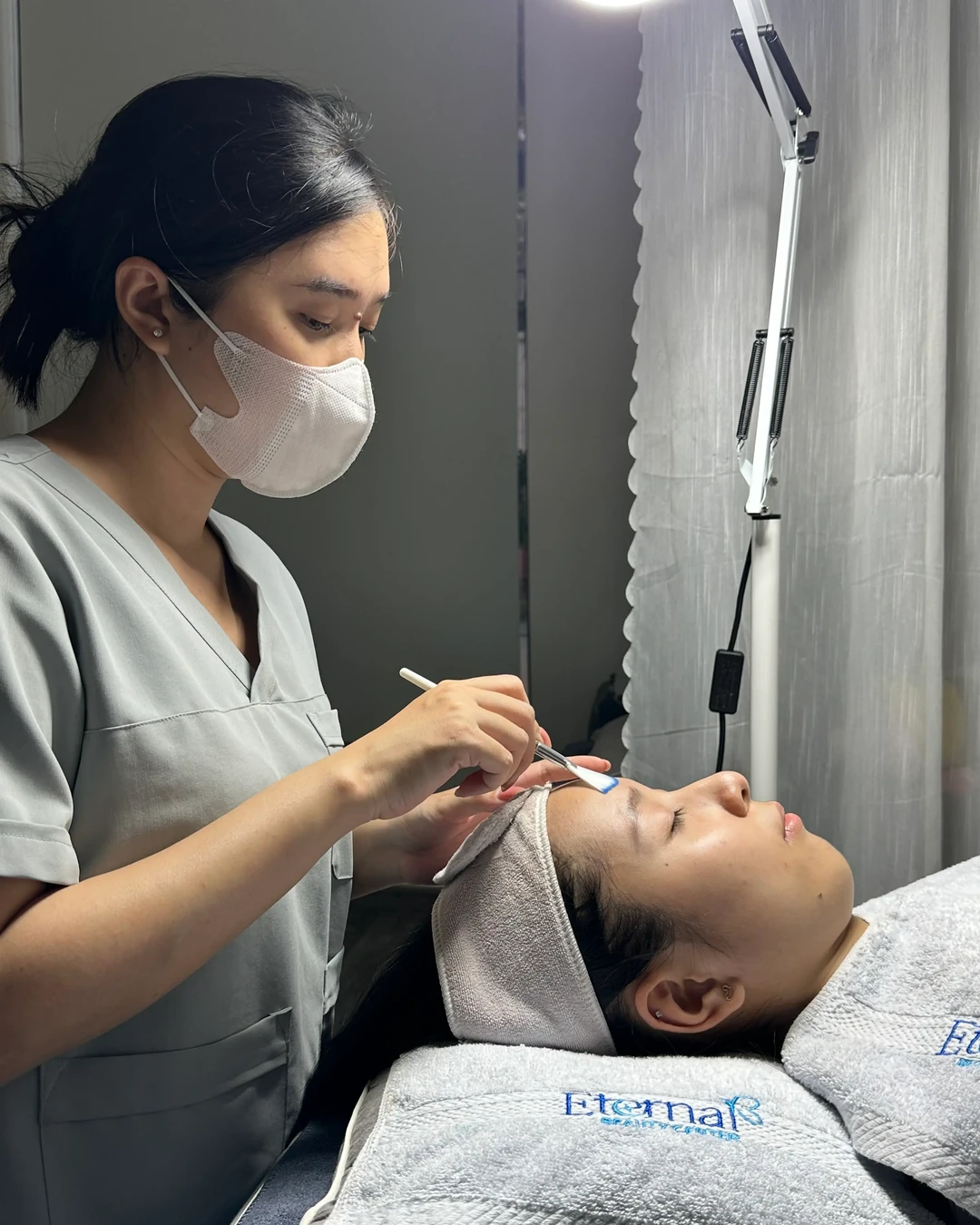
Mela Peel is a chemical peel designed specifically for post-acne marks. Its actives speed up the shedding of pigment-laden surface cells, limit the formation of new melanin, and include anti-inflammatory components that help with any redness alongside. After the peel, soothing serums are delivered by iontophoresis and the skin is calmed under LED light. A session takes around 45 to 60 minutes, with no visible peeling and no downtime.
It suits brown marks still sitting in the epidermis (flat, clearly brown, formed within the last few months) and mixed marks with mild redness, on skin with a stable barrier. For moderate marks and above, a typical course is 4 to 6 sessions spaced 2 to 4 weeks apart, as the doctor advises. Mela Peel is not for skin in an active inflammatory flare, freshly tanned skin, steroid-damaged skin, or other pigment conditions such as melasma, freckles or Hori's naevus.
On the evidence, superficial peels for brown marks in darker skin have only been studied on a small scale, and the results are more modest than advertising tends to suggest. In a randomised trial of 10 people with darker skin, salicylic acid peels were compared with an untreated half of the face: blinded dermatologists found no significant difference, although patients felt their skin had improved. Studies in India and Malaysia (45 and 36 people, peels 2 weeks apart for 3 to 6 sessions) recorded lighter marks compared with baseline, but had no untreated group for comparison. These studies used salicylic, glycolic or Jessner's peels, so they speak to superficial peels as a group.
Peels can also cause marks themselves on darker skin; in the Malaysian study, one person developed a mark from the peel. Professional guidelines advise preparing mark-prone skin for a few weeks before a peel, and strict sun protection throughout the course.
E-Mela: long-standing, dark brown marks, or marks with melasma
E-Mela was originally built for treatment-resistant melasma, and it is used for some post-acne marks because both conditions share the same target: melanin. The protocol has two tiers. A pigment peel thins the surface layer and deals with shallow pigment; the E-Mela step then applies a resorcinol-class active, a group that inhibits tyrosinase, the key enzyme in melanin production, concentrated on the darker areas. No heat is involved and there is no downtime.
That mechanism explains both its strength and its pace. Inhibiting tyrosinase reduces how much new pigment is made, while pigment already deposited clears gradually through the peel step and the skin's own renewal. Some people notice brighter, more even skin straight after the first session, mostly because the surface is cleaner and smoother, while the marks themselves fade over the course.
E-Mela suits brown marks that are long-standing, dark, or slow to respond to creams and standard peels; skin that darkens easily with heat; and especially marks sitting on a background of melasma, where heat-based options carry the most risk. Anyone pregnant, breastfeeding or recently treated with an invasive facial procedure needs a specific assessment first.
The evidence for this group of actives on acne marks is still limited, and most of it is funded by the ingredient's manufacturer. In a study of 77 women with darker skin in Brazil, applying a cream containing a resorcinol derivative twice daily for 12 weeks differed from the base cream only on the users' own ratings. A larger trial in Thailand (200 people, mostly with melasma) showed a clear benefit for melasma, but no difference in its small subgroup with post-inflammatory marks. Both involved daily home use over many weeks, so their results cannot simply be transferred to an in-centre protocol such as E-Mela.
Light and laser aimed at blood vessels: red marks
For red marks, the group with the right target is light or laser aimed at haemoglobin in blood vessels: pulsed dye laser (PDL, 585–595 nm), intense pulsed light (IPL), and narrow-band pulsed light filtered to roughly 500–600 nm, often called DPL. The energy goes mainly into the dilated capillaries that make a mark red, which peels and brightening creams barely touch because the problem is not pigment.
It is worth being clear that the evidence for vessel-targeting light is modest. A 2022 systematic review pooled 18 studies on post-acne red marks: pulsed dye laser (PDL) was the device used most and no serious side effects were reported, but the authors concluded that no method can yet be called the standard. Results are also inconsistent. A randomised trial in 30 Thai patients, treating one half of the face with PDL and leaving the other untreated, found no significant difference at 8 weeks. Data specific to DPL are thinner still: the most substantial controlled trial, in 26 people, compared it split-face with low-energy Q-switched 1064 nm laser and found that both reduced redness, with no difference at week 12. Most of what is known about this group comes from PDL and broadband IPL.
The caution: melanin also absorbs light in this range. On darker or recently tanned skin, or over brown marks, unsuitable settings can cause blistering or darken the mark. In a series of 33 patients with Fitzpatrick type III–IV skin treated with IPL for red marks, 15.2% had temporary darkening and 12.1% temporary lightening, more often over bony areas in type IV skin. An expert consensus on narrow-band pulsed light advises lower starting energies and more rigorous sun protection for darker skin. For purely brown marks, this group is not the first choice, and tanning should be avoided before each session.
Red marks also have options that need no device. A placebo-controlled split-face trial in 30 Thai patients found a 40% response to the vessel-narrowing topical oxymetazoline 0.05% after 8 weeks, against 6.67% on the placebo side; it is a prescription medicine and needs a doctor's advice. For many people, acne control and time are enough, because most red marks fade on their own once new inflammation stops piling on.
Picosecond laser: selected stubborn brown marks
A picosecond laser fires extremely short pulses, measured in trillionths of a second. At that duration the energy shatters pigment particles into tiny fragments for the body to clear, with less heat spreading into the surrounding tissue than older nanosecond lasers. Its target is melanin, including pigment that sits deeper than a peel can reach.
It is considered for a selected group: brown marks that persist despite sun protection, topicals and peels used for long enough, on stable skin with no tan and no active melasma. For red marks, it is simply aimed at the wrong target.
The evidence for lasers on brown marks is weaker than many people assume. A 2017 systematic review in JAMA Dermatology pooled 20 studies with 224 patients in total, only one of them randomised (6 people); most were not methodologically rigorous, and some recorded no improvement or even worsening. The Q-switched Nd:YAG laser was the most studied and looked promising; for picosecond lasers specifically, there is as yet no controlled trial on post-acne brown marks in Asian skin. This is why reviews place lasers second, after topical treatment and sun protection.
A retrospective study of 34 Chinese patients with post-acne marks illustrates the point: topical treatment plus laser gave moderate-to-marked improvement in 70.6% of patients, laser alone in 55.6%, and topicals alone in 50%. The differences were not statistically significant, and one patient developed marks caused by the laser itself.
The main risk sits in exactly the skin most prone to marks: heat and post-laser inflammation can trigger a new round of pigmentation. With low-energy laser repeated over many sessions (laser toning), case series have also documented mottled pale spots, sometimes after only a few sessions and not always reversible. The safe approach is conservative settings, well-spaced sessions, and strict sun protection both before and after.
A quick comparison of the four groups
Option | Targets | Best suited to | Heat or light energy | Main caution |
|---|---|---|---|---|
Mark-fading peel (Mela Peel) | Pigment-laden surface cells, plus anti-inflammatory support | Shallow brown marks, newer marks, mildly mixed marks | No | Needs a stable skin barrier; not during an inflammatory flare |
Pigment inhibition (E-Mela) | Melanin production and accumulated pigment | Long-standing, dark brown marks; skin that darkens with heat; marks on melasma | No | Results build over several sessions |
Vascular laser or light (PDL, IPL) | Dilated blood vessels | Red marks | Yes | Caution on darker or tanned skin and over brown marks |
Picosecond laser | Pigment particles, including deeper pigment | Stubborn brown marks that respond poorly to other approaches | Yes | Can cause new marks if settings or session spacing are wrong |
The table is a summary. The real choice also depends on whether acne has settled, whether melasma is present, and how many sessions you can manage.
How a doctor chooses: five common scenarios

At a consultation, the doctor assesses the type of mark (red, brown or mixed), how deep the pigment sits, acne activity and the skin barrier before discussing any treatment. The five scenarios below show how those factors lead to different choices. They are a guide, not a substitute for an assessment.
1. New marks a few weeks old, still pink-red, with the occasional breakout. Acne control comes first. Many new red marks fade on their own once fresh inflammation stops piling on; if redness lingers or spreads enough to bother you, the options on target are a vessel-narrowing topical or laser and light aimed at the vessels.
2. Flat brown marks a few months old that do not fade under the glass. The foundation is sunscreen and topical actives at home. Mela Peel is added when you want the marks to fade faster, or when they respond slowly to topicals.
3. Long-standing, dark brown marks that peels and creams have barely shifted, or skin that darkens whenever it gets hot, or melasma alongside. E-Mela is considered because it uses no heat, lowering the risk of stirring up more pigment.
4. Stubborn brown marks with suspected deeper pigment, on stable skin with no melasma and no tan. Picosecond laser at conservative settings may be considered, usually with maintenance from topical actives or peels.
5. Red and brown on the same patch of skin. This is very common. Each component needs its own approach (the red part calls for inflammation control, time or a vessel-targeted treatment, the brown part for a peel or E-Mela), and the doctor decides the order and spacing so that irritation does not stack up.
There is one more scenario few people consider: doing nothing yet. New marks in their first few weeks, with acne settled and daily sunscreen, often deserve more time before any procedure.
How fast is "fast" when clearing acne marks?
"Fast" should mean faster than letting marks fade on their own, not gone after one session.
Sessions are usually 2 to 4 weeks apart. The epidermis needs roughly one renewal cycle to push pigment-laden cells up and shed them, and the barrier needs to recover before the next session; how often you can have a chemical peel explains the principle. The most visible change after a first session tends to be on the surface: brighter, smoother skin. Change in the marks themselves is measured in weeks and months, and the deeper the pigment, the slower it goes.
The eye is poor at noticing gradual change on your own face in the mirror every morning. Photos taken under the same light, at the same angle and distance, and compared after 8 to 12 weeks are far more reliable; how to track skin changes with photos shows how.
With deeper brown marks, partial improvement is sometimes the realistic outcome. A 2024 systematic review of treatments for brown marks found that with lasers and energy devices, 18.1% of patients had a complete response, 61.2% a partial response, and 2.6% got worse. Knowing that in advance lets you judge a course by the right yardstick, rather than giving up early or pushing the intensity too hard.
When a stronger treatment is the wrong choice
For skin that marks easily, any procedure that causes inflammation can create the very thing you are trying to remove. That is why the most expensive or most powerful option is not automatically the right one. Marks tend to get worse in these situations:
Heat or light energy applied over melasma that has not been assessed.
Several treatments stacked close together, on top of exfoliants or strong actives at home. The barrier weakens, irritation lingers, and irritation is inflammation too. The skin barrier guide describes the warning signs.
Low-energy laser repeated too often, over too many sessions.
Unprotected sun exposure just before or after a session.
Picking at new spots while old marks are being treated.
Separately, a pigmented spot that grows, changes colour or shape, itches or bleeds is not an acne mark and needs a doctor's check before any cosmetic treatment.
Skin analysis and choosing a treatment at Eternal

A first visit at Eternal starts with skin analysis and a direct consultation with Dr Lê Hiền to establish whether you have red marks, brown marks or both, whether the pigment is shallow or deep, whether acne has settled, and whether melasma is present. Only then are the approach, number of sessions and cost chosen to fit your budget and time.
Mela Peel: shallow brown marks, newer marks and mildly mixed marks.
E-Mela: long-standing or dark brown marks, or marks on a background of melasma.
If acne is still active, the first step is E-Acne; if the main problem is indented scarring, the right route is E-Scar.
Eternal Beauty Center — 204 Đường Số 1, An Hội Đông Ward (formerly Go Vap District), Ho Chi Minh City. Hotline / Zalo: 0334 713 610. View map.