Acne on the back usually takes around 3 to 4 months to clear, longer if you count the marks it leaves, and the first change is rarely visible before 6 to 8 weeks. Many people who feel their back acne "never clears" have not been careless; they have done everything at once and switched approach before the skin had time to respond. A sensible plan moves through four overlapping stages: unclogging the follicles, calming inflammation, fading marks while watching for scars, then maintenance.
Before stage 1: make sure it is acne

Everything in this article applies to acne vulgaris on the trunk: the kind with comedones (blackheads and whiteheads) mixed with inflamed spots of different sizes. If your back has small red bumps that are all the same size and itchy, it is more likely yeast folliculitis, which is treated with antifungals rather than the steps below; how to tell the difference is covered in back acne or fungal folliculitis. If your back feels rough with tiny goosebump-like bumps that are neither inflamed nor painful, that is keratosis pilaris, which needs the surface layer softened rather than inflammation treated.
In practice, two or three of these can sit on the same back. Treating one correctly while missing the other is a very common reason a back "gets half better and then stalls".
Four stages that overlap rather than follow each other
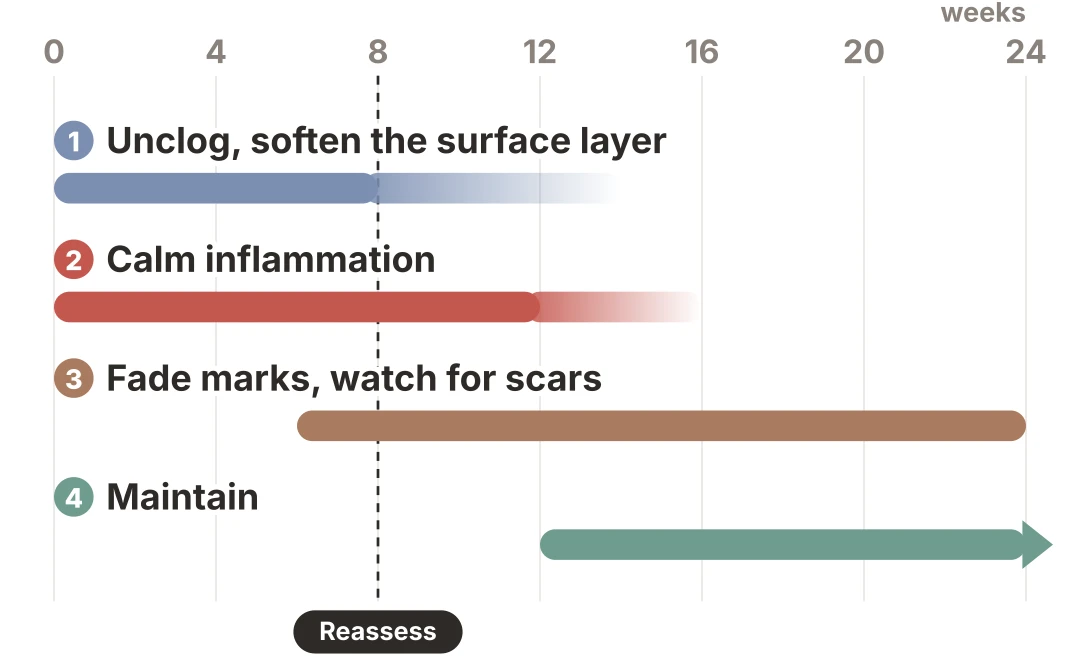
They are called stages, but they do not happen one after another. Unclogging and calming inflammation start together in the first week; marks are tackled more actively once inflammation has settled; maintenance begins when the back is clear and carries on after that. What differs is the focus: each stage has its own goal, its own tools, and its own way of telling whether you are on track.
On pace, the American Academy of Dermatology (AAD) tells people with back acne to expect improvement in about 6 to 8 weeks and clearing in typically 3 to 4 months; if nothing has changed after 6 to 8 weeks, that is the time to see a doctor. Expert groups on truncal acne also note that acne on the body tends to respond more slowly than on the face, although direct comparisons are limited.
Stage 1 — Unclogging follicles and softening the surface layer
Every acne spot starts as a blocked follicle too small to see. That is why the foundation of this stage is a topical retinoid, the group of actives that normalises how skin cells shed inside the follicle: they do less to clear the spots you already have than to stop new ones forming. How follicles become blocked is explained in full in what acne is and how it is treated.
This is also the group with the best trunk-specific data so far, and the AAD gives topical retinoids a strong recommendation. In two 12-week randomised trials with 2,420 participants in total, trifarotene, a newer topical retinoid, brought the trunk to clear or almost clear in 35.7% and 42.6% of users, against 25.0% and 29.9% on the base cream. In an open-label study that followed to 52 weeks (with no control group), the figure rose from 38.6% at week 12 to 66.9% at week 52, so a good deal of improvement came after the three-month mark. Two caveats apply: most participants had fair skin, and irritation on the trunk peaked in weeks 2 to 4.
On the back, the formulation largely decides whether you can keep going. Lotions, foams and sprays cover a large area faster and more evenly than thick creams, and they need to go over the whole breakout-prone area rather than on individual spots. The first two to four weeks often bring dryness and stinging; starting every other night and building up is how to get through that phase.
In a treatment room, softening the surface layer and extracting comedones that are ready leaves the back's surface clearer straight after the session. It is also worth being plain about the evidence: the AAD's 2024 acne guideline found the evidence for comedone extraction and chemical peels insufficient to make a recommendation, and no peel trial has been done specifically on the trunk. Extraction is an adjunct for non-inflamed comedones, carried out by trained staff. What keeps the result is still the steady application at home between sessions.
Stage 2 — Calming inflammation
This stage has the biggest influence on whether the back is left with marks and scars, because the deeper and longer the inflammation, the heavier the trace it leaves.
The main tool of this stage is benzoyl peroxide (BPO), which the AAD recommends strongly. On the back it is usually used as a wash, and the detail that decides whether it works is contact time. In small studies measuring bacteria on the back, an 8% BPO wash rinsed off after about 20 seconds did not reduce bacteria, while a foam left on for about 2 minutes before rinsing worked as well as a leave-on product. The AAD advises leaving BPO on the back for 2 to 5 minutes before rinsing. These studies measured bacteria rather than spot counts, but the mechanism is consistent. Two practical points: concentrations around 5% irritate less than stronger ones, and BPO bleaches towels, clothes and bedding.
Topical antibiotics, if used, should be paired with benzoyl peroxide rather than used alone, to limit antibiotic-resistant bacteria. When inflammatory acne is widespread or moderate to severe, oral treatment is considered; in a consensus of 36 Korean dermatologists on truncal acne, 94.4% favoured oral treatment for this group. Oral antibiotics such as doxycycline are used for a limited time and always alongside topicals. Isotretinoin is for severe acne, acne that has not responded to standard treatment and, according to the AAD, acne that is scarring or causing psychological burden, since that group should be managed as severe. For women with a hormonal pattern, spironolactone is an option: a retrospective study of 403 women recorded reduction or clearance in 84.0% of chest and 80.2% of back acne at the first follow-up, although no randomised trial has looked at the trunk specifically; when to think about hormones is covered in hormonal acne and when to get tested. All of these are prescription medicines that need a doctor's prescription and monitoring.
In the treatment room, the anti-inflammatory step after clearing the follicles is chosen to match the type of lesion. Deep, hard, inflamed nodules should not be squeezed or worked on mechanically; they need time and medication, not pressure.
Stage 3 — Fading marks and watching for scars
Once inflammation settles, what remains on the back is usually marks: red marks from vessels that are still dilated, brown marks from pigment, or both. How to tell them apart, and why they need different approaches, is covered in which treatment for acne marks. Post-inflammatory marks can take months, sometimes years, to fade completely, and on the back two things are worth knowing.
First, the topical retinoid from stage 1 keeps helping: it prevents new spots and helps surface pigment shed more evenly. Second, the back is not exposed to the sun every day the way the face is, but it is exposed in strappy tops, at the beach or in the pool; at those times, a back that still has marks needs sunscreen just like the face, because sun makes brown marks darker and slower to fade.
More important than marks are scars. In a group of 973 acne patients referred to specialists, scars were found on the back in 51% and on the chest in 38%. Unlike the face, the chest, shoulders and upper back are where hypertrophic and keloid scars are more common. The sign to watch for is a spot that has healed but stays firm, raised or itchy, or grows beyond the edge of the original spot. A study of 220 acne keloids on the chest found they stay round up to about 4 to 5 mm and then lengthen quickly, so the authors advise treating them at that size.
Silicone gel or sheets and corticosteroid injections are the two best-supported options for raised scars. A study in Cần Thơ of 129 hypertrophic and keloid scars, 53.5% of them on the trunk and 23% caused by acne, recorded an improvement in the Vancouver Scar Scale from 6.55 to 2.55 after 24 weeks of triamcinolone injections, although it had no control group. Injections are a doctor's procedure, never a home one.
Stage 4 — Maintenance: keeping the back from returning to square one
Acne is a chronic condition, so a clear back does not mean the disease is gone. Stopping everything the moment the back clears raises the risk of relapse, as the maintenance study below shows.
Maintenance data specific to the trunk are still lacking; the evidence comes from facial acne. In a 24-week trial of 243 people who had improved, continuing a retinoid combined with BPO kept the result in 78.9%, compared with 45.8% of those switched to a base cream. Applied to the back, the sensible approach is to keep the topical retinoid at a lower frequency and use a BPO wash a few times a week.
Daily habits play a real part: showering soon after heavy sweating, changing out of gym clothes straight away rather than wearing them for hours, and noticing repeated pressure from backpack and bra straps. Which habits have a basis and which are just folklore is analysed in back acne or fungal folliculitis.
Four common self-treatments, and why they derail the plan
Most people who have had back acne for years have tried at least some of the following. The problem is not that they have not been thorough enough; each of these breaks a specific stage.
Applying products at home the wrong way. Home treatment is the core of the plan; what derails it is how it is done. A retinoid, benzoyl peroxide, AHAs, BHAs and an exfoliating body wash used together over a large area almost guarantees irritation. Irritation forces you to stop even the things that were helping, and on mark-prone skin, irritation is also a form of inflammation that leaves marks. The second mistake is switching products after two or three weeks because "nothing is happening": back skin needs around 6 to 8 weeks to show whether a regimen works, and 3 to 4 months to clear, so each switch restarts the clock and you never learn what actually helped. Each stage needs only a few actives doing the right job, used for long enough.
Scrubbing hard. A stiff loofah, a natural sponge or a grainy scrub cannot reach comedones inside the follicle, but it creates micro-injury on the surface and makes inflamed spots worse. The AAD notes that scrubbing actually makes acne worse; this rests on expert experience rather than controlled trials.
Herbal leaf baths. There are no trials of leaf baths for acne, and a Cochrane review of herbal treatments for acne (35 trials, 3,227 people) concluded that evidence is lacking. The risks are documented, though: many plants cause contact dermatitis, and there are cases of blistering burns after sun exposure following a soak in fig-leaf decoction. A leaf bath does no harm as a bath, but using it in place of treatment costs you several months of stages 1 and 2.
Squeezing spots one by one. Squeezing an inflamed spot that has not come to a head pushes inflammatory material into the healthy tissue around it; on skin as prone to scarring as the back, that is the shortest route to raised scars.
When you need a doctor's prescription, not just skincare
See a dermatologist rather than continuing on your own when:
There are deep, painful nodules or cysts; these need prescription treatment and should not be squeezed.
The acne has started to scar, or firm, raised bumps remain after spots heal.
Nothing has changed after about 6 to 8 weeks of proper use, which is the point the AAD gives for back acne.
There are hormonal signs alongside: irregular periods, excess hair growth, hair thinning.
The acne spreads quickly over a few days, with fever or severe pain.
There is one more reason not to wait: in a survey of 1,972 patients, the time from onset to the first effective treatment was one of the factors linked with scarring, and it is the one a patient can actually change.
Back acne treatment at Eternal
At Eternal, Back Peel is a treatment designed specifically for the back, with sessions of 60 to 90 minutes. The first session always starts with a skin analysis to classify the lesions (acne, folliculitis or keratosis pilaris) before any treatment is chosen. A session covers cleansing and softening the surface layer, extracting comedones with a medical-grade technique, applying anti-inflammatory actives suited to the lesion type, recovery care, and guidance for home care between sessions, which shapes the result as much as the in-centre work.
There is no fixed number of sessions. For severe, long-standing cases, real cases at Eternal have needed around 8 to 10 sessions over roughly four months; recent flare-ups usually need fewer. If you are taking isotretinoin or a prescription acne medicine, mention it beforehand so the timing can be adjusted. When the condition calls for prescription treatment, that has to be prescribed and monitored by a dermatologist.
Acne on the face and on the body often go together: about half of people with acne have lesions on the back, chest or shoulders, and many do not mention it until they are examined. The two areas can be treated in parallel, with sessions scheduled so the skin is not worked on too intensively at the same time. The treatment for facial acne is E-Acne.
Eternal Beauty Center — 204 Đường Số 1, An Hội Đông Ward (formerly Go Vap District), Ho Chi Minh City. Hotline / Zalo: 0334 713 610. View map.