Darkening in the underarms, groin or neck is not a single condition. At least four different things present as "dark skin" here: post-inflammatory pigmentation from shaving and friction, a velvety thickening tied to metabolic health, a superficial bacterial infection that responds to antibiotics, and staining from years of vigorous rubbing. They call for different responses — and what separates them is usually not the colour but how the skin feels under your fingers.
Skin folds darken by a different mechanism than the face
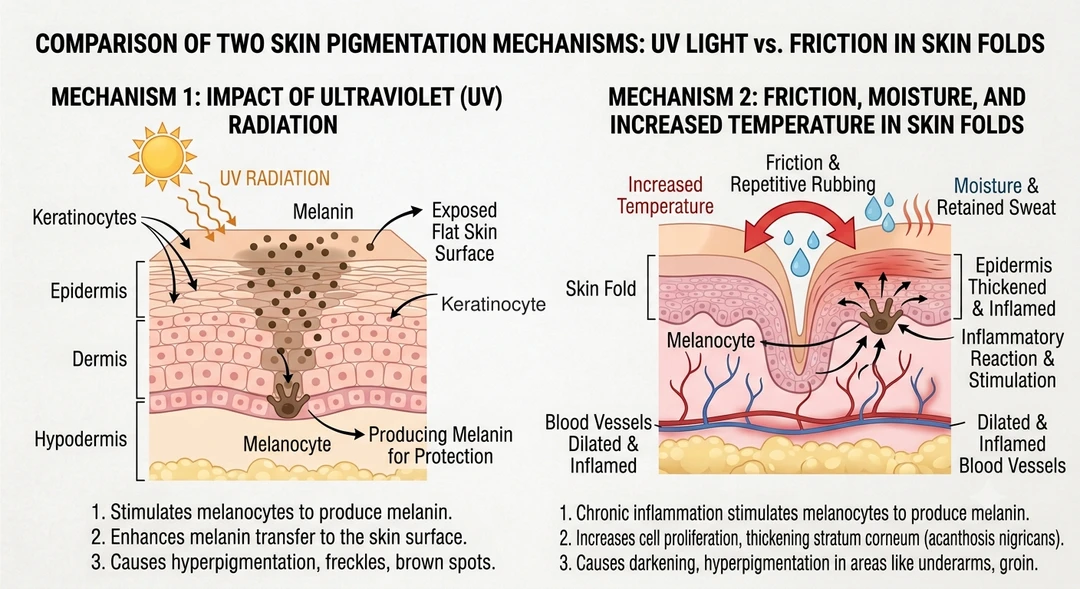
Almost everything written about pigmentation is written about the face, where UV drives the process. In the underarms and groin, UV barely matters — these areas are covered nearly all the time. What drives pigment here is a different trio: friction, occlusion and moisture.
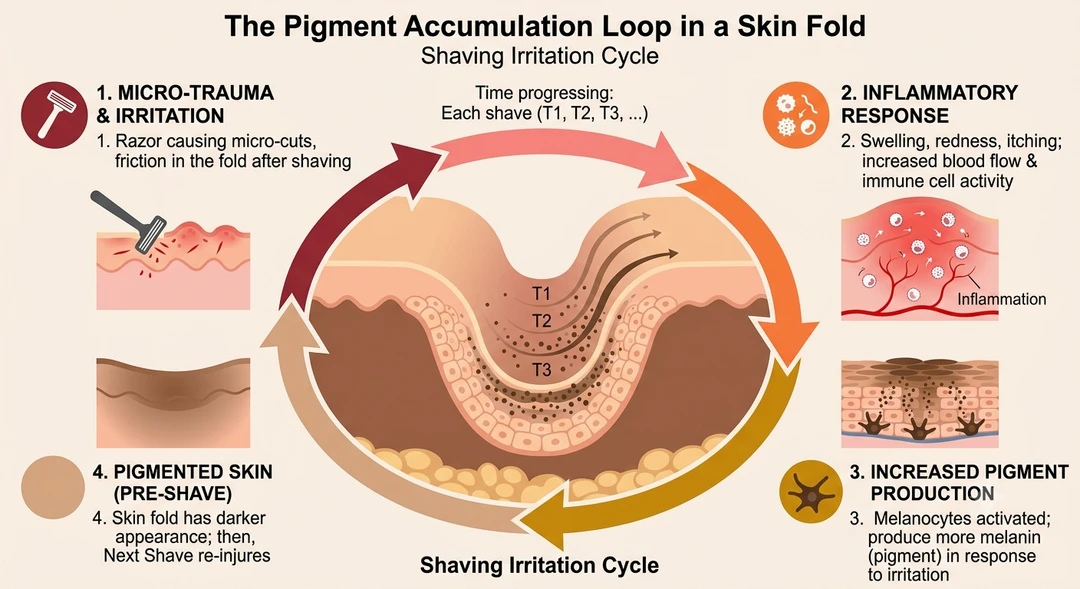
The two sides of a fold press together, rub with every movement, trap sweat and heat, and take the brunt of razors, wax and deodorant. Each time the outer layer is mildly injured, inflammation starts and melanocytes are told to make more pigment. This is the mechanism behind post-inflammatory hyperpigmentation (PIH) — the same process that leaves dark marks after acne, except that in a fold the trigger repeats daily instead of ending when a spot heals.
Two practical consequences follow. First, sunscreen — the backbone of every melasma protocol — is not the decisive intervention here, though it still matters whenever the area is uncovered. Second, as long as the friction continues, any brightening product is racing against pigment production that is still running.
Folds are not the only area with their own rules. Lips behave differently too, but from an entirely separate set of causes — dark lips and what actually lightens them covers causes specific to the lip, which do not transfer to skin folds.
Four look-alikes, and how to tell them apart yourself
The most useful first step is not picking a product but working out what you are dealing with. Most of the sorting can be done by looking and touching.
| What you see and feel | Likely condition | Main direction |
|---|---|---|
| Flat, smooth, grey-brown, matching the shaved or rubbed area | Post-inflammatory pigmentation | Remove the trigger, then brighten |
| Thickened, velvety to the touch, symmetrical, often on the neck too | Acanthosis nigricans | Assess metabolic health before cosmetic work |
| Red-brown, fairly well defined, fine scale, sometimes an odour | Superficial fold infection | Needs assessment and medication |
| Rippled or mottled, often over bony areas, years of scrubbing | Chronic friction staining | Stopping the friction comes first |
Post-inflammatory pigmentation — the most common group
In otherwise healthy adults this is the usual answer. The giveaway is that the skin surface is normal: flat, not thickened, not rough. The colour sits in the skin without changing its texture. The dark zone also maps onto the area under stress — where the razor passes, where clothing grips, where the fold rubs hardest.
Acanthosis nigricans — when skin colour is a medical sign
Acanthosis nigricans presents as symmetrical dark patches that are thickened and velvety to the touch, most often on the back of the neck and in the armpits. The route to it runs through metabolism rather than inflammation: excess insulin stimulates insulin-like growth factor receptors on keratinocytes, and the outer layer proliferates and thickens. It commonly accompanies excess weight, metabolic syndrome, type 2 diabetes and polycystic ovary syndrome.
This is the most important point in this article: with acanthosis nigricans, the dark skin is a symptom rather than the problem. Lightening the surface without addressing the metabolic picture works poorly and does not hold.
On how common it is, reported figures vary widely with the population studied — roughly 7% in unselected groups, rising to around 74% in people with obesity, with substantial variation between ethnic groups. One survey of affected sites found the neck most often involved, then the axilla, then elbows and knees. These numbers should be read for what they are: strong enough to justify screening, not to self-diagnose. A studied grading scale for acanthosis nigricans predicted insulin resistance with sensitivity around 57% and specificity around 84% — which still misses a meaningful proportion of cases.
If you have thickened dark patches on the neck and underarms alongside persistent jawline acne, irregular periods or rapid central weight gain, when hormonal acne needs testing describes the cluster of signs worth taking to a doctor together.
The superficial infection that is most often treated wrongly
One fold condition is caused by the bacterium Corynebacterium minutissimum, appearing as red-brown patches with reasonably defined borders and a fine scale, typically in the groin and armpits. It is frequently mistaken for a fungal infection and treated with antifungals for months without improvement, when the underlying problem is bacterial and responds to antibiotics.
Under a Wood's lamp the patches fluoresce coral red, because the bacteria produce coproporphyrin III — a quick way to separate it from ringworm and tinea versicolor. One technical detail worth knowing before an examination: those porphyrins are water-soluble, so washing within roughly a day beforehand can rinse them away and produce a false negative. What a skin analysis actually shows goes further into what a Wood's lamp can and cannot read.
Chronic friction staining
The last group appears in people who have scrubbed hard for years — nylon towels, stiff bath sponges, back scrubbers. The pattern is typically rippled and mottled, and it favours bony prominences. The literature links this group to macular amyloidosis, in which keratin-derived amyloid is deposited in the papillary dermis, and some authors argue friction staining may be an early stage of that same process. It explains why the group is so stubborn against brightening products: the pigment and the deposits sit deeper than topical products reach.
The mistake people repeat most: scrubbing it "clean"
The instinctive response to a dark patch is to scrub harder — salt, lemon, baking soda, a coarse sponge. The mechanism behind all four groups above says this is the wrong direction, and for friction staining it is the actual cause.
In a fold, every episode of irritation restarts the inflammation-to-pigment cycle. The "brighter right after scrubbing" effect comes from stripping the outer layer, not from pigment decreasing; it fades within days while the inflammatory load accumulates. Underarm skin is thin and often damp — keeping the skin barrier intact here is worth more than any exfoliating routine.
Remove the cause before thinking about brightening
How you remove hair
Shaving creates repeated micro-trauma around the follicle openings; waxing pulls the hair shaft out and usually provokes a stronger inflammatory response, along with a higher risk of ingrown hairs. For skin that pigments easily, frequency is the deciding factor: shaving three times a week for years adds up to hundreds of small inflammatory episodes on the same patch of skin.
This is why laser hair removal often improves underarm colour — but the mechanism needs stating correctly. Laser hair removal does not bleach skin. It removes the repeating source of irritation, and once the trigger stops, existing post-inflammatory pigment finally has a chance to fade. If you are weighing it up, is laser hair removal permanent explains the hair cycle and realistic expectations, while before and after care covers folliculitis and ingrown hairs — the two things that generate dark marks directly.
Deodorant and antiperspirant
Deodorants are routinely blamed as the main culprit. The evidence calls for more care than that. Aluminium was named Allergen of the Year 2022 by the American Contact Dermatitis Society, but largely because of growing recognition in children: the accompanying prevalence data put aluminium contact allergy at about 5.6% in children and 0.4% in adults.
In other words, aluminium allergy is real but uncommon in adults. The more frequent problem in this group is irritation — alcohol, fragrance, and applying product to skin that has just been shaved. The sensible experiment is switching to a fragrance-free, alcohol-free product and not applying it straight after shaving. If the skin still itches, stings or breaks out, that is the point to have contact dermatitis assessed properly rather than guessed at.
Clothing and moisture
Tight sleeves, gripping waistbands and fabrics that trap humidity all sustain the friction. This is the least discussed item on the list and also the cheapest and most durable.
What the evidence actually shows for brightening the underarms
This is where honesty matters. A systematic review published in 2025 on treating axillary hyperpigmentation pooled 10 studies, and what the authors stressed most was the quality of the evidence: small samples, short follow-up, and enough variation between protocols that a meta-analysis was not possible.
Within those limits, some results were reported:
Topicals: one study reported good-to-excellent response in roughly 30% with desonide, 24% with 4% niacinamide and 6% with placebo. Another, on sweet orange extract, recorded a melanin index falling from 349.04 to 253.06 units.
Pigment lasers: the Q-switched 1064nm Nd:YAG was the device used most often across the studies, with improvement graded as good and no serious adverse events reported.
Two caveats belong with those figures. First, they come from small studies in different populations on different protocols — "niacinamide works 24% of the time" is not a conclusion anyone can draw from this. Second, Eternal does not offer pigment lasers, IPL or cryotherapy; if your case is better suited to that group of interventions, the right outcome of a consultation is a referral toward appropriate expertise, not a different treatment chosen because it happens to be available.
Realistic expectations
Pigmentation in folds fades more slowly than on the face, for three compounding reasons: the trigger is hard to remove completely, part of the pigment sits deep, and the area keeps experiencing friction throughout treatment.
A sensible timeframe is measured in months, not weeks. The first sign that you are on the right track usually arrives as sensation before it arrives as colour: less stinging after shaving, fewer bumps around the follicles, and the dark area no longer spreading. If around three months of removing triggers and consistent care produces nothing in that direction, you are probably treating the wrong group — most often a case of acanthosis nigricans or an infection being managed as ordinary pigmentation.
When to see a doctor instead of buying another cream

The area is thickened and velvety to the touch, symmetrical, and especially if the back of the neck is involved too.
It appeared suddenly and spread quickly, particularly in someone who is not overweight or is middle-aged — the literature treats this as a situation where rarer systemic causes must be excluded.
There is scale, odour or significant itch.
There are painful lumps, recurring abscesses or tunnels in the armpit or groin — that is an inflammatory disease needing medical treatment, not a pigment problem.
Irritation persists after you have changed deodorant and stopped shaving.
The general rule matches the approach in facial conditions mistaken for acne: when the surface of the skin has changed and not just its colour, it is probably not a purely cosmetic problem.
Assessment and brightening at Eternal Beauty Center
A consultation at Eternal starts by establishing which group you fall into, because the four above lead to four different plans. For post-inflammatory pigmentation and friction staining, Body Rose is a non-invasive course for the underarms, groin, elbows and knees: pigmentation assessment, gentle exfoliation, brightening actives applied in layers, a light therapy step and a soothing finish. A typical plan runs 5–8 sessions spaced about two weeks apart, depending on the area and the depth of pigmentation.
What makes the result hold sits outside the treatment room: reducing friction and dealing with the source of irritation. For anyone shaving or waxing regularly, full hair removal is often the step with the longer-lasting effect, because it cuts off what produces the pigment in the first place.
If the consultation suggests acanthosis nigricans or an infection is more likely, you will be told plainly that a medical assessment or medication comes first — brightening the surface in those cases puts the steps in the wrong order.
Eternal Beauty Center — 204 Đường Số 1, An Hội Đông Ward (formerly Go Vap District), Ho Chi Minh City. Hotline / Zalo: 0334 713 610.