“Permanent hair removal in just one course”, “one treatment and it never grows back” – these are among the most common claims in the beauty industry. But from a scientific standpoint, “100% permanent” is almost never real. This article explains how the hair growth cycle works, why laser needs multiple sessions, and the realistic plan for each area of the body.
Permanent Removal vs Long-Term Reduction – the Difference You Should Know
In medical literature and international standards, there is an important distinction that many ads skip over: permanent hair reduction differs from permanent hair removal.
The US FDA – the American agency that regulates drugs and medical devices – clears laser hair removal devices under the term “permanent hair reduction”. The definition: a long-term, stable reduction in the number of hairs that regrow after a complete course, measured as the hairs that regrow at least 2 complete cycles after the final session.
What this means in practice:
Hair does not “disappear 100% and never grow back” after one or a few sessions
After a complete course, 70–90% of hair is reduced long-term in most clients
Hair that does regrow is usually finer, sparser and lighter, far less visible
Some follicles can still “wake up” over time, especially when hormones change
When a clinic advertises “permanent removal in one course – never grows back”, that is a promise beyond what current laser technology can guarantee. Setting the right expectations from the start helps clients stay realistic and avoid disappointment after the course.
How Laser Works on the Hair Follicle
To understand why laser needs multiple sessions, you first need to know what laser does to the follicle.
Laser hair removal works on the principle of selective photothermolysis – selective heat destruction using light. The core idea is to emit light of a specific wavelength that is selectively absorbed by melanin – the pigment in the hair shaft and the base of the follicle – while affecting the surrounding tissue very little.
When melanin in the follicle absorbs the laser light, the energy turns into heat. This heat spreads through the follicle and damages the stem cells in the bulge area – the region that controls the ability to regrow hair. When those stem cells are damaged enough, the follicle can no longer produce new hair, or produces much finer, weaker hair.
The wavelengths commonly used in laser hair removal fall in the 600–1200nm range – here, melanin absorbs light well while water and hemoglobin (other components of the skin) absorb relatively little. This is why laser can act selectively on the follicle without causing widespread damage to the surrounding skin.
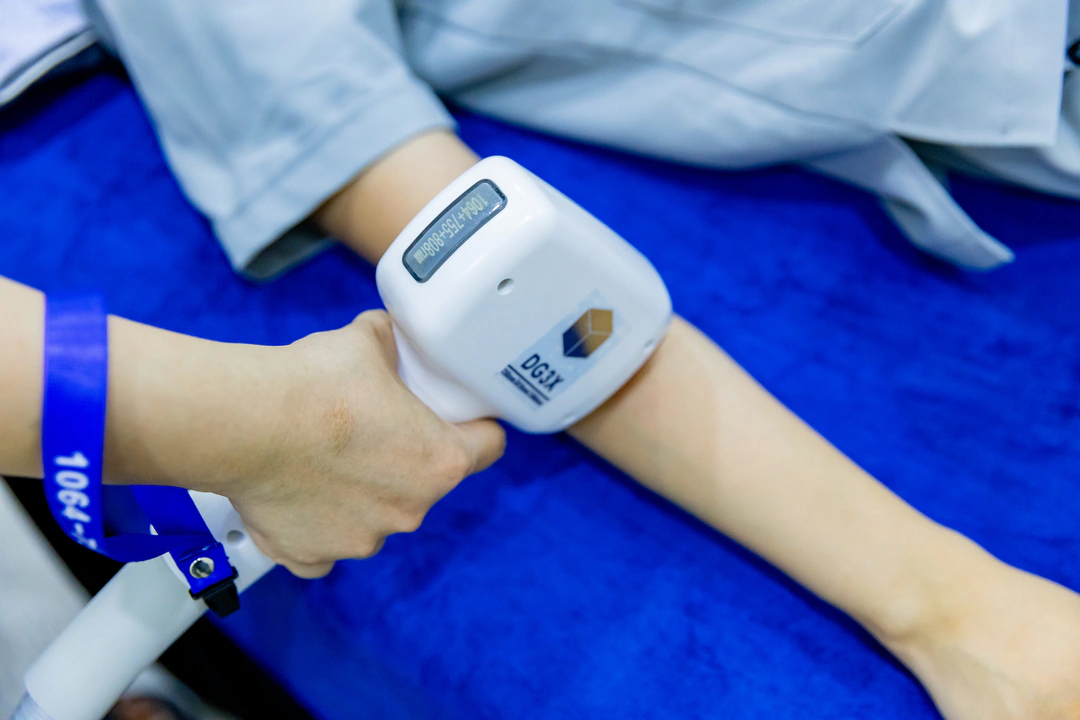
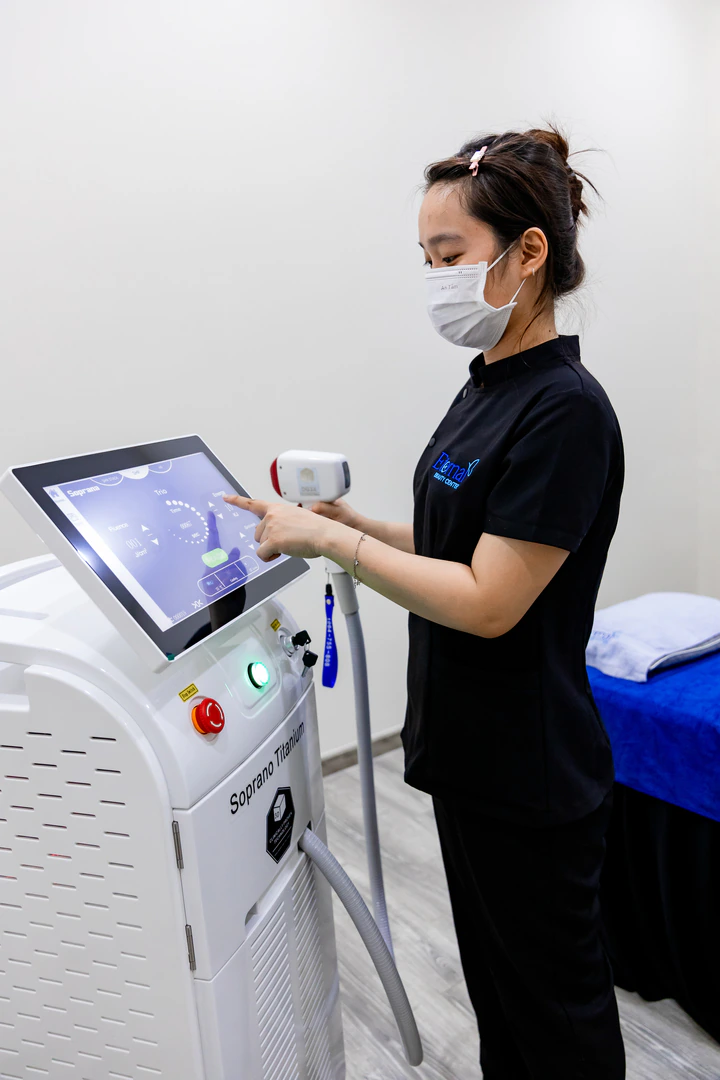
At Eternal Beauty Center, the Diode Laser device integrates 3 wavelengths – 755nm, 808nm and 1064nm – allowing the penetration depth to be adjusted across different skin types and follicle types:
755nm – strong melanin absorption, effective on fine hair and light skin
808nm – the standard wavelength for most hair and skin tones
1064nm – penetrates deeper, safer for darker skin (lower risk with epidermal melanin)
Combining wavelengths is an important technical factor – it is not “the more powerful the machine the better”, but rather choosing the right wavelength and energy level for each skin type and treatment area.
Why One Session Is Never Enough
This is the core of the article, and the part rarely spelled out in “one-and-done permanent” ads.
The short answer: not all follicles on the body are in the same phase at any given moment. Laser is only effective on follicles in the growth phase (anagen). Follicles in the resting (telogen) or transition (catagen) phase barely absorb laser energy effectively – they simply cannot “catch” the laser beam.
The proportion of follicles in the anagen phase varies by body area – each area has its own cycle. The common thread is: at any given moment, only a portion of follicles are in anagen, while the rest are resting or transitioning and will “wake up” on that area’s own cycle (a few weeks to a few months).
So the real-world model of laser hair removal is:
Session 1: laser effectively treats the group of follicles currently in anagen
Wait an appropriate amount of time for resting follicles to move into anagen
Session 2: laser treats the group of follicles that have just entered anagen
Repeat until most follicles have been “passed through” by the laser at least once
This is exactly why 5–8 sessions is the standard for most clients in common areas like the underarms and bikini, with the face and back sometimes needing more. It is not because the machine is weak or the technician is unskilled – it is because the physiology of the hair growth cycle sets this limit.
The Three Growth Phases and Which One Laser Actually “Bites”
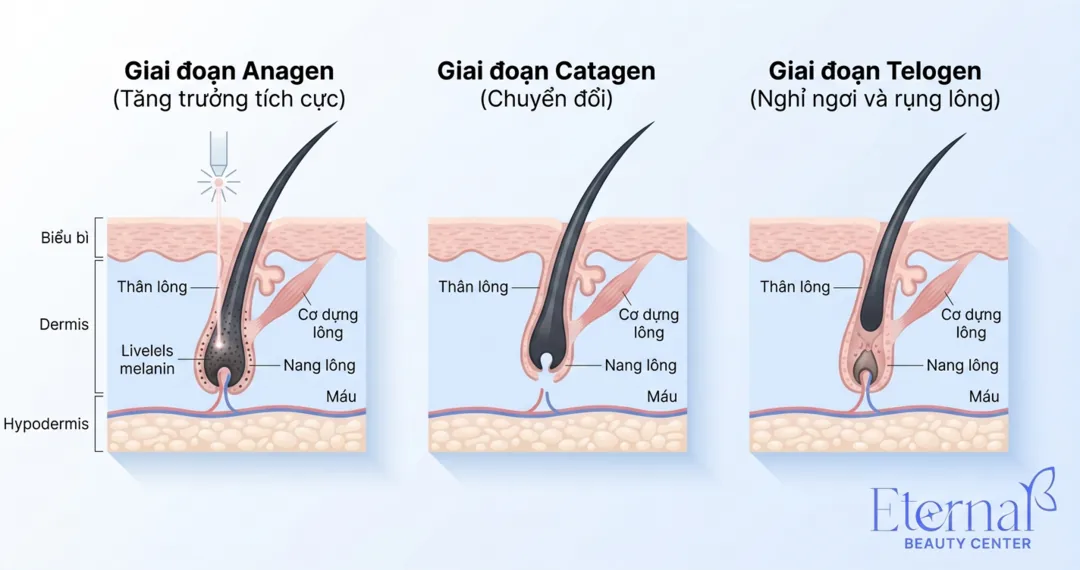
Each follicle on the body does not grow hair continuously – it works in a clear three-phase cycle:
Anagen (the active growth phase)
This is the phase where hair is actively growing. The key features for laser:
The follicle is firmly attached to the skin, extending deep into the dermis
The hair shaft contains the highest melanin content – the pigment laser targets
Stem cells are highly active in the bulge area – the real target of the laser
This is the only phase where laser can act effectively. Heat from the melanin reaches the stem cells → damaging the follicle’s ability to regenerate.
The duration of the anagen phase varies enormously between body areas:
Scalp hair: 3–7 years – this is why hair can grow up to half a metre long
Body hair (underarms, bikini, legs, arms): only 30–45 days – this is why body hair never grows past a certain length
Catagen (the transition phase)
A short phase (a few weeks) in which the follicle stops growing, shrinks and gradually detaches from the hair shaft. Laser is of low effectiveness in this phase because melanin in the shaft decreases and the stem cells are less active. This is the “in-between” phase between growth and rest.
Telogen (the resting phase)
A resting phase lasting from a few weeks to a few months depending on the area. The old hair sheds (sometimes called the exogen – shedding – phase), and the follicle stays dormant until a new anagen cycle begins. Laser has almost no effect in this phase because the follicle has no melanin-rich hair shaft to absorb the energy.
In short: only the anagen phase responds to laser. Follicles in catagen/telogen simply wait their turn to move into anagen before they can be treated in the next session. The proportion of follicles in each phase differs between body areas – this is why the underarms and bikini may need fewer sessions than the face or back.
Realistic Session Counts per Body Area
Based on the characteristics of the hair growth cycle and clinical experience, here is a reference guide for the common treatment areas at Eternal Beauty Center Go Vap:
| Treatment area | Reference course | Interval between sessions |
|---|---|---|
| Upper lip | 6–10 sessions | 4–6 weeks |
| Chin and jawline | 6–10 sessions | 4–6 weeks |
| Underarms | 5–8 sessions | 4–6 weeks |
| Bikini (V-shape or Brazilian) | 6–8 sessions | 4–6 weeks |
| Arms | 6–8 sessions | 6–8 weeks |
| Legs | 6–8 sessions | 6–8 weeks |
| Abdomen | 6–8 sessions | 6–8 weeks |
| Back | 8–10 sessions | 6–8 weeks |
| Full body | By area, combined plan | By area |
Important note: The actual number of sessions depends on hair density, hair colour, skin tone, hormonal factors and how well each client keeps to the schedule. This is a reference range for most cases – some clients (especially the face in people with hormonal factors, or the back in men with high hair density) may need 2–4 more sessions than the reference.
General observations from practice:
The face (upper lip, chin) usually needs the most sessions due to fine follicles, a short cycle, and sometimes hormonal influence (PCOS)
The underarms and bikini usually respond best and fastest due to dense follicles and abundant melanin
Coarse, dark hair on light skin responds best to laser; fine, light hair is harder
After the first session, clients usually see the “passed-through” hair shed gradually over 1–3 weeks
Not sure how many sessions your specific hair situation needs?
Book a consultation at Eternal Beauty Center Go Vap – our technicians will assess your actual hair density and skin tone and recommend a plan tailored to you, rather than applying a fixed number to everyone.
Current offers for new clients: underarm hair removal, 5 sessions from 249K and bikini hair removal, 5 sessions from 799K. Message us on Zalo or call 0334 713 610 for quick advice.
Intervals Between Sessions – Why Each Area Differs
A question clients often ask: “I just finished – why can’t I come back next week to clear it faster?”
The answer lies in the hair growth cycle. The next session only makes sense once a meaningful number of new follicles have moved into anagen – that is, there are “new targets” for the laser. Going too soon, before the follicles have changed phase, basically wastes the session: the laser hits the skin but there are no anagen-phase follicles to treat effectively.
The ideal interval between sessions depends on the length of the anagen cycle for each area:
The face (upper lip, chin) – short cycle, hair grows fast but fine. Interval usually 4–6 weeks
The underarms and bikini – medium cycle, coarse and even hair. Interval usually 4–6 weeks
Arms, legs, torso, back – longer cycle, hair grows more slowly. Interval usually 6–8 weeks
Keeping the right interval is the key to an effective course. Many clients who shorten the interval themselves “to clear hair faster” end up with poorer results than those who follow the standard schedule – because each early session only treats the few follicles that happen to be randomly in anagen.
Personal Factors That Affect the Plan
Two clients treating the same area can need very different numbers of sessions. The personal factors that affect the plan include:
Hair type and skin tone
Coarse, dark hair (black, deep brown) on light skin – responds best to laser, fewest sessions
Fine, light hair – needs more sessions, lower effectiveness per session (less melanin to absorb the laser)
White or grey hair – barely responds to traditional laser because it has no melanin
Dark skin – needs a long wavelength (1064nm) and carefully adjusted energy to limit the risk of epidermal damage
Follicle density
Some people have denser follicles than others due to genetics or ethnicity. The higher the density, the more sessions needed to clear it.
Hormonal factors
Hormones directly affect the hair growth cycle. Some conditions can make hair regrow faster or thicker:
Polycystic ovary syndrome (PCOS) – raised androgens, thicker hair growth, especially on the face, chin and lower abdomen
Hormonal changes during pregnancy and after birth
Use of birth control pills or hormone replacement therapy
The perimenopause and menopause – the estrogen/androgen balance shifts
Clients with clear hormonal factors usually need a longer course and more frequent maintenance sessions to sustain results.
Aftercare between sessions
Pause waxing, plucking or depilatory creams for the entire course – because these methods disrupt the cycle and remove the laser’s “target”
Sun protection on the treated area – especially for arms, legs and back – to limit epidermal damage and ensure the wavelength is absorbed correctly into the follicle
Avoid irritating products for a few days before and after each session
Clients who follow aftercare well usually finish the course faster and with more stable results.
Maintenance Sessions After the Main Course – Why They’re Normal
This is a part rarely discussed but important for setting the right expectations.
After completing the main course (for example 6 underarm sessions or 8 leg sessions), most clients reach a significant reduction – usually 70–90% compared to the start. But over time, a few factors can cause hair to regrow sparsely and mildly:
Some follicles in deep telogen never passed through anagen during the course – and “wake up” months to years later
Natural hormonal changes – pregnancy, after birth, birth control pills, menopause
Health factors – an endocrine condition developing after the course (PCOS, thyroid disorders)
This is why honest clinics usually remind clients about maintenance sessions 1–2 times a year after completing the main course – to treat the sparse new growth and keep results stable.
A maintenance session does not mean “the machine doesn’t work” or “the technician didn’t do it properly” – it is a natural part of how the body works. A hair removal course that is truly “100% permanent” in the literal sense would require destroying the entire stem-cell population of every follicle in the area – a level of impact no current laser device can guarantee without causing extensive skin damage.
How to Recognise an Honest Clinic
Based on everything analysed above, there are some signals that help clients recognise an honest, reputable clinic:
Positive signals:
Clear advice about “long-term hair reduction” rather than a commitment to “100% permanent removal after one course”
Assesses the treatment area and hair type before suggesting a specific session count, rather than applying a fixed number to everyone
Explains the hair growth cycle and why intervals between sessions are needed
Has a transparent maintenance-session policy, and doesn’t sell a “permanent package, never any extra cost” then push hidden fees later
Adjusts energy level and wavelength to each area and skin tone, not “one setting for every client”
Has a clear pre- and post-treatment care process
Signals to consider carefully:
Advertising “one treatment clears hair forever, never grows back” – scientifically incorrect
Applying the same energy level to every client – not optimised for each skin background
Intervals between sessions that don’t match the body area’s cycle (e.g. forcing underarm sessions every 2 weeks)
Committing to unrealistic specific results (“100% gone after 3 sessions for everyone”)
No examination or skin assessment before the first session
Setting the right expectations from the start is what helps clients choose the right clinic, complete the full plan, and achieve stable long-term results – rather than trying a few sessions, getting disappointed, and going to look for another clinic.
Frequently Asked Questions About Laser Hair Removal
Is laser hair removal really permanent?
According to the US FDA classification, laser hair removal technology is cleared under the term “permanent hair reduction”, not “100% permanent removal”. After a complete course, most clients see a 70–90% reduction in the number of hairs; the hair that regrows is usually noticeably finer, sparser and lighter. Some follicles can still “wake up” over time, especially when hormones change.
How many sessions does laser hair removal need to show clear results?
The standard for most clients is around 5–8 sessions for the underarms and bikini, 6–10 sessions for the face (upper lip, chin) and 6–8 sessions for the arms, legs and torso. This is a reference range – the actual number depends on skin tone, hair type, follicle density and each person’s hormonal factors. After the first session, clients usually see the “passed-through” hair shed gradually over 1–3 weeks.
How long should the interval between laser hair removal sessions be?
The interval depends on each area’s hair growth cycle: the face, underarms and bikini are usually 4–6 weeks; arms, legs, torso and back are usually 6–8 weeks. Going too soon, before the follicles have moved into the growth phase (anagen), reduces the session’s effectiveness – because laser needs follicles in anagen to treat.
Do I need maintenance sessions after completing the main course?
Yes. After the main course, some follicles in deep rest never passed through anagen during the course – they can “wake up” after a few months to a few years. Hormonal changes (pregnancy, birth control pills, menopause, PCOS) can also trigger some follicles to regrow. Maintenance sessions 1–2 times a year after the main course help treat the sparse new growth and keep results stable.
Is laser hair removal effective on all hair types?
Not evenly. Coarse, dark hair (black, deep brown) on light skin responds best to laser – thanks to high melanin content that absorbs the laser energy efficiently. Fine, light hair needs more sessions and is less effective per session. White or grey hair barely responds to traditional laser due to a lack of melanin – this is a limitation of current technology.
Can dark skin have laser hair removal?
Yes, but it needs a device with a long wavelength (1064nm) and carefully adjusted energy. The Diode Laser device at Eternal Beauty Center integrates the 1064nm wavelength alongside 755nm and 808nm, allowing safer hair removal for clients with darker skin tones – limiting the risk of affecting melanin in the epidermis.
Does hair removal darken the skin?
When performed with the right technique and proper care, laser hair removal does not cause darkening. On the contrary, for many clients who already have darkening in the underarm or bikini area from years of shaving or waxing, stopping the irritating habits (such as shaving and waxing) during the hair removal course usually helps that skin gradually lighten over time. This mechanism is explained in detail in the article Why Vietnamese skin is prone to post-inflammatory hyperpigmentation.
Book a Hair Removal Consultation at Eternal Beauty Center Go Vap
At Eternal Beauty Center Go Vap, the full hair removal package is performed with Diode Laser technology integrating 3 wavelengths, 755nm / 808nm / 1064nm – allowing it to be adjusted to each treatment area and skin tone:
A real assessment of hair density, skin tone and the treatment area before suggesting a session count
Honest advice about the number of sessions and maintenance afterwards – no “permanent in one go” promises
Laser settings adjusted to each area and each client, not applied as a fixed value
Support for darkening-prone areas (underarms, bikini) with integrated fractional RF in the same session
A private treatment room, with female technicians performing sensitive areas directly
Popular hair removal combos for new clients:
Underarm hair removal – 5 sessions from 249,000đ
Bikini hair removal – 5 sessions from 799,000đ
Upper lip, chin, arms, legs hair removal – quoted after consultation based on the area size
Unlimited-session hair removal package – suitable for clients who want to treat many areas or need a longer course
For clients who already have darkening in the underarm or bikini area from years of shaving or waxing, you can also consider the Body Rose (brightening dark areas) treatment, or ask about our other intimate-brightening services, to combine in parallel during the same period.
Contact Eternal Beauty Center Go Vap:
Address: 204 Street No. 1, Ward 16, Go Vap District, HCMC (convenient for clients from Phu Nhuan, Tan Binh, Binh Thanh, District 12)
Hotline / Zalo: 0334 713 610
Opening hours: 10:00 – 20:00 daily
Website: www.eternalbeauty.vn
The information shared by Eternal Beauty Center is for reference and lookup purposes only and does not replace medical diagnosis or treatment. Treatment results depend on each individual’s constitution and how their body responds. Clients should visit the clinic for advice on the most suitable method.