If you've been researching hair removal, you've almost certainly run into two names: IPL and diode laser. Both are marketed as "advanced light-based hair removal", both promise smooth skin — so many people assume they're the same technology under different labels. They're not. One is a broad-spectrum intense pulsed light, the other a true laser with a precisely selected wavelength — and that difference directly affects how much hair you lose, how much the treatment hurts, how safe it is on Asian skin tones, and how much you end up spending overall.
This article compares the two technologies on the evidence: guidance from the American Academy of Dermatology (AAD), the U.S. National Library of Medicine (NCBI/StatPearls), and randomized clinical trials that pitted IPL and diode laser against each other directly — combined with real-world treatment experience at Eternal Beauty Center, a skincare clinic in Go Vap, Ho Chi Minh City. By the end, you'll be able to answer the question for yourself: given my skin and my goals, which technology should I choose?
Why IPL and diode laser shouldn't be lumped together
In Vietnam's beauty market, the phrase "high-tech hair removal" is applied to everything: handheld devices costing a few million dong, budget spa packages, and medical-grade laser systems at dermatology clinics. Most of these fall into one of two camps:
IPL (Intense Pulsed Light) — a high-intensity flash of light. Not a laser.
Diode laser — a true laser, currently the most widely used professional hair-removal technology worldwide.
Distinguishing them isn't about declaring one "fake". Both are studied technologies, and both genuinely reduce hair. But they differ on three points that matter to anyone paying for treatment: how much hair reduction you get for the same number of sessions, how safe the treatment is on darker skin tones (including most Vietnamese skin), and how durable the results are over time. Choosing the wrong technology for your skin and hair type is the single most common reason people end up "treating forever without finishing" — or walk away with post-treatment dark patches.
The shared mechanism: selective photothermolysis
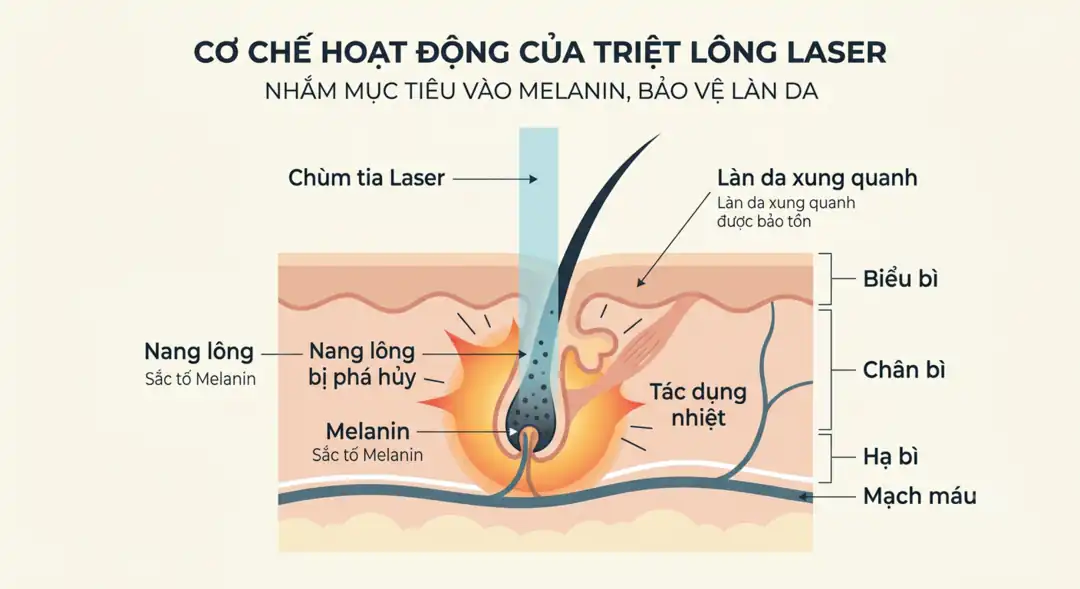
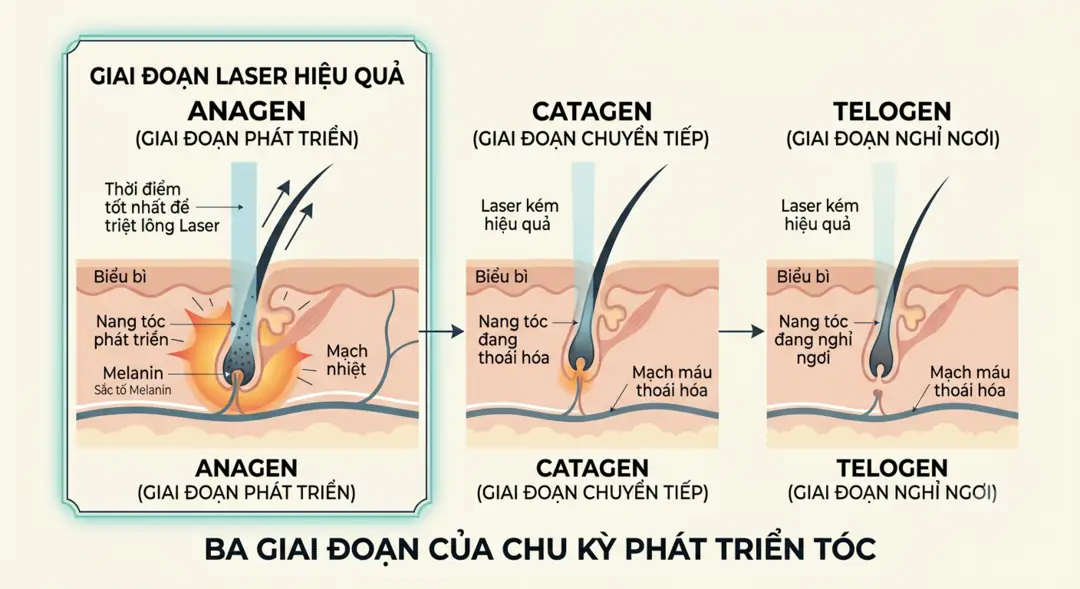
Before comparing, it helps to understand what the two technologies share. Both IPL and diode lasers work through selective photothermolysis — the principle behind all light-based hair removal.
In plain terms: melanin, the pigment that makes hair dark, absorbs light very efficiently at certain wavelengths. When a suitable beam hits the skin, melanin in the hair shaft and follicle absorbs the energy and converts it to heat, and that heat damages the follicle — the structure that manufactures the hair. A sufficiently damaged follicle stops producing hair or produces only finer, lighter strands.
Two important consequences follow from this mechanism:
Dark hair on light skin is the ideal scenario — the light "hunts" melanin, so the greater the contrast between hair and skin, the more precisely the energy lands where it should. Conversely, the darker the skin, the more the epidermis itself competes for that energy — raising the risk of burns and pigmentation if the technology isn't well matched.
No technology finishes the job in one visit — only follicles in their active growth (anagen) phase contain enough melanin to respond well. At any given time, only a fraction of your hair is in that phase, so every course requires multiple sessions spaced weeks apart to catch each "batch". According to the AAD, each session typically removes around 10–25% of hair, and most people need roughly six sessions or more.
Where IPL and diode laser part ways is in how they generate and control that light — and that's where every practical difference begins.
What is IPL? The broad-spectrum "multi-tasker"
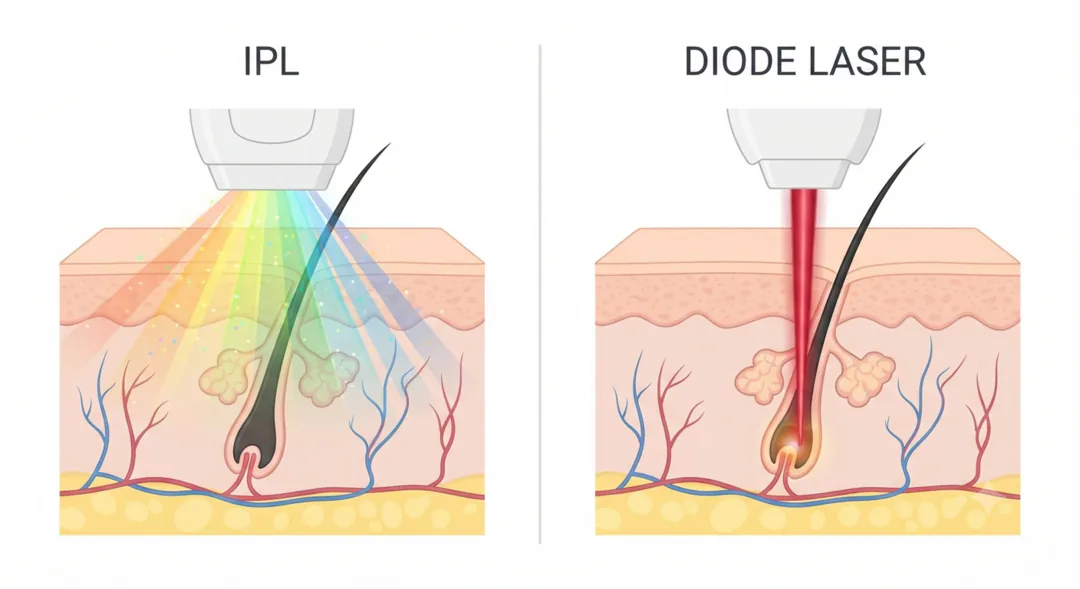
IPL (Intense Pulsed Light) uses a high-powered flash lamp that emits polychromatic, non-coherent light across a broad spectrum of roughly 500–1200nm — essentially a very powerful camera flash rather than a laser beam. Filters trim away unwanted portions of the spectrum, keeping a band that's reasonably suited to the treatment goal.
Because it emits many wavelengths at once, IPL is genuinely versatile: beyond hair reduction, it's used for photorejuvenation, visible vessels and superficial pigmentation. But for the specific job of hair removal, that versatility becomes a weakness:
Scattered energy: only part of the spectrum is efficiently absorbed by follicular melanin; the rest dissipates into surrounding tissue — wasted energy that heats the skin without helping.
Poor selectivity: broadband light also engages melanin in the epidermis, so on darker or recently tanned skin the risk of burns and pigmentation is higher.
Limited penetration: lower peak power and scattering make it harder for IPL to reach deep-seated follicles (bikini-line hair, coarse hair), which translates into slower results and more sessions.
IPL is not a scam technology — in professional hands, on fair skin with dark hair, it delivers real hair reduction. The issue is that it is less selective and less consistent than a dedicated laser, especially on Asian skin. It's also the technology inside almost every at-home handheld hair-removal device, at far lower energy levels (more on that in section 9).
What is a diode laser? Why it became the workhorse of hair removal
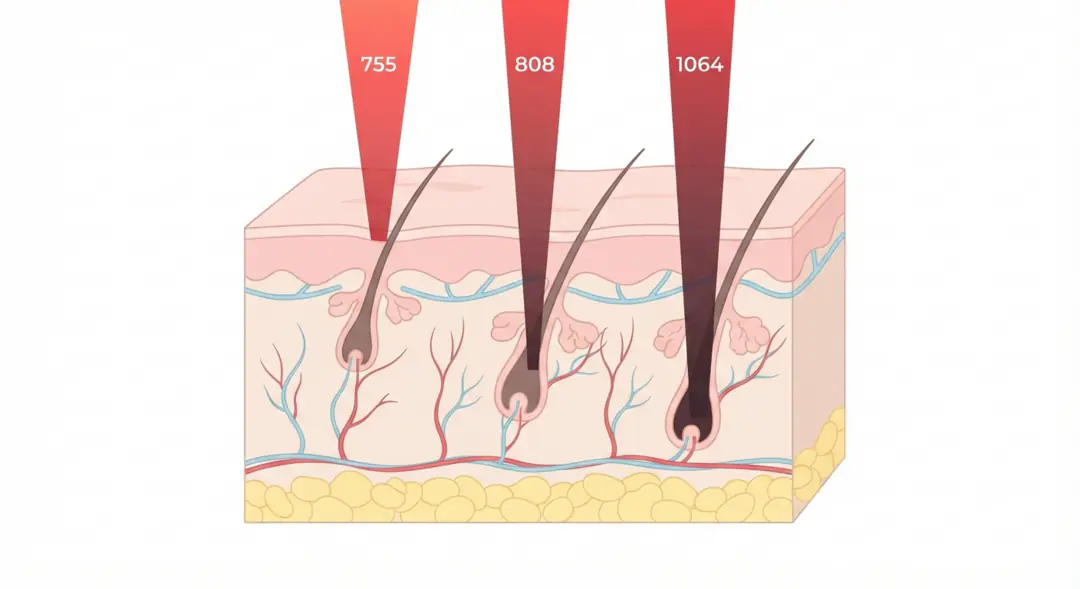
A diode laser is a true laser: monochromatic (a single defined wavelength), collimated, and energy-dense. The classic hair-removal diode wavelength is 800–810nm — a sweet spot: short enough for strong melanin absorption, long enough to penetrate to the follicle while being less intercepted by epidermal melanin than shorter wavelengths.
The core differences from IPL:
All the energy is concentrated at exactly the wavelength that matters — nothing is scattered, so the same fluence destroys follicles more effectively.
Precise control: the practitioner adjusts fluence and pulse duration to your skin type, treatment area and hair thickness.
Deep penetration: effective even for coarse, deep-rooted hair in areas like the underarms, bikini line and beard.
The new generation: triple-wavelength diode
Modern diode platforms (such as the Soprano Titanium system used at Eternal Beauty Center) combine three wavelengths in a single applicator: 755nm – 808nm – 1064nm:
755nm (the alexandrite-laser band): strong melanin absorption, effective on fine or lighter hair.
808nm (the classic diode): the balanced workhorse between penetration depth and absorption.
1064nm (the Nd:YAG band): the deepest-penetrating and safest for darker skin, since epidermal melanin absorbs it least.
Blending the three lets a single course handle multiple hair types (coarse and fine, shallow and deep) across a range of skin tones, instead of forcing one wavelength to fit everyone. Modern systems pair this with low-fluence, high-repetition in-motion (SHR) sweeping and a contact-cooling tip, which together largely eliminate the burning-hot sensation older diode machines were known for.
IPL vs diode laser: 10-point comparison table
| Criterion | IPL | Diode laser |
|---|---|---|
| Nature of the light | Broadband pulsed light ~500–1200nm; not a laser | Monochromatic laser; classic 808nm, modern 755/808/1064nm |
| Energy concentration | Spread across many wavelengths | Fully concentrated at the optimal wavelength |
| Hair-reduction efficacy | Real, but slower and less durable | Statistically superior in head-to-head trials |
| Typical sessions needed | More (often 8–10+) | Usually 6–10 depending on area and individual response |
| Penetration depth | Limited — struggles with deep follicles | Good — handles coarse, deep-rooted hair |
| Safety on darker/Asian skin | Weaker; contraindicated on very dark skin | Safer, especially with the 1064nm wavelength |
| Sensation | Mild stinging (lower energy) | Hotter on older machines; modern cooled in-motion systems are quite comfortable |
| Common risks | Burns and pigmentation on dark/tanned skin; inconsistent results | Low risk with correct technique; parameters must match skin type |
| Best suited for | Fair skin + dark hair; mild reduction goals | Most skin types (I–V), including tan skin; coarse hair, large areas |
| Cost per session | Lower | Higher per session, but fewer sessions and longer-lasting results |
Quick takeaway: IPL is a "multi-purpose lamp" — decent at many things. A diode laser is a dedicated instrument for hair removal — it does one job, does it well, and does it controllably.
What the research says: numbers from head-to-head trials
Comparing IPL and diode laser isn't a matter of opinion — clinical trials have put the two technologies head-to-head on the same person.
Randomized left-right controlled trial (2013): 30 participants had their underarms treated — diode 800nm on one side, IPL 600–950nm on the other — over six sessions four weeks apart, with 12-month follow-up. At 12 months, the diode side showed 69.2% hair reduction versus 52.7% for IPL — a statistically significant difference. The trade-off: the diode was more uncomfortable (mean pain score 3.7/10 vs 1.6/10 for IPL — note this was an older-generation single-pulse diode without modern cooled in-motion delivery). No serious side effects occurred on either side.
Double-blind axillary trial (2014): 21 women, one technology per underarm, six sessions, six-month follow-up. Conclusion: both reduced hair significantly and safely, but the diode laser was more effective.
Trial on darker skin (Fitzpatrick III–V): 30 women with unwanted facial hair were split into three groups — diode, Nd:YAG 1064nm, and IPL — for eight sessions. Final hair reduction: diode 92%, Nd:YAG 90%, IPL 70%. The authors concluded IPL was the least suitable option for darker skin.
Three studies, three settings, one consistent pattern: both technologies work, but the diode removes more hair and holds the result longer — and the gap widens on darker skin. This is why professional dermatology clinics worldwide have standardized on lasers (diode, alexandrite, Nd:YAG) as their primary hair-removal platforms, while IPL has shifted toward adjunct use and home devices.
(Sources are listed in the reference section at the end of this article.)
The deciding factor: Asian and Vietnamese skin tones
If you could ask only one question before choosing a hair-removal technology, it should be: "How safe is this on my skin tone?"
Most Vietnamese skin falls into Fitzpatrick types III–IV (golden to tan), with some in type V. On this canvas:
The epidermis carries more melanin than fair European skin — meaning your skin actively competes with your follicles for the light energy. The less selective the technology, the higher the odds of energy landing in the wrong place.
A misfire doesn't just mean a burn — it often means post-inflammatory hyperpigmentation (PIH): dark patches that can take months to fade, and to which Asian skin is notoriously prone after any inflammatory injury.
The medical literature lists IPL as contraindicated on very dark skin (Fitzpatrick VI) and calls for real caution on types IV–V or recently tanned skin. The 810nm diode, by contrast, has repeatedly been shown safe and effective on types III–V, and the 1064nm wavelength included in triple-wavelength diode systems is the safest of all for darker skin.
None of this means tan skin can never be treated with IPL — it means IPL's margin of safety on Vietnamese skin is much narrower, and depends heavily on the operator's experience and the device's filter quality. With a diode — especially a triple-wavelength system that can lean on 1064nm for darker tones — the practitioner has far more room to stay both effective and safe.
One related note: treated skin is more sun-sensitive after any light-based session. Diligent sun protection on exposed areas is a mandatory part of aftercare, particularly in summer.
Does it hurt? The role of cooling technology
Fear of pain is the biggest barrier that keeps people from starting hair removal — and it's where this comparison gets interesting.
On paper, IPL is gentler — as the 2013 trial recorded (pain score 1.6 vs 3.7 for diode). But read that number correctly: IPL hurts less largely because it delivers less useful energy — the very reason it's less effective. Less pain per session, but more sessions and less durable results, doesn't necessarily add up to less total discomfort.
Older diode machines genuinely ran hot — high peak energy packed into single pulses. Modern diode systems changed the equation with two innovations:
Low-fluence in-motion delivery (SHR): instead of firing discrete high-energy pulses, the applicator sweeps continuously, building heat in the follicle gradually until it reaches the destruction threshold. The sensation shifts from "hot rubber-band snap" to "gradually warming".
Contact cooling: the applicator surface is actively chilled, soothing the skin at the exact point of contact while protecting the epidermis from heat build-up.
At Eternal Beauty Center, clients treated with the cooled triple-wavelength diode typically describe underarm or bikini sessions as "mild prickling, slightly warm" — most need no numbing cream for standard areas. Pain thresholds vary from person to person, but the comfort gap between IPL and a modern diode has narrowed dramatically compared with a decade ago.
At-home IPL devices vs in-clinic diode laser
For many readers this is the real-world question: buy a handheld IPL device for a few million dong, or book a diode course at a professional clinic?
Home hair-removal devices (Ulike, Braun, Philips Lumea and similar) almost all use IPL — and for consumer-safety reasons they are energy-capped far below medical equipment. The consequences:
Results are mostly temporary growth delay — follicles are "lulled to sleep" (pushed into their resting phase) rather than destroyed. Stop using the device and hair typically returns; manufacturers themselves recommend ongoing maintenance sessions indefinitely.
Nobody assesses your skin first: using the device on tanned or darker skin, over moles or tattoos, or too close to the eyes are common mistakes that cause burns and pigmentation. There's also a lesser-known phenomenon called paradoxical hypertrichosis — energy too weak to destroy the follicle can instead stimulate thicker hair growth in adjacent areas, reported more often on darker skin types and with low-energy devices.
Coverage is uneven: sweeping by hand makes it easy to miss patches — leading to blotchy, inconsistent results.
Home devices do have their place: fair-skinned users with light treatment goals who accept indefinite upkeep. But if your goal is visible, lasting hair reduction on Vietnamese skin — especially coarse-hair zones like underarms and the bikini line — a diode course at a qualified clinic, with a proper skin assessment and individually tuned parameters, is the sounder choice for both results and safety. For a deeper look at how "permanent" each method's results really are, see is laser hair removal permanent?.
The real cost equation: cheaper per session or better per result?
Comparing hair-removal prices by "cost per session" is the easiest way to fool yourself. The correct comparison is total cost to reach the result you want:
IPL usually costs less per session, but needs more sessions (each one removes less hair) and delivers less durable results — many clients end up returning for regular "maintenance". The total spend over one or two years is often not cheap at all.
Diode laser costs more per session, but the trial data shows greater reduction per session and longer-lasting results — meaning the cost per percentage of hair actually removed is usually lower.
Diode pricing in Vietnam has also become far more accessible than a few years ago. At Eternal Beauty Center, for example, the full hair-removal package with the triple-wavelength diode laser starts from 49,000 VND per session for small areas, with multi-session combo packages for new clients — medical-grade laser is no longer a luxury compared with ordinary spa IPL.
One more "hidden cost" worth counting: the cost of complications. A single burn or pigmentation episode from the wrong technology on darker skin can take more time and money to treat than an entire hair-removal course.
Risks and side effects of each technology
Let's be clear: both technologies are safe when properly indicated and properly performed. The controlled trials above recorded no serious or permanent adverse events. Normal post-session reactions — mild redness, warmth, slight swelling around the follicles — settle within hours to a day or two.
The difference lies in how likely things are to go wrong when conditions aren't ideal:
With IPL, risk rises when:
Skin is darker (Fitzpatrick IV and above) or recently sun-exposed — burns, hyperpigmentation and even hypopigmentation become more likely.
The device is low quality with poor filtering — stray wavelengths escape the safe band.
The operator lacks experience selecting parameters for Asian skin.
With diode lasers, risk mainly comes from:
Overly aggressive parameters (high fluence, long pulses) on darker skin — burns are still possible if the operator is careless.
Skipping cooling or using poor applicator technique.
Risks shared by both (all uncommon): paradoxical hypertrichosis (see section 9), transient folliculitis, and herpes reactivation in people with a history of cold sores. And a standard list of contraindications/precautions applies to all light-based treatments: pregnancy, photosensitizing medication (high-dose isotretinoin warrants a doctor's input), active infection in the treatment area, and tattoos within the treatment zone.
This is why the pre-treatment consultation and skin assessment matters as much as the technology itself. A serious clinic will take your history, examine your skin tone, and test-patch the energy level — rather than putting the applicator straight to work.
Which should you choose? Recommendations by scenario
Pulling all of the above together, here's how to map the decision onto your own situation:
Prioritize a diode laser (especially triple-wavelength) if:
Your skin is a typical Vietnamese tone or darker (golden, tan, quick to catch sun).
Your hair is coarse, dark and fast-growing — especially underarms, bikini line, legs.
You want clear results within 6–10 sessions that last, rather than maintaining forever.
You've already done many IPL sessions and the hair keeps coming back.
IPL can be a fit if:
Your skin is fair and your hair dark — strong skin-hair contrast.
You only want mild reduction and accept more sessions plus periodic upkeep.
You want to self-treat at home with a handheld device, understand the limits of what it can achieve, and follow the safety rules (never on tanned skin, never near the eyes, cover moles and tattoos).
See a professional first, whichever you choose, if:
Your skin is distinctly dark or scars/pigments easily after injury.
Your hair growth is unusually heavy (hirsutism) — it may have a hormonal cause (such as PCOS) that deserves evaluation, not just removal of the visible hair.
You're on dermatological or hormonal medication, pregnant, or breastfeeding.
Triple-wavelength diode laser hair removal at Eternal Beauty Center
At Eternal Beauty Center (Go Vap, Ho Chi Minh City), hair removal is delivered exactly the way this article recommends — technology matched to skin, not to a price tag:
Technology: triple-wavelength diode laser, 755nm – 808nm – 1064nm (Soprano Titanium platform) with contact cooling and in-motion delivery — wavelengths blended to each client's skin tone and hair type, including tan skin.
Process: a consultation and skin assessment before the course begins; parameters are personalized and re-tuned session by session based on your actual response.
Sensitive areas: underarms and bikini line receive additional soothing protocols; clients with existing underarm or bikini darkening can pair their course with the Body Rose brightening treatment.
Transparent pricing: from 49,000 VND per session for small areas, with new-client combos (e.g., underarms at 249,000 VND for 5 sessions) — and a guarantee that the machine and technology used are the ones you were quoted.
We don't promise "absolutely permanent after one course" — the medical literature doesn't support that promise (hormone-influenced areas like the face may need touch-ups; see is laser hair removal permanent?). What we do commit to is visible, lasting hair reduction, safe for your skin tone, on a schedule and budget agreed upfront — done properly.
Frequently Asked Questions (FAQ)
Which removes hair more effectively — IPL or diode laser?
Head-to-head controlled trials favor the diode laser: for example, 69.2% vs 52.7% hair reduction at 12 months (fair skin, underarms, six sessions), and 92% vs 70% after eight sessions on darker skin. IPL does work, but more slowly and less consistently — especially on darker skin tones.
Is IPL hair removal harmful?
At a professional clinic, on suitable (fair) skin, IPL is safe. Risk increases on darker or tanned skin — burns and pigmentation are more likely than with a dedicated laser, because broadband light is less selective. IPL is not recommended on very dark skin.
Can tan or darker skin be treated?
Yes — but with a long-wavelength laser (a diode, ideally a system that includes 1064nm) rather than IPL, and with a practitioner experienced in darker skin. If you have an active tan, let the skin recover and protect it from sun before starting.
How many sessions until I see results?
Per the AAD, each session removes roughly 10–25% of hair; most people need about six or more sessions spaced 4–6 weeks apart, depending on the area and individual factors. A diode typically needs fewer sessions than IPL for the same result. Regrowth between sessions becomes progressively finer and sparser.
Is diode laser hair removal permanent?
Laser hair reduction is long-lasting — most destroyed follicles don't recover. But "100% permanent" is an overstatement: a fraction of follicles can regenerate, and hormone-influenced areas (such as facial hair in women) may need maintenance sessions. Details in is laser hair removal permanent?.
Does it hurt?
IPL usually feels like light stinging. Older diodes ran noticeably hot, but modern machines with contact cooling and in-motion sweeping reduce the sensation to mild warmth and brief prickling — most clients skip numbing cream for standard areas.
Can an at-home IPL device make hair grow back thicker?
There is a rare phenomenon called paradoxical hypertrichosis: energy too low to destroy the follicle can stimulate denser growth in adjacent areas — reported more often on darker skin and with low-energy devices. It's one more reason to be cautious about self-treating Vietnamese skin at home.
Is light-based hair removal safe during pregnancy?
There isn't enough safety data for pregnancy, so the standard advice is to postpone IPL/laser hair removal until after delivery, and to consult your doctor if breastfeeding. Extra hair growth during pregnancy usually subsides on its own after birth.
Summary
IPL and diode laser both remove hair through the same principle — selective photothermolysis — but differ fundamentally in how they control the light, and that difference shows up clearly in outcomes:
IPL: broadband, versatile, cheaper per session — but its energy is scattered, it needs more sessions, results fade sooner, and its safety margin on darker skin is narrow. A fit for fair skin, dark hair and modest goals.
Diode laser: a dedicated instrument with concentrated energy, demonstrably higher efficacy, and better safety on Asian skin — especially triple-wavelength 755/808/1064nm systems that handle tan skin and fine hair alike. The sensible default for most Vietnamese clients who want visible, lasting reduction.
Whichever you choose: a pre-treatment skin assessment, personalized parameters, and post-treatment sun protection shape your outcome at least as much as the name of the technology.
Book a hair-removal consultation at Eternal Beauty Center
Not sure which technology suits your skin — or tired of courses that never seem to finish? Let the team at Eternal Beauty Center assess your skin tone and hair type and map out a triple-wavelength diode course that fits you.
Hotline / Zalo: 0334 713 610
Address: 204 Street No. 1, Ward 16, Go Vap, Ho Chi Minh City
Opening hours: 10:00 – 20:00 daily
Related services: Full Hair Removal – Triple-Wavelength Diode Laser · Body Rose – underarm & bikini brightening
Medical disclaimer: This article is for informational purposes only and does not replace an in-person examination, diagnosis or personalized medical advice. Hair-removal outcomes vary between individuals depending on skin tone, hair type, hormones and adherence to the treatment schedule. Please consult a qualified professional before undergoing treatment.