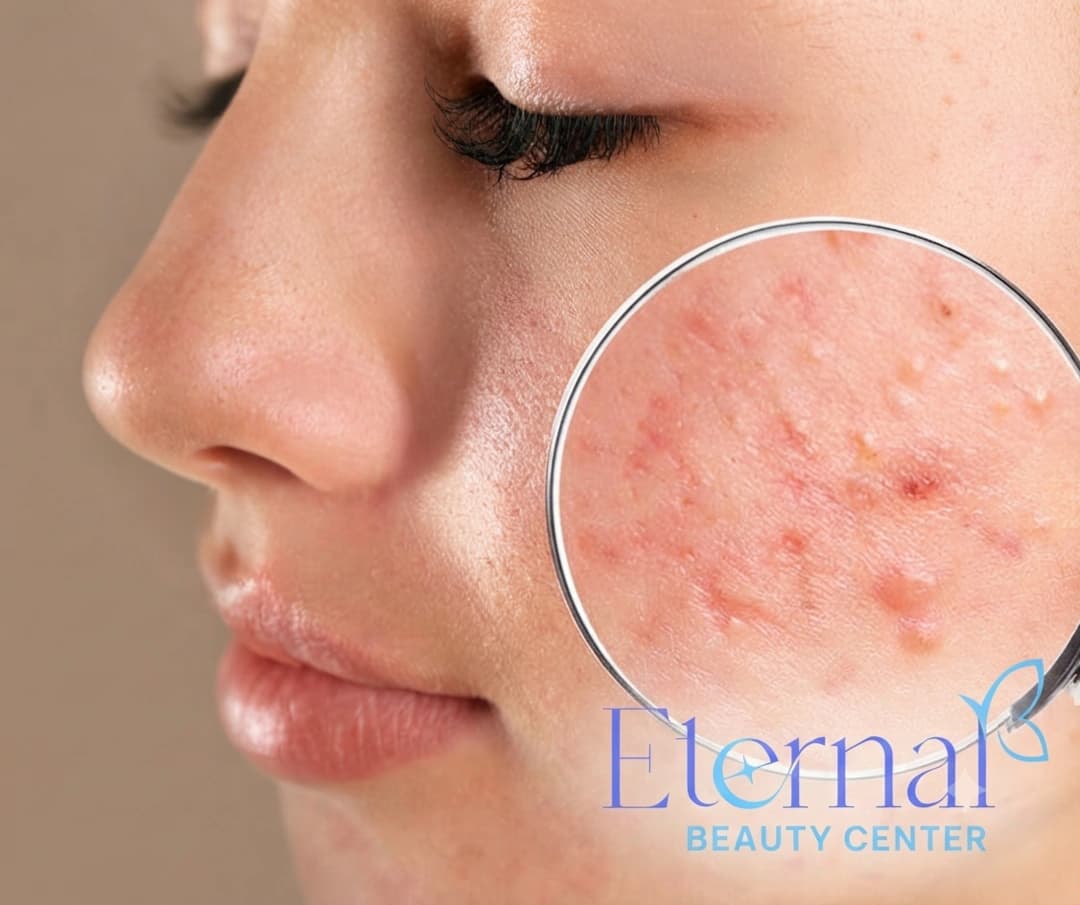
An inflamed pimple only stays red and swollen for a few days, but the brown mark it leaves behind can last 4–6 months, sometimes longer. Dr. Lê Hiền explains why Vietnamese skin is especially prone to this, and what can realistically be done to limit it.
Why clients worry about dark marks more than the acne itself
An inflamed pimple usually lasts only a few days to two weeks. But the dark brown mark left after the pimple has healed can linger for months — even a year.
During consultations, Dr. Lê Hiền finds this is what tires many clients more than the acne itself. Acne eventually clears; the marks stay, leaving the skin looking uneven and rough even after breakouts are under control.
The medical name for this is post-inflammatory hyperpigmentation (PIH). It is a more common dermatological issue than people think on Vietnamese skin, and it forms through a different mechanism than atrophic or raised scars. Understanding that mechanism is the first step to treating it effectively.
What post-acne dark marks (PIH) really are
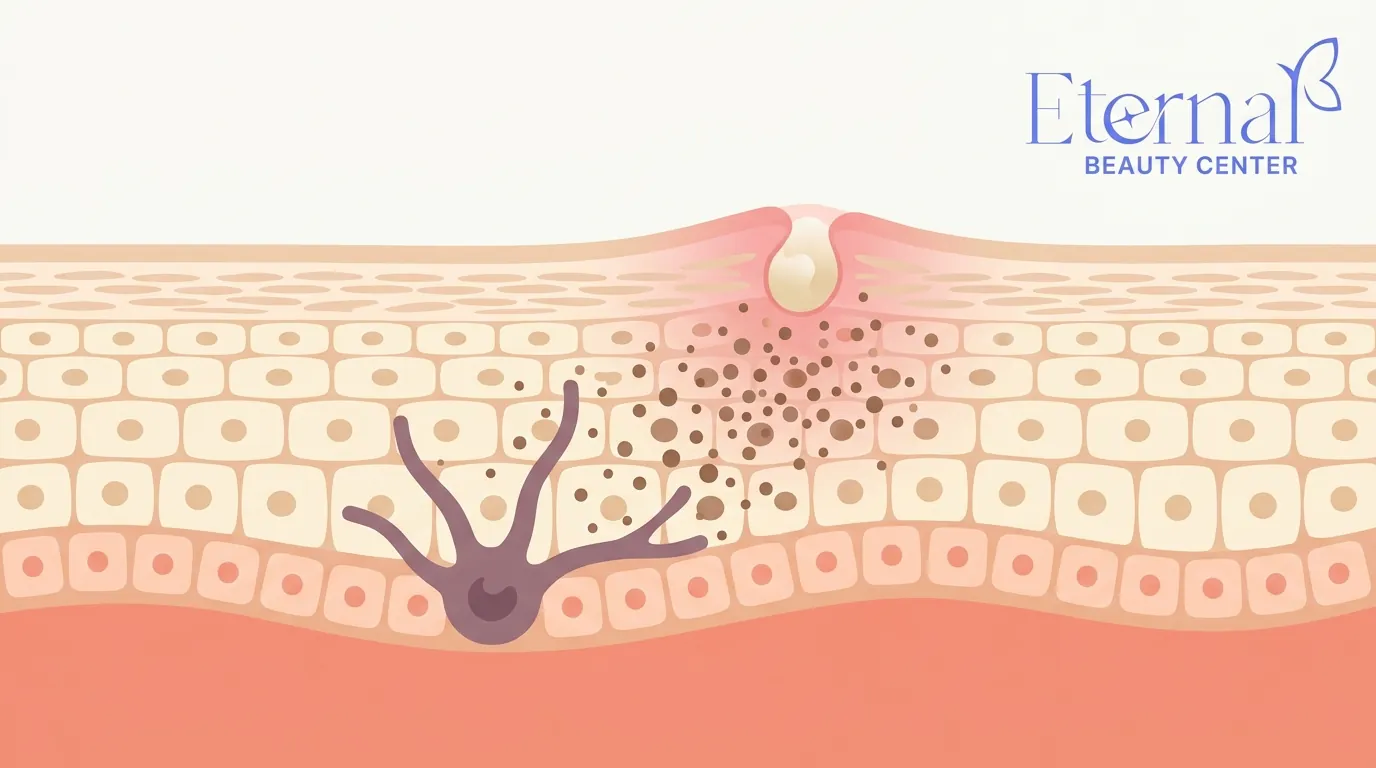
When an inflamed pimple appears, the skin's immune system responds by releasing inflammatory mediators such as cytokines and prostaglandins. This is a protective reaction — it helps isolate bacteria and repair the damage.
But at the same time, these inflammatory molecules directly stimulate melanocytes — the pigment-producing cells in the basal layer of the epidermis. Melanocytes synthesise more melanin and push it into neighbouring cells. The result is that the just-inflamed area accumulates an excess of pigment — the dark brown mark left after the pimple heals.
PIH comes in two forms depending on pigment depth:
Epidermal PIH – pigment concentrated in the outer layer of the skin. It can fade within 3–6 months with proper care.
Dermal PIH – pigment that has dropped into deeper layers, usually from prolonged inflammation or invasive handling (improper squeezing, scratching, rubbing). This type can last 12–18 months, sometimes longer.
A rough at-home check: gently press and stretch the skin over the mark. If it fades noticeably, it is likely epidermal PIH. If it stays dark, it may have reached the dermis. This is only a crude observation; an accurate assessment needs a professional skin analysis.
Why Vietnamese skin is especially prone to dark marks
This is the important part. The rate of post-acne dark marks is not the same across skin types – and Vietnamese skin is in the higher-risk group.
There are three anatomical and physiological reasons:
First, the density and activity of melanocytes. Fitzpatrick III–V skin (which includes most Vietnamese and Southeast Asian people) has more active melanocytes than fair skin. At the same level of inflammation, melanocytes in Vietnamese skin produce more melanin and spread it more widely.
Second, a lower activation threshold. On Vietnamese skin, even mild inflammation – sometimes not clearly visible – is enough to trigger a hyperpigmentation response. This is why some people without "obvious inflammatory acne" still develop marks after small closed comedones or tiny bumps pass.
Third, melanin tends to "drop" into the dermis. On darker skin, pigment incontinence – pigment escaping the epidermis and falling into deeper layers – happens more easily. This is the mechanism that makes marks on Vietnamese skin harder to fade and longer-lasting.
A concrete example Dr. Lê Hiền often shares in consultations: with the same moderate inflamed pimple, a fair-skinned person may heal without an obvious trace; the same lesion on Vietnamese skin can leave a brown mark lasting 4–8 months. This difference is not due to poor care, but to the physiology of the skin type.
Two factors that make marks darker and more stubborn
The severity of post-acne marks is not fixed – it depends on two adjustable factors:
The intensity and duration of inflammation
The stronger and longer the inflammation, the more strongly melanocytes are activated, and the darker and deeper the mark left behind. This is why inflammatory acne left to resolve on its own (with no intervention) usually leaves darker marks than acne whose inflammation is controlled early with a medical protocol.
Specifically, an inflamed pimple that stays red and swollen for 2 weeks triggers markedly more pigmentation than the same pimple if its inflammation is reduced within 3–4 days with appropriate measures.
Invasive handling of the pimple
This is often overlooked. When a pimple is mechanically disturbed – pressed, squeezed, rubbed – even without obviously breaking the skin – local inflammation increases and lasts longer. Mechanical damage keeps the inflammatory cascade firing after the original lesion has been cleared.
It is especially serious when squeezing a deep inflamed pimple that has not come to a head. In that case, inflammatory fluid and bacteria can be pushed sideways into surrounding healthy tissue instead of out. The inflamed area spreads → the pigment spreads → the mark is not only larger than the original pimple, but can also reach the hard-to-fade dermis.
This is the mechanism behind a common observation: many people who squeeze pimples at home notice "the mark is bigger than the original pimple". It is not imagination – it is the real consequence of mechanical damage plus a hyperpigmentation response on Vietnamese skin.
Telling "dark marks" and "scars" apart – two different problems
This is often confused in conversations about acne-prone skin. The two conditions sound related but have completely different mechanisms:
Post-acne dark marks (PIH) – a pigment problem; the skin structure is intact. The mark is flat, differing only in colour from the surrounding skin. It can fade over time.
Atrophic scars – a structural problem, with loss of collagen and elastin in the dermis. The skin sinks into a depression. It cannot fill back in on its own.
Keloid and hypertrophic scars – the opposite: the skin is pushed up by excessive collagen growth.
Telling them apart matters because the treatment protocols are completely different. Some methods that help fade marks (such as brightening peels) have almost no effect on atrophic scars. Conversely, procedures for atrophic scars (such as TCA Cross or Subcision) are not the first choice for marks alone.
Sometimes a person has both problems coexisting on the same area – this is when a consultation with a dermatologist becomes necessary to build a sensible order of treatment.
See also Distinguishing the 3 types of atrophic scars for a deeper look at structural scarring.
What at-home skincare can actually do for dark marks
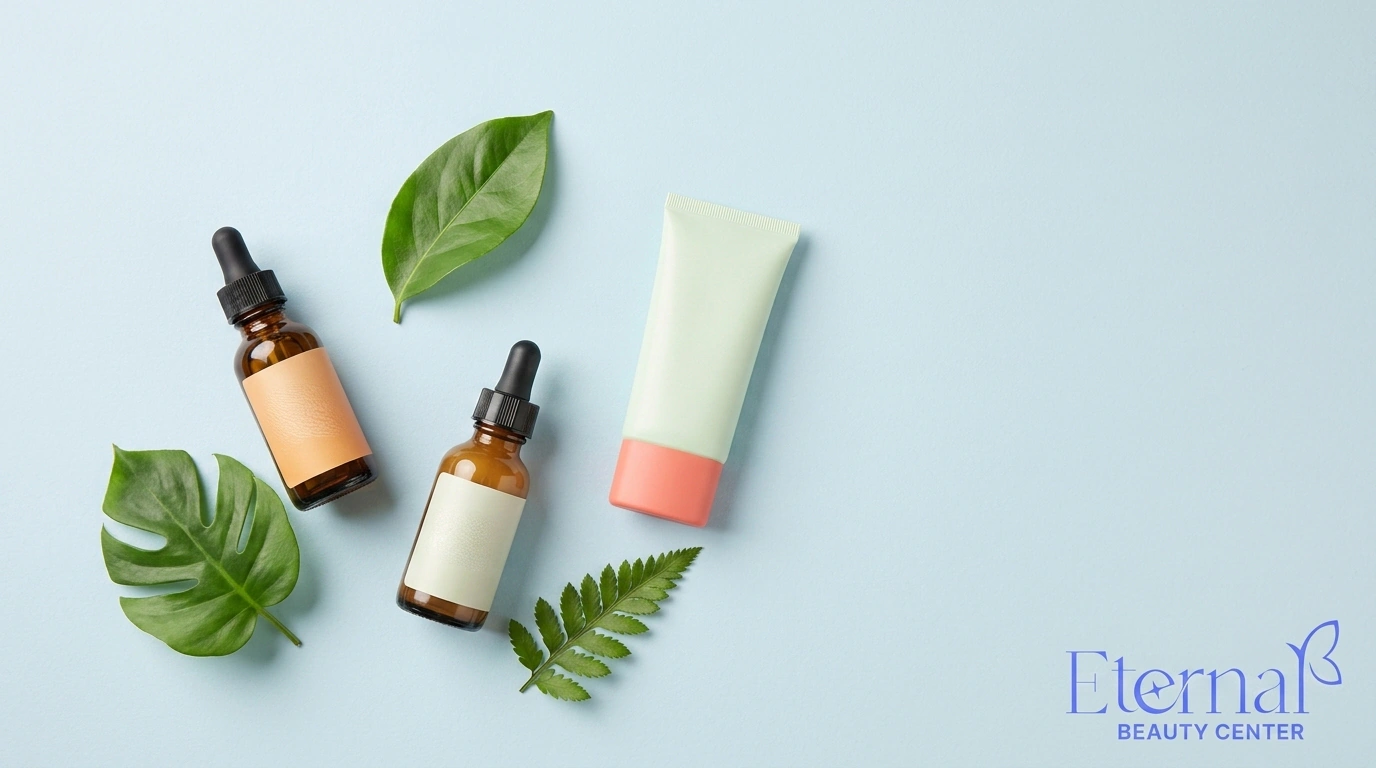
Unlike atrophic scars – where at-home skincare has clear anatomical limits – post-acne dark marks are within reach of certain topical ingredients. But the effect is not fast, and each ingredient has its own role that needs to be combined correctly.
Ingredients with a clear scientific basis for PIH
Niacinamide – slows the transfer of melanin from melanocytes to keratinocytes. Gentle, low-irritation, suitable for long-term use.
Vitamin C (L-ascorbic acid and derivatives) – inhibits the tyrosinase enzyme, slowing melanin synthesis. Also antioxidant.
Retinoids (Tretinoin, Retinol, Adapalene) – speed up cell turnover, helping pigment-laden skin shed faster. They also reduce the risk of new acne (the root of marks).
Azelaic acid – a dual role: it reduces inflammation and inhibits tyrosinase. Especially suitable for sensitive skin and skin with a history of melasma.
Tranexamic acid (topical) – works on the inflammation–pigment signal, effective for stubborn marks.
AHAs (Glycolic, Lactic, Mandelic) – exfoliation that supports cell turnover, helping epidermal PIH fade faster.
The most important ingredient, often forgotten
Sunscreen. This is the point Dr. Lê Hiền stresses at every pigment-related consultation. UV rays activate melanocytes – exactly the mechanism that formed the PIH in the first place. Skin with PIH exposed to unprotected sun will darken further, and all the brightening ingredients above quickly lose their effect.
Sunscreen of at least SPF 30, PA+++, applied evenly every day and in sufficient amount, is the prerequisite for any mark-fading routine – at home or at a clinic – to have a chance of working.
The real role of skincare with marks
In many cases of mild-to-moderate epidermal PIH, a suitable skincare routine maintained for 3–6 months can fade the marks noticeably. But:
The process is slow – no topical product "erases marks" in a few weeks as advertised.
Effectiveness is limited for dermal PIH – pigment that has dropped deep needs intervention at the appropriate depth.
Effectiveness drops markedly if acne is still active – new marks keep forming to replace the ones fading.
This is why the correct approach always starts with: control the acne first, treat the marks second, rather than doing both at once.
When skincare is enough, and when medical methods are needed
This question is usually best answered after a consultation with a skin analysis, because it also depends on skin type and pigment depth. But there are some general signals:
At-home skincare may be enough when:
The marks are mild to moderate, formed less than 3 months ago.
The pigment is mainly in the epidermis (pressing and stretching the skin fades it clearly).
Acne is well controlled, with no new inflammatory lesions appearing.
The skin has no accompanying issues (melasma, atrophic scars, irritation).
There is reason to see a dermatologist when:
Marks persist beyond 6 months despite correct skincare.
Marks are deep and dark, still clear when the skin is stretched (suggesting dermal PIH).
There are several overlapping issues: marks + scars + active acne + irritated skin.
Marks keep spreading or darkening despite diligent sun protection.
Medical methods often considered for stubborn PIH include chemical peels for Asian skin (mela peel, mandelic peel), pico lasers specialised for pigment, and iontophoresis. Each has its own indication – not "the stronger the better", because overly aggressive intervention on skin with a high PIH risk can darken it further.
At Eternal Beauty Center, Dr. Lê Hiền assesses pigment depth and the skin base with a skin analysis before proposing a method – favouring a gentle-to-strong approach and monitoring the response at each stage.
Limiting marks while acne is still active – the right approach from the start
This part is perhaps the most important, because the best way to deal with marks is to keep them from forming badly in the first place. A few practical principles:
Control inflammation early instead of waiting for the pimple to "ripen"
Every extra day of inflammation is more time the melanocytes stay activated. Reducing inflammation within the first 2–4 days (with appropriate dermatological measures) is markedly different from letting a pimple stay red and swollen for 1–2 weeks.
Do not squeeze inflamed, swollen pimples that have not come to a head
This is the number-one rule for limiting PIH. An inflamed pimple that resolves on its own will leave a mark; the same pimple squeezed at the wrong time will leave a bigger, darker and deeper mark. If it needs handling, wait until the core has clearly formed, or go to a clinic where a dermatologist examines it first.
Extract at the right time, with the right technique
When a pimple has a clearly formed core, releasing it with the right technique shortens the inflammation time, which in turn reduces marks. But the keywords are "right technique" and "right time" – hard squeezing, non-sterile tools, or extracting lesions before they are ready all backfire and make marks worse.
This is why the medical-grade acne extraction process at Eternal includes a dermatologist consultation to decide which lesions to treat in the session, combined with anti-inflammatory iontophoresis and LED light after extraction – all aimed at reducing post-procedure inflammation and limiting the marks left behind.
Use sunscreen consistently, even while you still have acne
Many people think "I don't need sunscreen while I have acne because makeup will cover it". This is one reason PIH is stubborn. UV still reaches the skin through ordinary makeup and activates pigment at inflamed lesions – creating PIH immediately.
A lightweight, alcohol-free, non-comedogenic sunscreen is a non-negotiable part of the routine, even during acne treatment.
Book a consultation at Eternal Beauty Center Gò Vấp
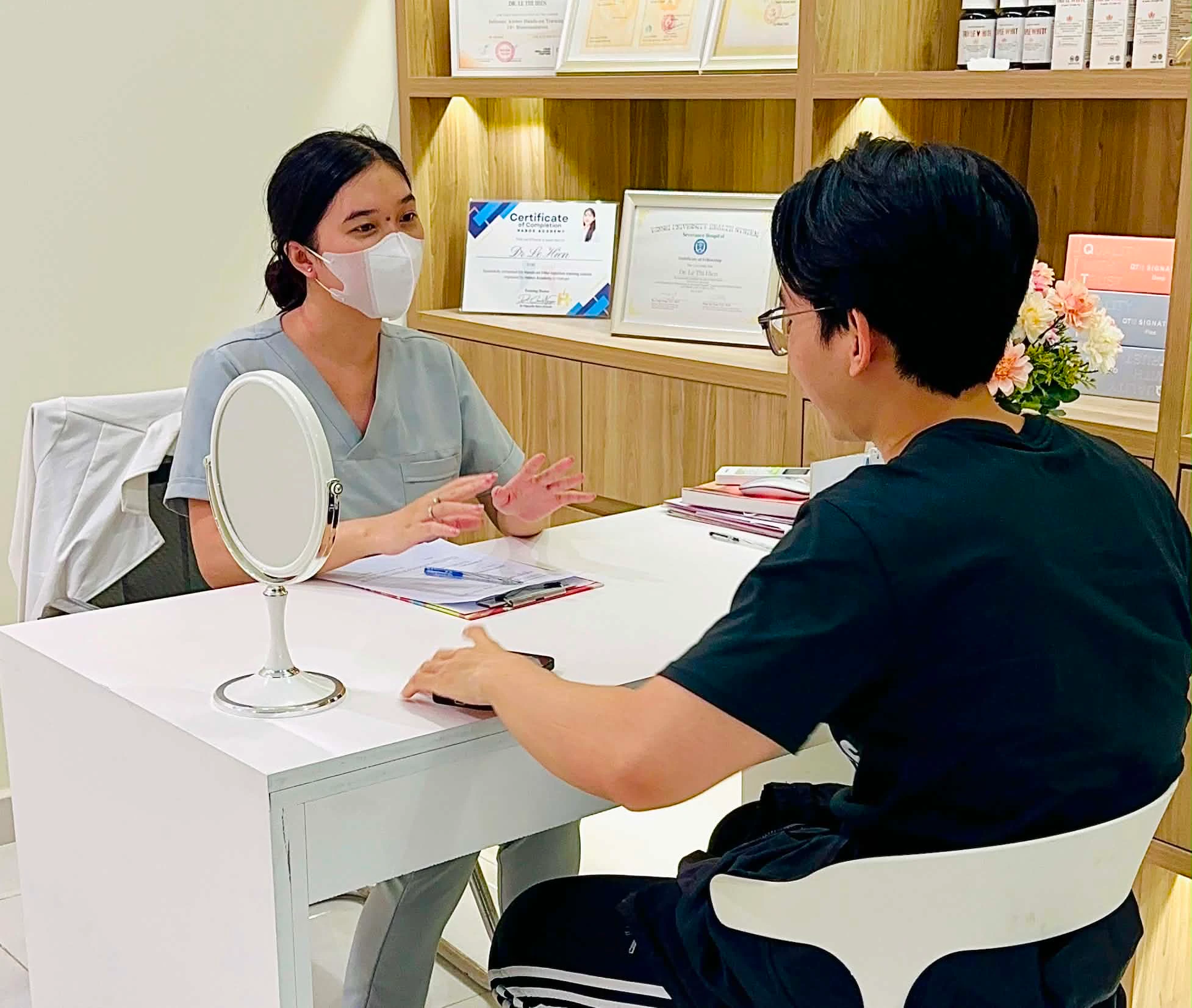
Post-acne dark marks have no one-size-fits-all formula. The severity of the marks, the pigment depth, whether acne is still active or stable, whether the skin barrier is sensitive or healthy – each factor changes the right approach.
At Eternal Beauty Center Gò Vấp, dermatologist Dr. Lê Hiền examines you directly, assesses pigment depth with a skin analysis and builds a protocol suited to each case:
A one-on-one consultation directly with the dermatologist, not through a sales consultant.
A skin analysis assessing pigment depth (epidermal or dermal) with specialised equipment.
Clearly distinguishing marks – scars – active acne to set the right order of treatment.
A gentle-to-strong protocol suited to Vietnamese skin's higher PIH risk.
A transparent quote after the consultation, with no unexpected extra costs.
A personalised at-home skincare routine for each stage of the course.
Contact Eternal Beauty Center Gò Vấp:
Address: 204 Street 1, Ward 16, Gò Vấp District, Ho Chi Minh City (convenient for clients in Phú Nhuận, Tân Bình, Bình Thạnh and District 12)
Hotline / Zalo: 0334 713 610
Opening hours: 10:00 – 20:00 daily
Website: www.eternalbeauty.vn
This article was produced with professional input from Dr. Lê Hiền, Dermatologist — Eternal Beauty Center Gò Vấp.
The information shared by Eternal Beauty Center is for reference and lookup purposes and does not replace medical diagnosis or treatment. Treatment results depend on each individual's constitution and how their body responds. Clients should book a consultation for advice on a suitable method from the doctor.