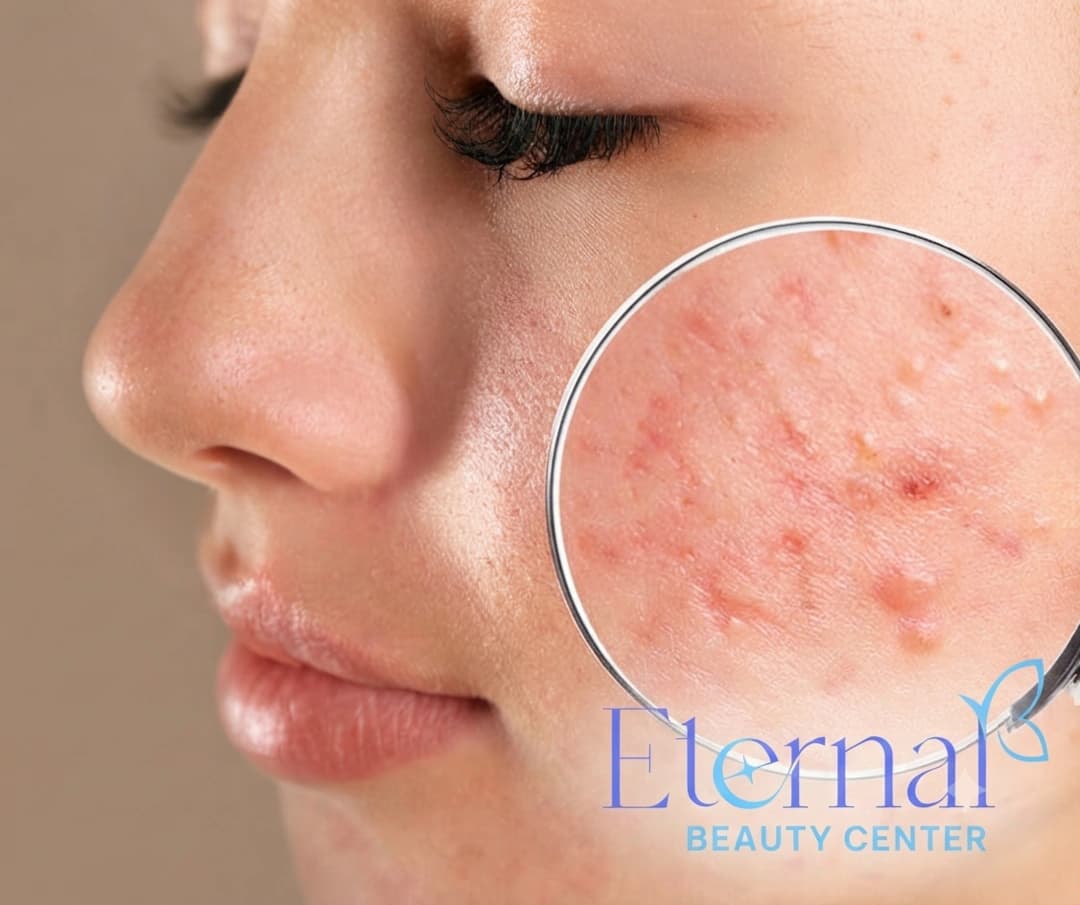
Atrophic acne scars are not a single, uniform type of damage. On the same face, a person may simultaneously have a few small ice pick scars scattered across both cheeks, one or two deep boxcar scars around the chin, and gently undulating depressions running along the cheekbones. Each type forms through its own mechanism – and responds to different treatment methods.
This is why messaging like "erase acne scars in X sessions" or "a complete solution for every type of scar" often fails to reflect clinical reality. A fixed protocol applied to every skin type may work for some scars while leaving many others inadequately treated. It is also why many clients have invested repeatedly yet seen less improvement than they hoped.
This article is based on the classic classification of atrophic acne scars in the dermatological literature, with clinical analysis from Dermatologist Dr. Le Hien – founder and clinical director of Eternal Beauty Center. Dr. Le Hien graduated from the Vietnam Military Medical University in Hanoi, specialising in Dermatology and Medical Aesthetics.
Where acne scars form – and why classification matters
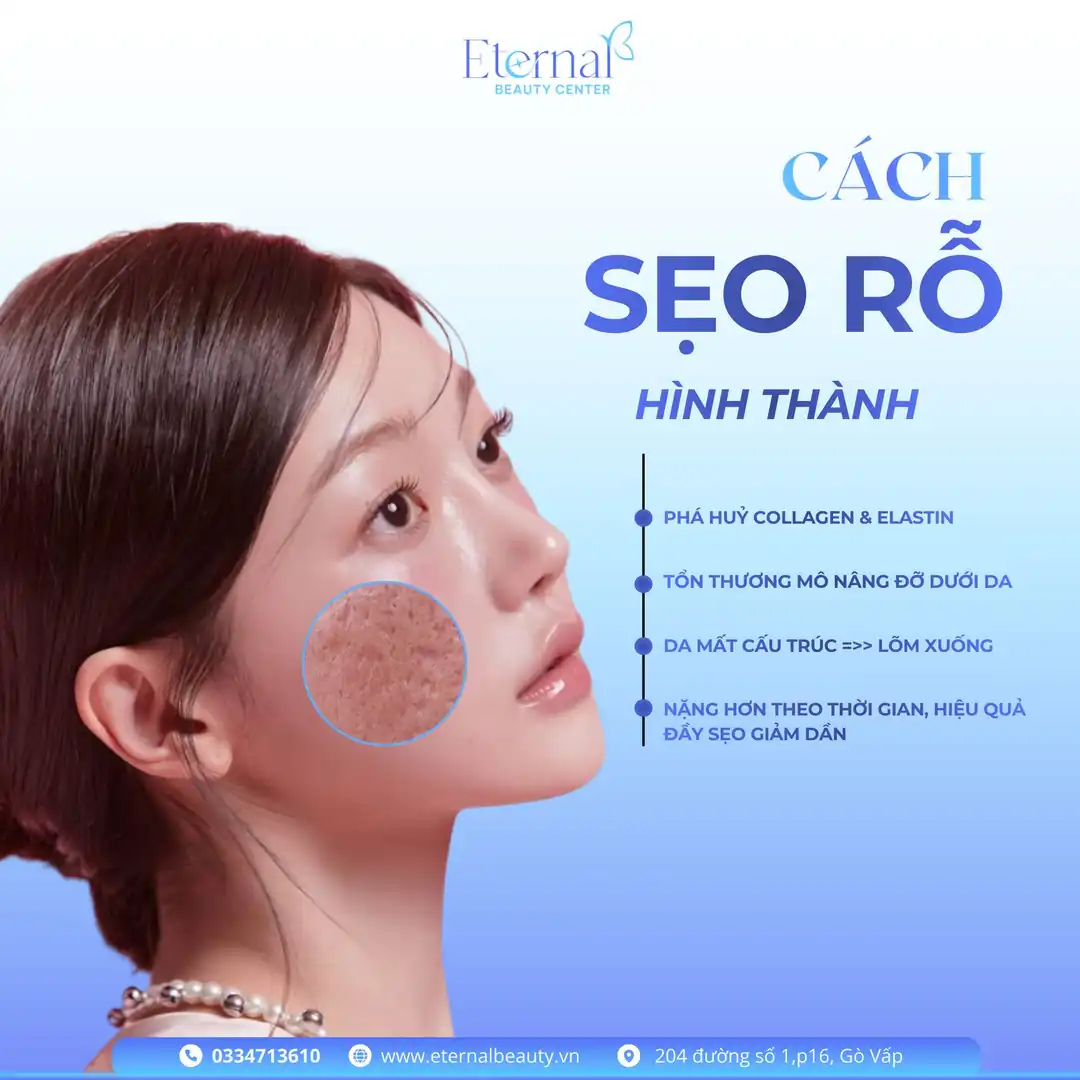
Atrophic acne scars are the consequence of prolonged or mismanaged acne inflammation, leading to a loss of supporting tissue in the dermis – the deep layer of skin that contains collagen, elastin and the structural support network. When collagen and elastin are destroyed in the inflamed area, the skin loses its support and collapses inward, forming depressions.
The key point: the damage lies in the dermis, not on the skin's surface. This is why topical products are almost never able to "fill in" atrophic scars – they cannot reach the layer where the damage actually occurred.
But even within the dermis, each type of scar has a different geometry and depth – which is exactly why classification must come before treatment.
The three common types of atrophic acne scars
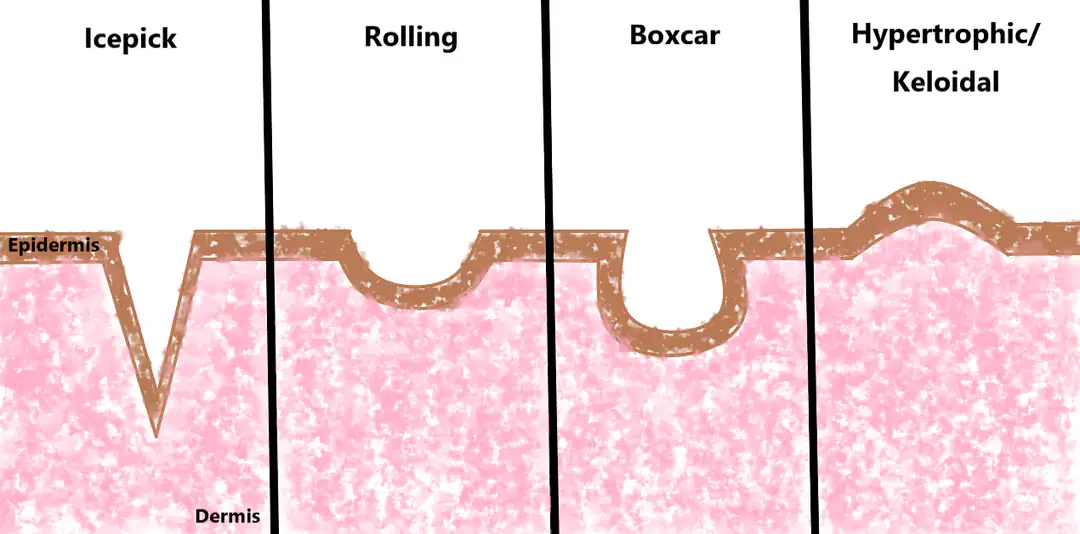
In the dermatological literature, atrophic scars are divided into three main forms according to the shape of the opening and the base of the scar. This classification is the foundation of every modern scar treatment protocol.
1. Ice pick scars
Morphology:
Narrow opening, usually under 2mm
A sharp base that is deep and tapers downward
Extends deep into the dermis, sometimes reaching the subcutaneous layer
Looks like skin punctured by a sharp point (hence the name)
Common locations: Both cheeks, especially areas with highly active sebaceous glands.
Why this is the hardest type to treat: Because the base sits deep and the opening is very narrow, most surface-acting methods (ablative laser over the whole area, full-area peels, standard microneedling) only reach the epidermis and the superficial dermis – not enough to affect the base of the scar. Ice pick scars require point-focused methods that go directly into the base to stimulate localised collagen regeneration.
Suitable methods at Eternal:
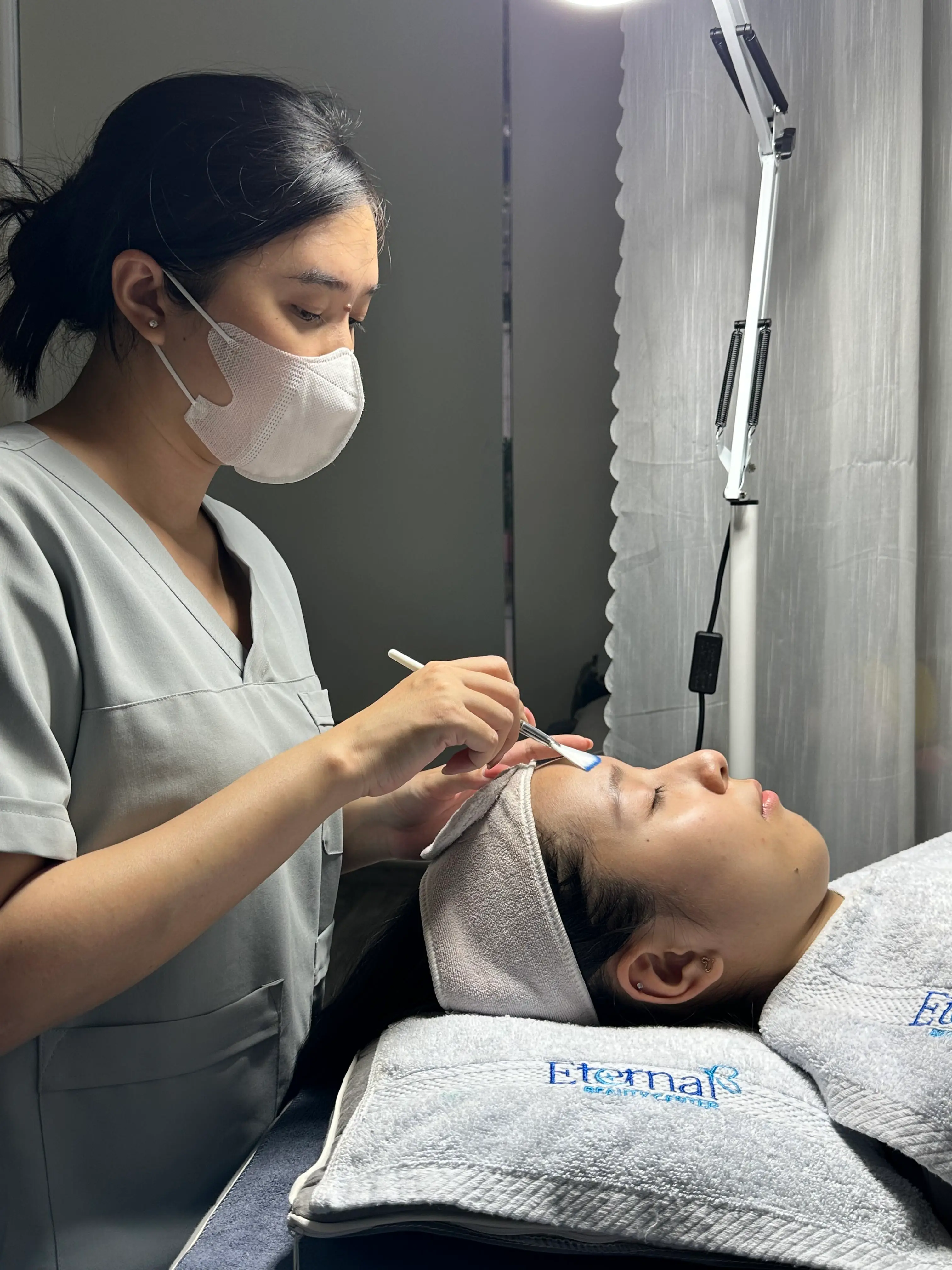
TCA Cross (Chemical Reconstruction of Skin Scars) – applying high-concentration TCA solution directly into the base of the scar to trigger a controlled reaction and stimulate collagen production exactly where filling is needed. This is one of the techniques Dr. Le Hien commonly uses for ice pick scars at the clinic
Punch excision – removing the scar with a specialised tool, used for large, deep scars (rarely used for clients with many scars)
2. Boxcar scars
Morphology:
Wide opening with a clear border against the surrounding skin
A flat base with vertical walls forming a U shape
Can be shallow (0.1–0.5mm) or deep (>0.5mm)
Accounts for roughly 20–30% of atrophic scar cases
Common locations: The cheeks and temples.
Treatment characteristics: Because the opening is wide and the base is flat, boxcar scars respond to methods that act over an area rather than a single point. However, the result depends on depth:
Shallow boxcar – responds well to microneedling, Scar Peel and ablative laser
Deep boxcar – needs Subcision to release the walls, or methods that act more deeply into the dermis
Clinical note: The sharp walls of a boxcar scar are what make it look "defined" under light – softening these edges is one of the main treatment goals. Dr. Le Hien often combines full-area Microneedling with point TCA Cross for boxcars that remain deep, improving texture and depth at the same time.
3. Rolling scars
Morphology:
Wide opening, usually over 4–5mm
An undulating base with no sharp border
Surrounding skin tends to "ripple" when stretched
A type of scar that can look "mild" but is in fact very hard to treat
A distinctive formation mechanism: Unlike the two types above, rolling scars are not just ordinary depressions. The base of the scar is tethered down to the underlying tissue by fibrous bands (the subcutaneous layer or the muscular fascia). These fibrous bands create the characteristic "wavy" appearance and make rolling scars very difficult to improve with surface-acting methods.
Why laser or peels alone are usually not enough: These methods act on the surface and the superficial dermis but do not address the fibrous bands deeper down. The skin may look smoother temporarily, but the scar returns because the underlying tethering force is still there.
Suitable methods at Eternal:
Subcision (subcision / fibrous band release) – the core technique: a specialised needle is passed beneath the base of the scar to cut the fibrous bands, releasing the base and allowing it to lift naturally. It simultaneously creates a sterile inflammatory response that stimulates new collagen production. At Eternal, Subcision is performed directly by Dr. Le Hien
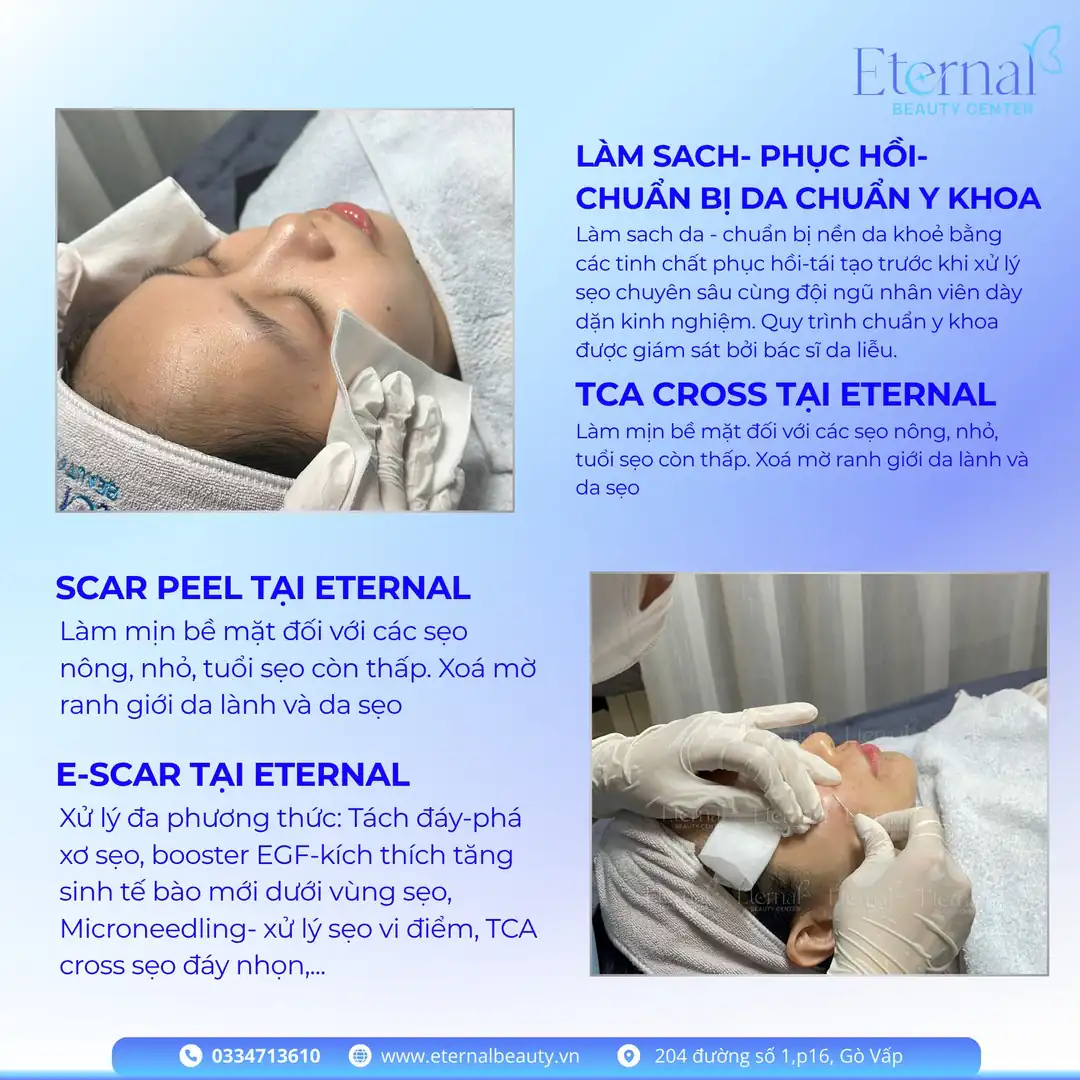
In many cases, Subcision is combined with an EGF Booster to stimulate cell proliferation and Microneedling to refine surface texture – a combination Eternal calls the E-Scar protocol
Most clients have several scar types at once
This is the point most easily overlooked in scar treatment. In reality, it is rare for a client to have only one type of scar. Within a single cheek area you may see:
A few small scattered ice pick scars
One or two deep boxcars on the side of the cheek
Several undulating rolling scars on the upper cheek
When all of these scar types appear at once, no single method can address them all. This is why, in modern aesthetic dermatology, scar treatment always follows a multi-modal approach – combining several techniques in one protocol, each treating the scar type it works best on.
A typical E-Scar protocol at Eternal Beauty Center may include:
Subcision for areas with many rolling scars
Point TCA Cross for the remaining ice pick scars
Microneedling over the whole area to refine texture
EGF Booster to stimulate cell proliferation beneath the scarred area
Recovery and soothing steps after the procedure
This approach is called multi-modal because each "layer" of damage is treated with the right tool – instead of applying one technique to everything and hoping for overall improvement.
Choosing where to treat acne scars – criteria worth considering
The aesthetics market in Ho Chi Minh City now has many spas, aesthetic centres and clinics offering acne scar treatment with uneven quality. When weighing your options, there are several medically relevant criteria to consider:
Who performs the examination – atrophic scars are a dermatological issue, not an ordinary beauty service. The examination and protocol design should be carried out by a dermatology specialist, not a sales consultant or technician
Is there a specific scar classification – if you are recommended the same protocol without any distinction between scar types, that is a sign the approach is not yet personalised
Does the protocol combine multiple techniques – as analysed above, most clients have several scar types at once and need a multi-modal approach
Is the cost stated before treatment – transparent pricing from the examination onward is important to avoid unexpected charges
Is there a no-upsell commitment – a serious clinic only recommends what is truly necessary for your current skin condition
These are the criteria Eternal Beauty Center has set since its founding, under the clinical direction of Dermatologist Dr. Le Hien. Every client who comes for acne scar treatment is examined 1:1 directly by the doctor, with skin analysis using specialised devices, classification of each individual scar, and a protocol built for their specific skin.
Why scar classification should be done by a dermatologist
Classifying atrophic scars may sound simple from a photo, but in clinical practice there are many factors that cannot be recognised by the naked eye:
The true depth of the scar – can only be assessed under specialised lighting and by evaluating the skin's elasticity
The degree of fibrosis at the scar base – long-standing scars often have thick fibrous tissue, respond more slowly and require a different technique
The condition of the surrounding skin – skin with a weak protective barrier, active inflammation or sensitivity needs baseline treatment before any scar intervention
The risk of post-inflammatory hyperpigmentation – especially important for Asian skin (Fitzpatrick types III–V), where the risk of darkening after a procedure is considerably higher than for fair skin. This is a factor Dr. Le Hien always weighs carefully during the examination with clients at Eternal
This is why the first examination with a dermatologist matters more than any single treatment course. Correct classification from the start saves time and cost and – most importantly – avoids treating in the wrong direction and causing further skin damage.
When is the right time to start treating acne scars
A common belief is "the sooner the better", but this is not entirely accurate. According to dermatological principles, atrophic scars should only be treated when:
Inflammatory acne is under control – with no active inflammation remaining. Treating scars while inflammatory acne is still present can increase the inflammatory response and create new scars during the treatment itself
The skin's protective barrier is healthy enough – the skin is not irritated or flaking
The skincare routine is stable – to reduce the risk of irritation during and after the procedure
If a client still has active inflammatory acne, Eternal prioritises controlling the acne first with the Manual Acne Extraction service and a suitable skincare protocol, then moves on to the scar treatment phase. This sequential approach avoids the situation of treating old scars while creating new ones.
Conversely, leaving scars too long is not beneficial either: the fibrous tissue at the base thickens over time, and the response to filling methods gradually decreases. The "ideal" window is when acne has stabilised but the scar has not fully fibrosed – and this timing needs to be assessed directly by a doctor.
The next step: examination and accurate classification

Understanding that atrophic scars come in three types with three different approaches is the first step. The second – and more important – step is knowing which type of scar you have and to what degree, in order to build the right protocol.
At Eternal Beauty Center Go Vap, every client seeking acne scar treatment starts with a 1:1 examination directly with Dermatologist Dr. Le Hien. During the examination, the doctor will:
Analyse the skin and classify each specific scar type (ice pick / boxcar / rolling) across the treatment area
Assess the depth, degree of fibrosis and expected response of each type
Evaluate the baseline skin condition, the risk of darkening and the factors to prepare before the procedure
Recommend a personalised protocol combining the appropriate techniques (TCA Cross, Subcision, Microneedling, Scar Peel or the multi-modal E-Scar protocol)
Provide a detailed, transparent quote after the examination, with no unexpected charges
See more details on the medical acne scar treatment service page.
Eternal Beauty Center Go Vap contact information:
Address: 204 Street No. 1, Ward 16, Go Vap District, Ho Chi Minh City (near Wards 12, 14, 17; convenient for clients from Phu Nhuan, Tan Binh, Binh Thanh and District 12)
Hotline / Zalo: 0334 713 610
Opening hours: 10:00 – 20:00 daily
Website: www.eternalbeauty.vn
This article was produced with professional consultation from Dermatologist Dr. Le Hien – Eternal Beauty Center Go Vap.
The information shared by Eternal Beauty Center is intended for reference only and does not replace medical diagnosis or treatment. Results depend on each individual's condition and response. Clients should book an examination for personalised advice from a doctor.