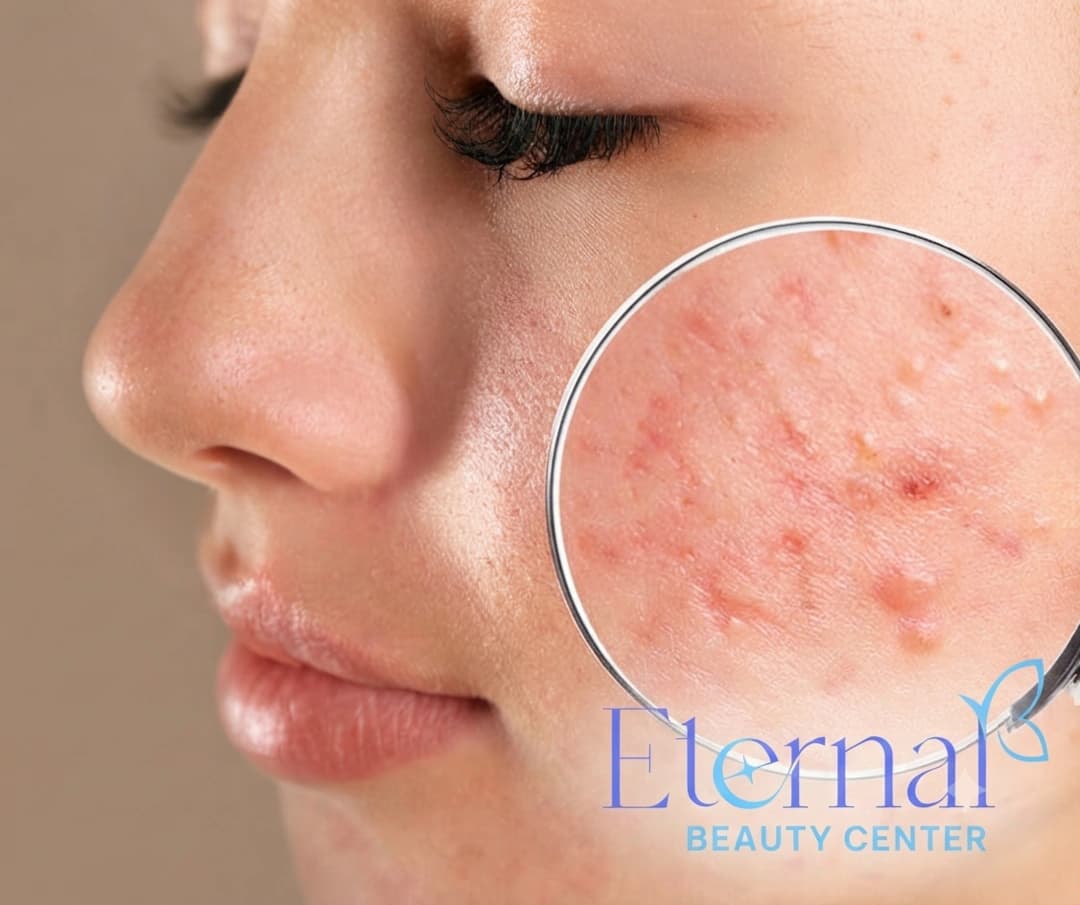
A skincare active is an ingredient with scientific evidence that it acts directly on a skin concern — acne, pigmentation, ageing — rather than simply moisturising the surface. The six "backbone" actives worth knowing are BHA, AHA, retinol, vitamin C, niacinamide and azelaic acid. The rules for combining them fit in one line: niacinamide pairs with almost everything; use vitamin C in the morning; use retinol at night; never layer retinol with AHA/BHA or benzoyl peroxide in the same application; and always wear sunscreen. This guide explains each active and includes a combination chart showing which pairs you can layer, which to split between morning and night, and which to avoid.
Written by the dermatology team at Eternal Beauty Center (Go Vap, Ho Chi Minh City), drawing on the American Academy of Dermatology (AAD), Cleveland Clinic, DermNet and reviews on NCBI/PubMed.
What are skincare actives, and why using them right matters
An active is an ingredient that produces a measurable biological change in the skin, as opposed to "base" ingredients that only soften, hydrate or give a product its texture. When a serum says "10% niacinamide" or "0.5% retinol," that number is the active — the part that actually treats acne, brightens or fights ageing; the rest is solvent and delivery system.
Here is the point most people miss: more actives does not mean better skin. Your skin has a protective barrier of lipids and skin cells; pile on too many strong actives at once and that barrier erodes, leading to redness, stinging, flaking and — paradoxically — more breakouts. Most "skincare ruined my skin" stories come not from a lack of actives but from the wrong dose, the wrong timing and the wrong combinations.
That is why understanding each active's mechanism, concentration and how it pairs matters far more than owning a lot of products. It is also why a well-built 4–5 step routine usually outperforms a chaotic 10-step one.
The 6 most important actives (and who they're for)
These are the six most-researched actives, found in almost every evidence-based routine. For each: how it works – reference concentration – who it's for.
BHA (salicylic acid) — for oily skin, pores and acne
BHA (beta hydroxy acid, most commonly salicylic acid) is oil-soluble, so it can get inside pores to clear sebum and dead cells — the core difference from AHA. That makes it especially effective for oily skin, blackheads, congestion and enlarged pores. BHA is also mildly anti-inflammatory and antibacterial.
Reference concentration: 0.5–2% (over-the-counter).
Who it's for: oily and combination skin, acne-prone skin. Dry/sensitive skin should use it sparingly (1–2× per week).
Note: salicylic acid is chemically related to aspirin; approach with caution if you're aspirin-sensitive. AHAs and BHAs are the two main chemical exfoliants — the same family as peel agents; see What is a chemical peel to understand how a clinical peel differs from at-home exfoliation.
AHA (glycolic, lactic, mandelic) — for texture and surface pigmentation
AHA (alpha hydroxy acid) is water-soluble and works on the skin's surface, loosening dead cells to improve texture, fine lines and surface pigmentation. The three common types differ by molecule size:
Glycolic acid — the smallest molecule, the deepest-penetrating and strongest, but also the most likely to irritate.
Lactic acid — gentler, with added hydration; suits normal to slightly dry skin.
Mandelic acid — the largest molecule and the gentlest; good for sensitive and deeper skin tones (lower risk of post-inflammatory hyperpigmentation).
In general, AHAs suit dry, ageing and dull skin; BHA is better for oily, acne-prone skin. Compared with BHA, AHAs (especially glycolic) carry a higher irritation risk for some people.
Reference concentration: 5–10% at home (glycolic/lactic); mandelic 5–10%.
Who it's for: dry, dull, sun-damaged skin and uneven texture.
Retinol / retinoid — the "gold standard" for ageing, acne and pigmentation
Retinoids (vitamin A derivatives, from over-the-counter retinol to prescription tretinoin) speed up cell turnover and stimulate collagen — widely considered the best-evidenced anti-ageing active (per the AAD). Retinoids also treat acne (by keeping pores clear) and fade pigmentation.
Because they're powerful, retinoids must be introduced correctly — a process called retinization:
Start low and slow: a low concentration (e.g. 0.25%), twice a week for the first 1–2 weeks, then build up to alternate nights and nightly as tolerated.
Night use only: retinoids are light-sensitive.
The "sandwich" method: apply moisturiser before and after retinol to buffer the skin.
A 4–6 week adjustment phase: expect possible dryness, light flaking or "purging" — learn to distinguish this from true irritation (burning, lasting redness/swelling).
Daytime sunscreen is mandatory, because retinoids make skin more sun-sensitive.
Contraindication: retinoids are not used during pregnancy (oral or topical). If breastfeeding, consult your doctor; see Postpartum melasma: which actives are safe while breastfeeding.
Who it's for: most people wanting anti-ageing, stubborn-acne control or pigment fading — except during pregnancy or when the barrier is already compromised.
Vitamin C — antioxidant protection and brightening
Vitamin C (in its purest form, L-ascorbic acid) is a potent antioxidant that neutralises free radicals generated after UV and pollution exposure, and it is a required co-factor for collagen synthesis (per an NCBI/PMC review). Vitamin C also inhibits tyrosinase — the rate-limiting enzyme for melanin — so it brightens and fades pigmentation.
Two things determine how well vitamin C works:
pH: L-ascorbic acid only penetrates well when the formula's pH is below 4. That's why vitamin C is itself an acid and can clash on pH with a few other actives.
Stability: L-ascorbic acid is easily oxidised by light, heat and air (a serum that has turned brown is spent). Combining vitamin C + vitamin E + ferulic acid stabilises the formula and boosts photoprotection — studies show vitamin C alone offers only minimal protection, with the clearest benefit coming from multi-ingredient formulas.
Reference concentration: 10–20% (L-ascorbic acid).
Timing: preferably morning, applied before sunscreen to add a layer of antioxidant defence (but it does not replace sunscreen).
Who it's for: most people wanting brighter, more even-toned skin and anti-ageing support.
Niacinamide — the multitasker: barrier, oil and calming
Niacinamide (vitamin B3) is the most "easy-going" active: at around 5% it has been shown to reduce oil, refine pores, brighten (by reducing pigment transfer to the surface) and boost ceramide production to repair the barrier. It is very well tolerated and pairs with nearly every other active — often used to "buffer" retinol or acids and reduce their irritation.
Reference concentration: 2–5% for most skin (effective with low irritation risk); some formulas go to 10%.
Who it's for: almost everyone — oily, acne-prone, sensitive or barrier-compromised skin, and anyone using retinol/acids.
Note: it's the ideal starter active because it's so safe.
Azelaic acid — for acne, redness and pigmentation, yet gentle
Azelaic acid is a rare "three-in-one": antibacterial (it inhibits the acne bacterium C. acnes), pore-clearing and anti-inflammatory, while also inhibiting tyrosinase to fade pigmentation (per DermNet). Thanks to its anti-inflammatory action, it handles both inflammatory acne and red/sensitive skin — situations where many other acids make things worse.
Reference concentration: 15% (gel, often for rosacea/redness) to 20% (cream, for acne); cosmetic products are often around 10%.
Treats: mild-to-moderate acne, redness (papulopustular rosacea), melasma and post-acne marks. DermNet notes azelaic acid is "similarly effective" to tretinoin for acne, with results typically after 4–6 weeks.
Who it's for: sensitive skin, skin dealing with both acne and pigmentation, and it's often a preferred option in pregnancy/breastfeeding (low systemic absorption) — but always check with your doctor.
For melasma and dark marks, azelaic acid is usually paired with vitamin C and niacinamide; read the deep dive at Actives for melasma.
The combination chart: what to layer, what to split, what to avoid
The general principle: one or two "strong" actives per session is plenty. Niacinamide and azelaic acid are gentle and pair with most things; retinol and the exfoliating acids (AHA/BHA) are the most conflict-prone when used together. The chart below summarises safe pairings.
| Active pair | Level | How to use it correctly |
|---|---|---|
| Niacinamide + (any active) | ✅ Layer | Apply niacinamide first to calm; buffers retinol/acids |
| Vitamin C + niacinamide | ✅ Layer | Fine together in the morning — the "they cancel out" myth is debunked (below) |
| Vitamin C + sunscreen | ✅ Highly recommended | AM: vitamin C → let dry → sunscreen (adds protection, does not replace SPF) |
| Vitamin C + azelaic acid | ✅ Layer | Together in the morning, complementary brightening |
| Retinol + niacinamide | ✅ Layer | Niacinamide reduces irritation and repairs the barrier |
| Retinol + azelaic acid | ✅ Layer | Azelaic is gentle and supports acne/pigment care alongside retinol |
| Retinol + vitamin C | ⚠️ Split | Vitamin C in the morning — retinol at night |
| Retinol + AHA/BHA | ⚠️ Split / alternate | Not in the same application; alternate nights (e.g. acid night / retinol night) |
| AHA + BHA (high strength, together) | ⚠️ Caution | Beginners shouldn't stack them; limit to 1–3× per week and watch for irritation |
| Vitamin C + AHA/BHA | ⚠️ Split | Both are acidic → higher irritation risk and pH conflict |
| Retinol + benzoyl peroxide | ❌ Not together | Benzoyl peroxide can degrade retinoids + cause strong irritation; keep them fully separate AM/PM |
| AHA/BHA + benzoyl peroxide | ❌ Not together | Exfoliation overload, easily damages the barrier |
Legend: ✅ can be layered · ⚠️ split between AM/PM or alternate · ❌ avoid in the same application.
Clearing up 2 common myths
1. "Niacinamide cancels out vitamin C" — this is an outdated myth. The worry traces to 1960s data: mixing pure niacinamide with acidic vitamin C at very high temperature and concentration produced nicotinic acid, causing transient flushing. Those conditions don't occur in modern cosmetics (moderate concentrations, room temperature). Recent research — including a 2023 study in the Journal of Cosmetic Dermatology — found that using the two together actually improved brightness and texture more than either alone. Bottom line: they can be used together.
2. "Retinol and acids must never meet" — not quite. The issue isn't that they "chemically neutralise" each other; it's that both accelerate cell turnover, so layering them in one application easily causes dryness, flaking and irritation (per Dr Rebecca Marcus, FAAD). The fix is to separate the timing: acid in the morning / retinol at night, or alternate nights. Benzoyl peroxide is a different case — it can actually degrade many retinoids, so those two need to be kept fully apart (e.g. benzoyl peroxide in the morning, retinoid at night).
The golden rules of combining actives
These five rules matter more than which brand you use — they decide whether your actives work or backfire.
Apply thin to thick, and lower pH first. After cleansing: light water-based serums first (like low-pH vitamin C), then thicker creams, then moisturiser and — in the morning — sunscreen.
Split actives between morning and night. Mornings are for protection (antioxidant vitamin C + sunscreen). Nights are for renewal (retinol or acids). This both avoids conflicts and uses the skin's natural timing.
Low and slow — add only one new active at a time. Start 2–3× per week and build up. Introducing several actives at once means you won't know which one caused a problem.
Patch test and "listen" to your skin. Test on a small area (along the jaw) first. Learn to tell the adjustment phase (dryness, light flaking, temporary purging) from true irritation (burning, swelling, lasting redness) — the latter is a signal to reduce frequency or stop.
Sunscreen is a mandatory "active." Retinol, AHA/BHA and vitamin C all make skin more sun-sensitive or are undone by sun exposure. Without sunscreen, almost every other active loses its point. See How to use sunscreen correctly.
3 mistakes that make actives backfire
Most active-related trouble comes from three avoidable mistakes.
Over-exfoliation. Using AHA/BHA daily, plus retinol, plus a cleansing brush… erodes the barrier: a "fake" shine, tightness, stinging on contact with water, and inflammatory breakouts. The fix: cut exfoliation back to 1–3× per week and focus on repair (niacinamide, ceramides, moisturiser).
Mixing everything at once. Stacking 4–5 strong actives in one session doesn't work faster; it only raises the irritation risk and makes troubleshooting impossible.
Skipping sunscreen. The costliest mistake: it darkens pigmentation and marks while cancelling out your vitamin C, retinol and brightening actives.
A minimalist actives routine (AM / PM)
An effective routine doesn't need many steps — it just needs the right active in the right session. Here's a template; adjust it to your skin type and start at the "beginner" level.
| Morning (protect) | Night (renew) | |
|---|---|---|
| Beginner | Cleanser → niacinamide → moisturiser → sunscreen | Cleanser → moisturiser (add BHA or low-strength retinol 2–3 nights/week) |
| Advanced | Cleanser → vitamin C → niacinamide → moisturiser → sunscreen | Cleanser → alternate [retinol] and [AHA/BHA] → moisturiser (sandwich); azelaic on off-nights |
A safety tip: don't start vitamin C, retinol and acids in the same week. Add them one at a time, 2–3 weeks apart, so both your skin and you can assess.
When to see a dermatologist

At-home actives are limited in concentration and depth; when a problem is stubborn or you need faster results, in-clinic treatments are stronger and more controlled. Some cues to see a professional:
Persistent inflammatory acne or cystic acne that doesn't improve after 8–12 weeks of correct actives → consider a deeper protocol such as E-Acne – medical acne treatment or Acne Peel. For background, read What is acne.
Stubborn melasma, dullness or dark marks → at-home actives (vitamin C, niacinamide, azelaic) are first-line, but a targeted peel and protocols like E-Mela or Mela Peel go deeper. See Melasma: causes and treatment and Post-acne dark marks.
You want a safe professional peel instead of a DIY peel at home (risk of burns and hyperpigmentation) → learn about What is a chemical peel and services like Eternal Peel and Aquapeel.
At the clinic, a doctor will assess your skin under magnification, identify your true skin type and condition, and design a suitable actives routine — sparing you the "buy-by-review, then wreck the barrier" cycle.
Frequently asked questions
What are skincare actives? Actives are ingredients with scientific evidence that they act directly on a skin concern — acne, pigmentation or ageing — as opposed to base ingredients that only hydrate or give texture. The six most common are BHA, AHA, retinol, vitamin C, niacinamide and azelaic acid.
Which active should a beginner start with? Niacinamide is the safest starting point because it's very gentle and suits every skin type. Once your skin is comfortable, add one "hero" active for your goal: BHA for oily/acne-prone skin, vitamin C to brighten, or low-strength retinol for anti-ageing — one at a time.
Can I use several actives at once? Yes, but limit yourself to one or two "strong" actives per session and split them between morning and night. Niacinamide and azelaic acid are gentle and pair with most things; retinol and exfoliating acids (AHA/BHA) are the most likely to conflict if layered in the same application.
Does niacinamide really "cancel out" vitamin C? No. That's an outdated myth from 1960s data based on extreme temperature and concentration not found in modern cosmetics. Recent research shows they're safe together and can even improve brightness and texture more than using either alone.
Can I use BHA/AHA together with retinol? Yes, if you separate the timing rather than applying them at once. Because both accelerate cell turnover, layering them causes dryness and irritation. The safe approach is acid in the morning and retinol at night, or alternating nights — while starting slowly and wearing sunscreen daily.
Should vitamin C be used in the morning or at night? Preferably in the morning, before sunscreen, because vitamin C is an antioxidant that reinforces daytime protection against UV and pollution — though it complements rather than replaces sunscreen. Night use still works if it fits your routine better.
Which actives are safe in pregnancy or while breastfeeding? Retinoids (retinol, tretinoin) are contraindicated in pregnancy. Azelaic acid, niacinamide and vitamin C are generally considered safer, but you should check with your doctor first. For the postpartum stage specifically, see the postpartum melasma article.
How long until I see results? It depends on the active and the concern. Hydration and calming can show within days to weeks; azelaic acid usually needs 4–6 weeks; retinol and pigment fading typically need 8–12 weeks or more of consistent use. Consistency and sunscreen matter more than constantly switching products.
Quick summary
Actives = evidence-based ingredients that change the skin; the six backbones are BHA, AHA, retinol, vitamin C, niacinamide and azelaic acid.
BHA for oily/acne skin (oil-soluble, into pores); AHA for dry/dull skin (water-soluble, surface).
Retinol is the anti-ageing gold standard — use at night, low and slow, never in pregnancy.
Vitamin C in the morning before sunscreen; niacinamide is a multitasker that pairs with all; azelaic is gentle and treats both acne and pigment.
Combining: niacinamide/azelaic pair with most; split vitamin C (AM) and retinol (PM); never layer retinol with AHA/BHA or benzoyl peroxide at once.
Niacinamide does not cancel vitamin C — that's an outdated myth.
Sunscreen is the non-negotiable that lets every other active work.
Book a skin analysis & actives consultation at Eternal Beauty Center
Not sure which active to start with, or is your current routine irritating your skin? The dermatology team at Eternal Beauty Center will assess your skin, identify your type and condition, and recommend a suitable actives routine — plus an in-clinic protocol when needed, with an honest forecast of results.
Hotline / Zalo: 0334 713 610
Address: 204 Đường Số 1, Phường 16, Gò Vấp, Ho Chi Minh City
Opening hours: 10:00 – 20:00 daily
Explore services: E-Acne – acne treatment · E-Mela – melasma treatment · What is a chemical peel
This article is for information only and does not replace diagnosis or treatment by a doctor. Every skin type has different characteristics and tolerance; consult a dermatologist before starting or combining strong actives, especially during pregnancy or breastfeeding.
References
American Academy of Dermatology (AAD) — Retinoids, acne treatment and sunscreen guidance (aad.org)
Cleveland Clinic — Skin care ingredients & how to layer actives (health.clevelandclinic.org)
DermNet — Azelaic acid; Topical retinoid; Alpha hydroxy acids (dermnetnz.org)
NCBI / PMC — "The Roles of Vitamin C in Skin Health" (PMC5579659)
Journal of Cosmetic Dermatology (2023) — Study combining niacinamide and vitamin C