El Niño does not make individual UV rays any stronger. The UV index depends on how high the sun is, on cloud and on the ozone layer, not on air temperature. What El Niño 2026–2027 brings to southern Vietnam is a dry season forecast to run 1–2°C hotter than average, with less rain and heat arriving as early as February: more clear days on which UV reaches the skin, plus heat and sweat, which do their own damage. Preparing the skin therefore comes down to three things: watch the UV index rather than the thermometer, keep sunscreen from being sweated away, and limit heat if your skin is prone to melasma or redness.
El Niño 2026–2027: what is forecast for southern Vietnam
El Niño is an unusual warming of the sea surface across the central and eastern equatorial Pacific, which shifts wind and rainfall patterns over a wide area. In its bulletin of 8 October 2026, the US Climate Prediction Center (NOAA CPC) described the current event as strong to very strong, likely to last through January–March 2027, with a high chance of becoming the strongest since records began in 1950. The World Meteorological Organization (WMO) expects it to persist at least into early 2027, while noting that the strength of an El Niño does not translate directly into the size of its impact in any given region.
For Vietnam, the seasonal climate bulletin issued by the National Center for Hydro-Meteorological Forecasting on 15 October 2026 forecasts temperatures in the south 1–2°C above the long-term average in December 2026 and January 2027, and 1–2°C above average nationwide from February to April 2027. Heat waves in the south-east may begin in February 2027, earlier than usual, and intensify through March and April, with rainfall below average. The southern regional forecasting station expects daytime highs of 35–38°C in March and April 2027, above 38°C in places. On 30 October 2026 the government issued Directive 39/CT-TTg on preparing for heat, drought, water shortages and saltwater intrusion caused by El Niño.
The last El Niño showed that these figures are not abstract. April 2024 was the hottest April in Vietnam since 1980: 110 of 186 weather stations broke temperature records, and the south-east recorded 28 days of heat-wave conditions, 10–17 more than average.
Hotter does not mean stronger UV
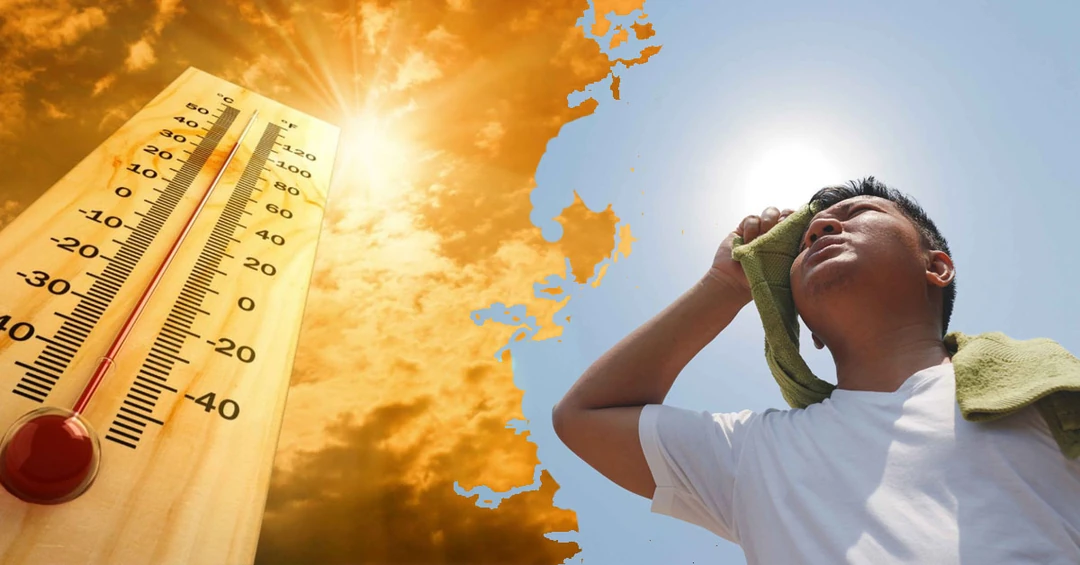
The burning feeling of standing in the sun comes from infrared radiation. UV, the part that causes sunburn, tanning and skin ageing, cannot be felt at all. According to the World Health Organization (WHO), UV intensity at a given place depends first on the height of the sun, then on cloud, the ozone layer, altitude and reflective surfaces. Air temperature is not on that list.
Ho Chi Minh City offers a clear example. On 26 December 2023 the temperature was only 23–29°C, a pleasant day, yet the measured UV index was 8.7–9.6, in the "very high" band. At a latitude of about 10.8° north, the midday sun passes directly overhead twice a year, around mid-April and late August, and even in December it still stands more than 55° above the horizon at noon. Sunshine in the city therefore carries high UV almost all year round, cool days included.
So what does El Niño change? Any direct effect on UV intensity is small. A study over China even found a thicker ozone layer in El Niño years, which slightly reduced clear-sky UV; the difference between El Niño and La Niña years was in the range of a few percent up to about 10%, depending on region and season. No study has measured this effect over Vietnam. The meaningful change is in cloud and rain: a rainy season that ends early and a drier dry season mean more clear days, and so more hours of skin exposed to high UV. In Thailand, which has a similar climate, ground measurements show midday UV peaking in April and May, just before the rains begin. Alongside this come heat and sweat, which do not make UV any stronger but affect the skin in their own ways.
Read the UV index, not the thermometer
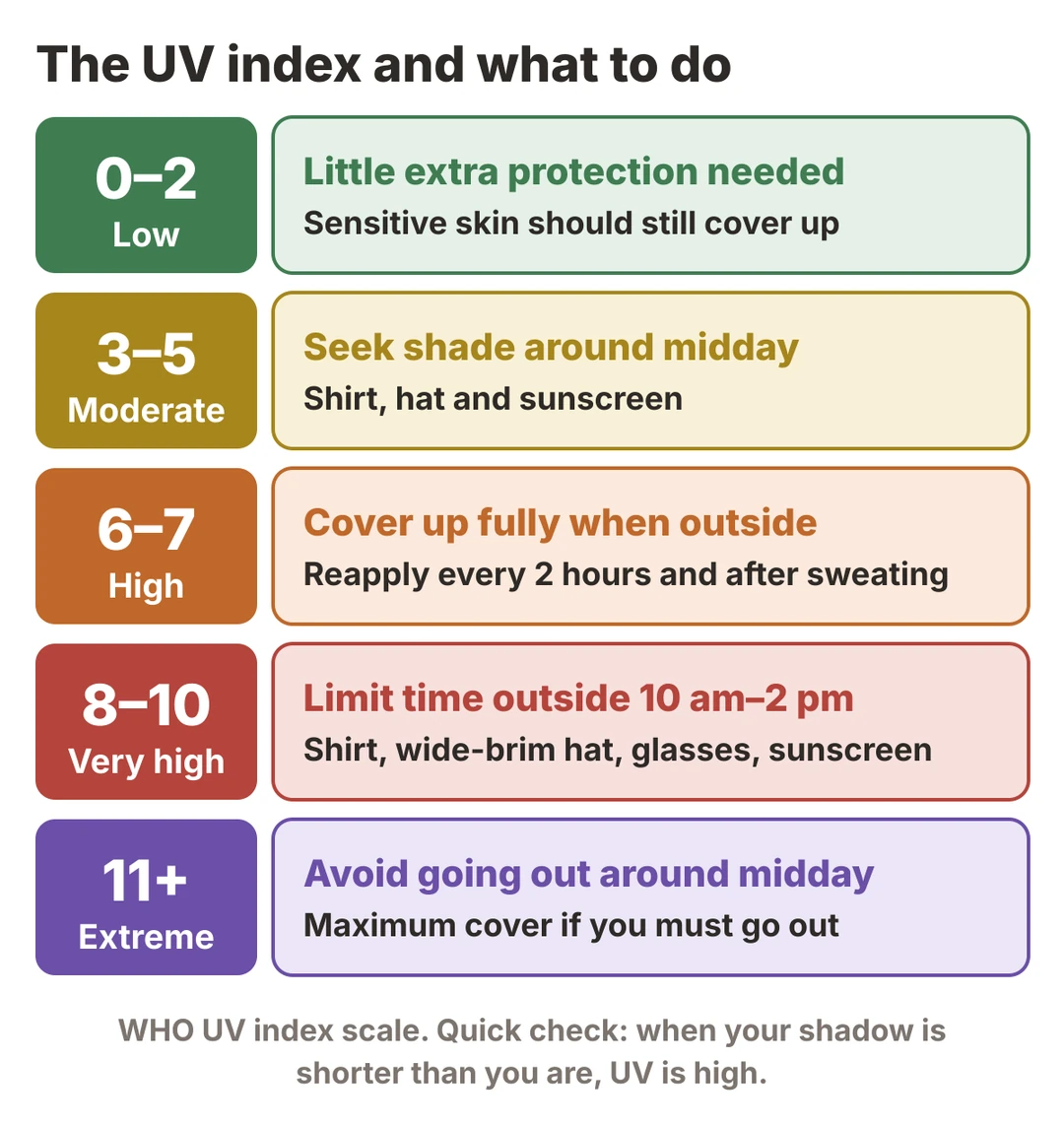
The UV index measures the strength of skin-reddening UV radiation at ground level, on a scale standardised by WHO together with WMO and partner organisations. From 3 upwards the skin needs protecting; from 8 upwards it is best to stay out of the midday sun. The scale used by Vietnam's National Center for Hydro-Meteorological Forecasting draws its bands slightly differently, with "very high" running from 7.5 to 10.4, but the meaning is the same.
A few points make the index easier to use day to day:
Timing. The day's highest UV falls in the four hours around solar noon; WHO estimates that about 60% of the day's UV arrives between 10 am and 2 pm.
The shadow rule. When your shadow is shorter than you are, the risk of sunburn is clearly higher. It is a quick check when no weather app is to hand.
Thin cloud does little. Up to 80% of UV can pass through light cloud. Shade cuts exposure by about half or more, but not to zero.
Reflective surfaces. Dry sand reflects about 15% of UV and sea foam about 25%, and half a metre under water UV is still at about 40%. Worth remembering on a beach trip over the Tết holiday.
Treat the number as a threshold for action. The national forecasting center is responsible for UV index forecasts, and most weather apps show the figure too. Satellite-derived values can differ from ground measurements, though: a study in Thailand found satellite estimates 22–50% higher than ground readings on clear days. Use the number to decide whether you need to cover up rather than as an exact value.
Four ways heat and sun act on the skin
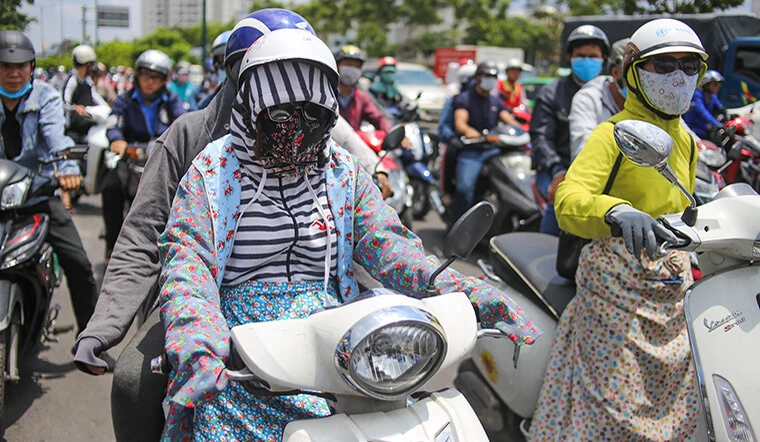
A midday motorbike ride in the dry season exposes the skin to four different stressors at once, and each needs its own form of protection.
Stressor | Main effect on skin | How to block it |
|---|---|---|
UV radiation | Sunburn, tanning, dark marks, ageing; long term, higher skin-cancer risk | Shade, clothing, broad-spectrum sunscreen |
Visible light | Long-lasting darkening in darker skin, worse melasma | Tinted sunscreen with iron oxides, covering up |
Heat | Linked to worse melasma, facial flushing, rosacea flares | Avoid heat sources, cool the skin |
Sweat and humidity | Heat rash, sunscreen washed off, friction acne | Breathable clothing, reapplying sunscreen, keeping skin dry |
UV radiation. Darker skin still burns; the American Academy of Dermatology (AAD) stresses that this applies to every skin tone, and WHO notes that people with darker skin still develop skin cancer.
Visible light. This is the part most often overlooked. In a study of 20 people with skin types IV–VI, skin exposed to visible light darkened more and stayed darker for longer than skin exposed to long-wave UVA; in fair skin (type II) this did not happen. The AAD notes that visible light worsens melasma, especially in people with darker skin. Vietnamese skin is mostly type III–IV, so this part of sunlight deserves attention.
Heat. The evidence here is more modest. A 2022 review of how melasma develops observed that no systematic study has yet examined the role of infrared radiation in melasma. What exists is mainly observational and laboratory data: a survey of 1,001 people with melasma at 10 centres in India found that longer exposure to heat, from cooking fires or hot workplaces, went with more severe melasma, and in the laboratory, skin tissue held at 41°C increased pigment production. For rosacea, heat is a clearer trigger: in a US National Rosacea Society survey of 1,066 patients, 75% named hot weather as something that made their rosacea flare. These data do not prove that heat causes melasma, but they are consistent enough that people prone to melasma should limit heat sources; our article on why melasma keeps coming back looks at triggers beyond direct sunlight in more detail.
Sweat. Miliaria rubra, the most common form of heat rash, affects up to 30% of adults who move to the tropics or are suddenly exposed to hot, humid conditions. Sweat also washes sunscreen away, and helmet straps or face masks rubbing on wet skin create the conditions for acne.
Adjusting sun protection for the hot months
How to read SPF and PA ratings and how mineral and chemical sunscreens differ is covered in our article on using sunscreen properly. This section deals only with what needs to change when it is hot and you sweat a lot.
How much to apply and how often to reapply
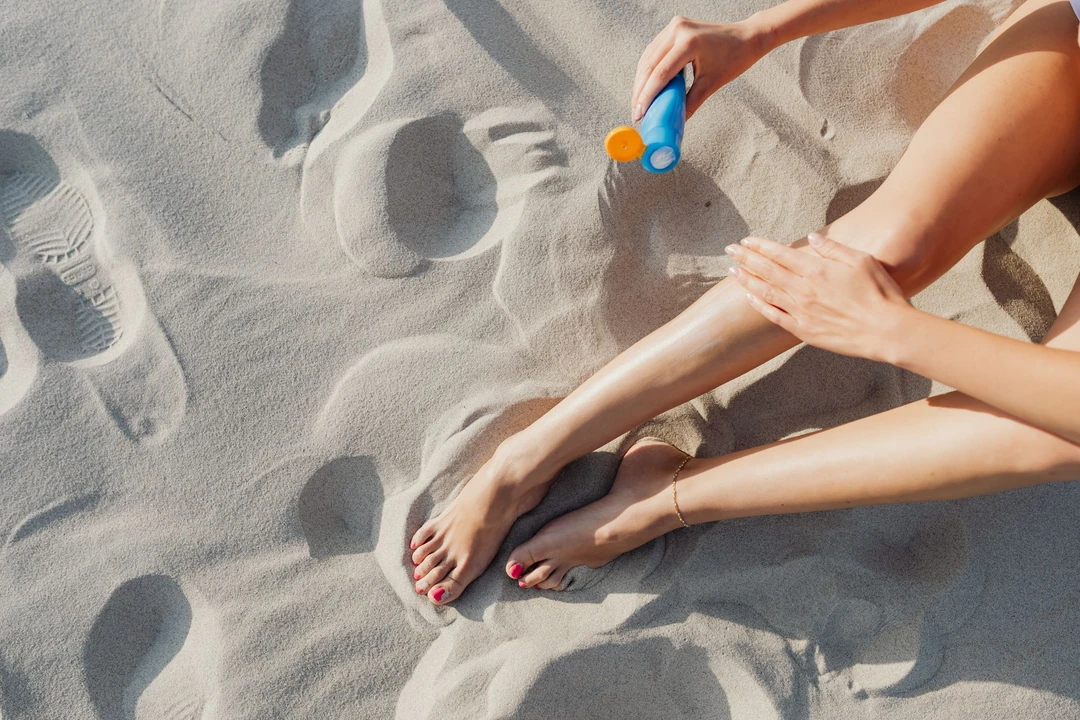
The SPF on the label is measured at 2 mg of product per square centimetre of skin. A review found that in real life people typically apply 0.39–1.0 mg/cm², roughly 20–50% of that amount, so the protection they actually get is far lower than the figure on the tube.
In the United States, sunscreen labels may only claim "water resistant (40 minutes)" or "water resistant (80 minutes)", and words such as "sweatproof" and "waterproof" are not allowed. A water-resistant sunscreen should be reapplied after 40 or 80 minutes of swimming or sweating, immediately after towel drying, and at least every 2 hours. On days of midday riding or outdoor work, reapplying before heading out in the afternoon does more than switching to a tube with a higher SPF.
Tinted sunscreen for melasma-prone skin
The AAD advises people with melasma to use a tinted sunscreen containing iron oxides with an SPF of 30 or more, because iron oxides block part of the visible light that clear sunscreens let through. In a double-blind randomised trial in Mexico, 68 people with melasma all used 4% hydroquinone for 8 weeks; the group using a sunscreen with iron oxides improved by a further 15% on the melasma severity score (MASI) compared with the group using a UV-only sunscreen.
Covering up: shade, clothing, hats and sunglasses
WHO considers shade and covering clothing the most effective protection, with sunscreen as an extra layer. Fabric rated UPF 50 blocks about 98% of UV; UPF 30 or higher is a sensible minimum. Sunglasses cut the UV reaching the eyes by about 80%, and combined with a wide-brimmed hat they reduce UV on the face by about 65%, according to Australian measurements cited by the US Centers for Disease Control and Prevention (CDC).
When problems appear: heat rash, sunburn and signs of heat illness
Heat rash
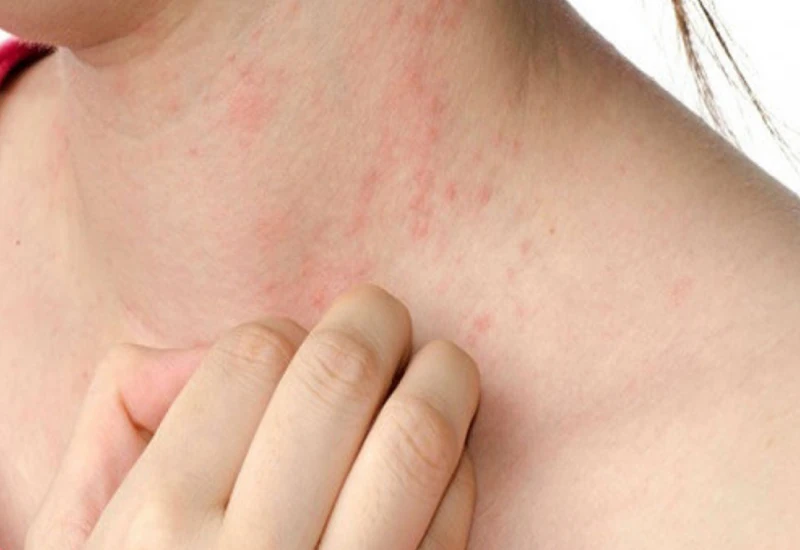
Heat rash develops when sweat ducts become blocked. In adults the usual form is miliaria rubra: small red bumps of 2–4 mm that itch or prickle, clustered where sweat cannot escape. Treatment is mainly about cooling down: stay in a room with a fan or air conditioning, wear loose breathable clothes, change out of sweaty clothing promptly and use cool compresses. Avoid thick creams and ointments on the rash, because they block the ducts further. Most cases settle within a day or two in a cooler environment. If the bumps turn pustular, become very painful or spread, see a doctor.
Sunburn
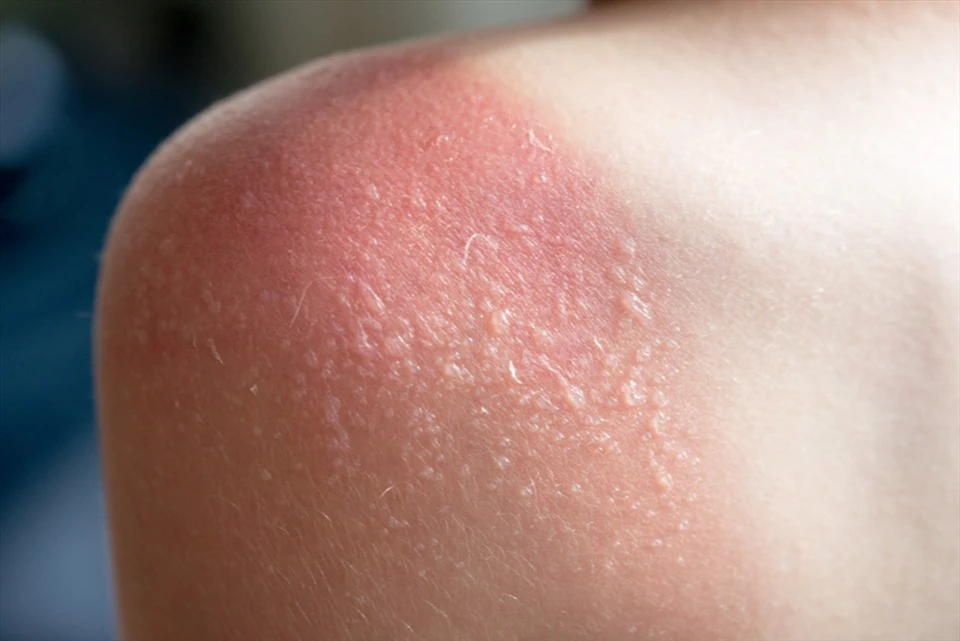
The AAD advises getting out of the sun straight away, taking frequent cool baths or compresses, applying a moisturiser with aloe vera or soy while the skin is still damp, drinking extra water, and not popping blisters. A painkiller such as ibuprofen can help if it is safe for you. Avoid products containing benzocaine or lidocaine. See a doctor if sunburn comes with fever, chills, dizziness, a rapid pulse, extreme thirst, large painful blisters, or painful eyes that are sensitive to light. Sunburned skin is prone to dark marks, and peels or laser should not be done on it until it has fully recovered; our article on aftercare after peels, microneedling and laser has more detail.
Signs that need emergency care
According to the CDC, heat stroke shows up as confusion, slurred speech, fainting, seizures and a very high body temperature. If you see these signs in someone, call emergency services (115 in Vietnam), move them somewhere cool, cool them down quickly and stay with them. Heat exhaustion is milder, with headache, nausea, dizziness, weakness, heavy thirst and heavy sweating; the person should be moved somewhere cool, given frequent sips of water and taken to a medical facility.
Medicines and ingredients that make skin more sun-sensitive
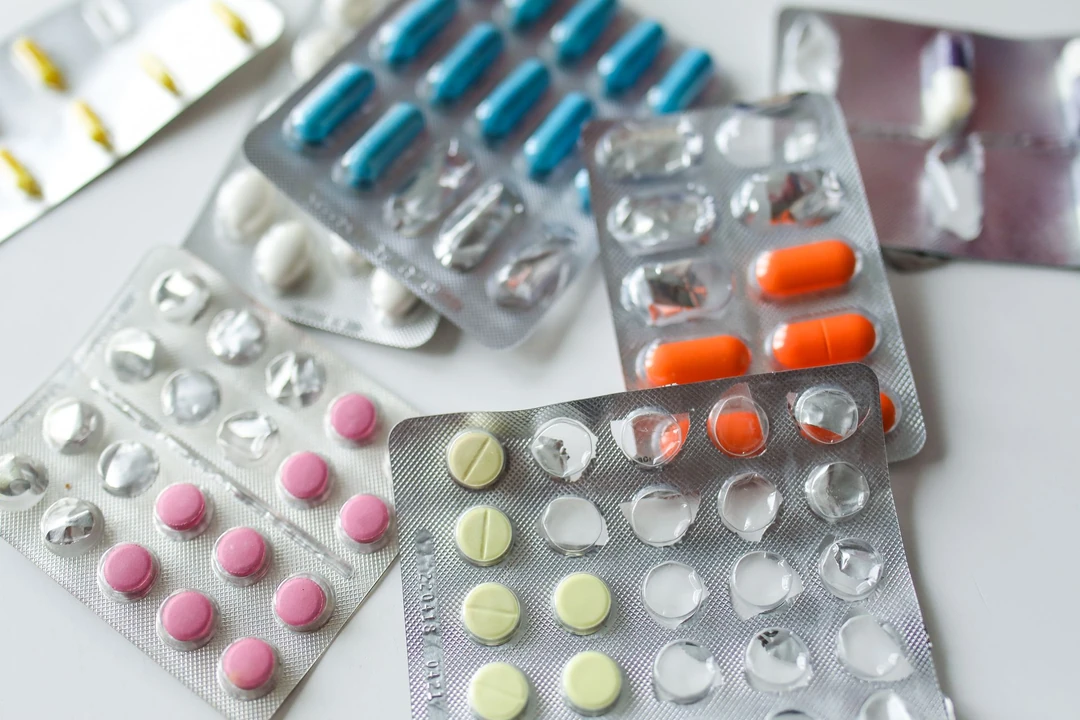
Several common skin medicines and ingredients make the skin react more strongly to sunlight, which matters all the more in a fierce dry season.
Doxycycline, an antibiotic often prescribed for acne: the label reports photosensitivity showing up as an exaggerated sunburn reaction and advises avoiding strong sunlight and considering sunscreen. If your skin turns unusually red while taking it, contact the prescribing doctor.
Topical retinoids such as tretinoin and adapalene: the labels advise limiting sun exposure and not applying them to sunburned skin.
Oral isotretinoin: the medication guide advises avoiding sunlight and UV light as much as possible. Skin after a course is discussed in our article on red acne marks after isotretinoin.
AHAs (glycolic acid, lactic acid): in a study sponsored by the US Food and Drug Administration (FDA), after 4 weeks of AHA use the skin's sensitivity to UV-induced redness rose by about 18% and UV-induced cell damage roughly doubled; the effect disappeared about a week after stopping the product.
The answer is not to drop the treatment. Do not stop prescribed medicines on your own; instead, use active ingredients at night, cover up more carefully and ask your doctor if your skin reacts unusually.
Melasma-prone and mark-prone skin: preparing before peak heat
People with melasma, acne marks that are still fading, or a recent course of peels or laser are the ones who lose most in a long dry season. For them, the period before the March–April peak is the time to prepare: switch to a tinted sunscreen, plan time outdoors around the UV index, and cut out avoidable heat sources such as long spells at the stove or riding at midday.
The sunny season does not mean every treatment has to stop. The decision depends on the type of procedure, how well you can avoid the sun afterwards and how easily your skin darkens. Where melasma is involved, heat-free approaches are usually preferred in the hot months, such as E-Mela at Eternal. Our article on melasma causes and treatment covers the foundations of melasma care, and skin analysis reveals pigment below the surface that the naked eye cannot yet see.