For most people with comedonal acne or mild to moderate inflammatory acne, treating acne without oral medication is a sound plan: the right topical actives, gentle skincare and supporting procedures are usually enough to bring breakouts under control. Nodular or cystic acne, acne that is leaving scars, and acne that has not improved after two to three months of properly used topicals are different. There, oral medication is often the better way to protect your skin, and putting it off has a cost of its own.
This article helps you work out where you stand, explains what a pill-free plan actually involves, sets out when to stop and reassess, and introduces the four acne approaches without oral medication offered at Eternal Beauty Center. If you would like the background on how acne forms and how it is classified first, start with what is acne.
Why many people want to treat acne without oral medication
The wish to avoid tablets usually comes from a few very concrete worries:
Fear of isotretinoin: dry lips, dry skin and, above all, the risk of birth defects if pregnancy occurs during treatment.
Concern about antibiotics: months of antibiotics in the past, stomach upset, or worry about resistant bacteria.
Being pregnant, breastfeeding or planning a pregnancy.
Clearing on tablets and then breaking out again, which leaves people doubting that oral treatment solves anything.
Most of these concerns are legitimate. Isotretinoin causes birth defects, so anyone taking it must use strict contraception. The 2024 acne guideline from the American Academy of Dermatology (AAD) also advises limiting oral antibiotics, using them for a defined period and always alongside a topical treatment to reduce resistance.
The trouble starts with the next step, when a reasonable worry turns into a rule of avoiding oral medication whatever happens. A more useful question is whether your acne actually needs it. The story of one client who treated acne for nine years, including five courses of isotretinoin, shows both sides: tablets are not always the final answer, and choosing to go without them still takes a carefully built plan.
Which acne can be controlled without oral medication
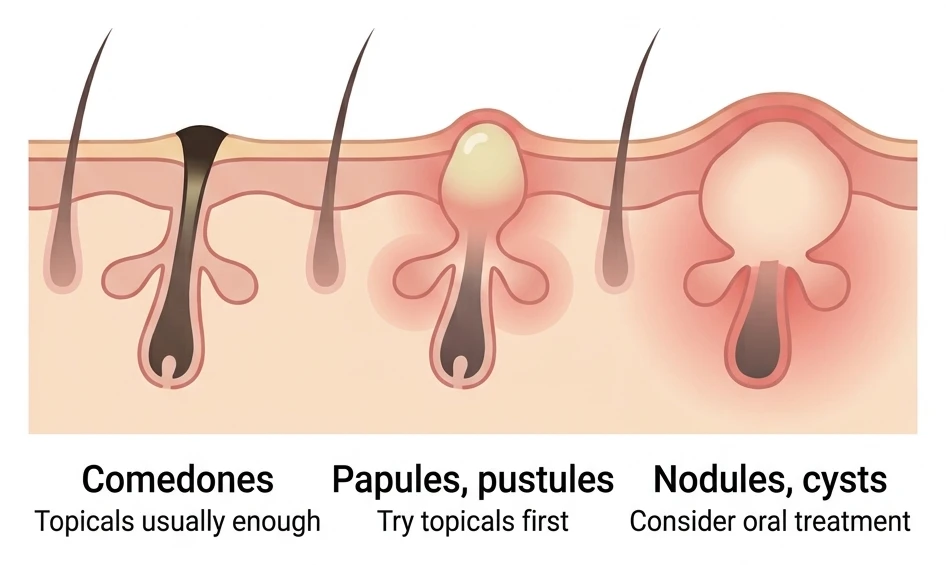
The AAD's 2024 guideline gives a strong recommendation to benzoyl peroxide (BPO), topical retinoids and topical antibiotics (used together with BPO), and a conditional recommendation to azelaic acid and salicylic acid. For mild to moderate acne, the foundation of treatment is already topical, and the two groups below can usually take the pill-free route.
Comedonal acne: blackheads, whiteheads and closed comedones
This is the best fit. Comedones form when follicles are blocked by sebum and unevenly shed skin cells. Topical retinoids normalise exactly that shedding process, which makes them the core active. Extraction and peels can clear the skin faster at the start, but without a maintenance active new comedones form again within weeks. For closed comedones in particular, do closed comedones go away on their own explains why they linger and how to handle them.
Mild to moderate inflammatory acne on the face
Red bumps and scattered pustules, few or no deep lumps, and no pitted scars yet. The usual first step pairs BPO with a topical retinoid, sometimes adding a topical antibiotic but always together with BPO. Peels and light can help calm inflammation, although the evidence behind them is much weaker than for topicals.
In both groups, a topical plan only works if the actives match the main type of lesion, are applied every day for long enough, and do not damage the skin barrier along the way. In its patient guidance, the AAD lists the usual reasons acne will not clear: not giving a treatment enough time, switching products constantly, and using so many products at once that the skin becomes irritated. Most of those mistakes can be fixed without adding a single tablet.
When oral medication is still the right call
In some situations, hesitating over oral medication does more harm than the medication would. The main reason is scarring: each wave of deep inflammatory acne can leave permanent atrophic scars, and current scar treatments improve them only partly; they do not restore the skin to how it was. Talk to a doctor about oral treatment if any of the following applies:
Nodules or cysts: deep, painful lumps that last for weeks.
Acne that is leaving pitted or raised scars, even when there are only a few spots.
Acne spreading to the chest, back or shoulders.
Inflammatory acne that has not improved after about two to three months of properly used topicals.
Acne that weighs heavily on your mood, making you avoid work, school or other people.
Chin and jawline acne with irregular periods, excess hair growth or hair thinning in women: hormones need assessing; see hormonal acne: when to test.
A sudden severe flare with fever, joint pain or fatigue: see a doctor promptly rather than managing it yourself.
For this group, the AAD 2024 guideline strongly recommends isotretinoin for severe acne, scarring acne, acne with a significant psychosocial burden, or acne that has not responded to standard treatment. Oral doxycycline also carries a strong recommendation, but only for a limited period and always with a topical. For women, combined oral contraceptives and spironolactone are conditionally recommended options. The treatment ladder section of what is acne covers each drug group in more detail.
Worries about isotretinoin and antibiotics: which are justified and which go too far
Isotretinoin. The risk of birth defects is real, so contraception is required throughout treatment and for a period afterwards as your doctor directs. Dry lips and skin affect almost everyone and are usually manageable with moisturisers. The drug needs a prescription and follow-up blood tests. In return, it acts on all four factors behind acne, and for many people it can bring long-lasting remission after the course ends.
Oral antibiotics. The resistance concern is justified when antibiotics are taken alone, for long stretches, or bought on an old prescription. Prescribed for a short course alongside BPO or a topical retinoid, they are being used exactly as the guideline recommends.
"It came back after the tablets." Acne is a chronic condition. Whether or not the first phase includes oral medication, clear skin still needs topical maintenance; the AAD advises continuing treatment even after acne clears to prevent new breakouts. Acne returning after antibiotics are stopped without that maintenance step is a common course of events, not proof that the medicine was useless.
Quick comparison table
Situation | Is going without oral medication reasonable? | What is usually considered |
|---|---|---|
Blackheads, whiteheads, closed comedones, little inflammation | Usually reasonable | Topical retinoid as the base; extraction and superficial peels as support |
Mild to moderate inflammatory acne on the face, no scarring | Worth trying first | BPO with a topical retinoid, possibly a topical antibiotic alongside BPO; supporting procedures |
Inflammatory acne not better after 2–3 months of correct topical use | Needs a doctor's reassessment | Review the diagnosis and how products are used; a time-limited oral medication may be added |
Chin and jawline acne with irregular periods or excess hair growth | Depends on the assessment | Examination, possibly hormone tests; hormonal therapy in women |
Nodular or cystic acne, acne that is scarring | Oral medication should not be delayed | Isotretinoin or another oral medication as prescribed; procedures only as support |
Pregnant or breastfeeding | Limiting oral medication is justified | The doctor selects pregnancy-appropriate topicals and procedures |
What a plan without oral medication involves
Going without tablets is still treatment; the work simply shifts to topical actives and skincare. A complete plan has three layers, and if one is missing the other two struggle to hold the result.
Topical actives: the foundation
Topical retinoids (adapalene, tretinoin), BPO, azelaic acid and salicylic acid are chosen according to the dominant lesion type: retinoids lead when comedones dominate, BPO plays a bigger part when inflammation does. Start at a low strength and low frequency, then build up. In the first few weeks of a retinoid, skin can feel dry, look red, peel slightly and sometimes produce a few extra spots. This is when most people give up, so having someone follow your progress helps more than going it alone. How to combine actives is covered in the skincare actives guide.
Skincare that does not irritate
A gentle cleanser, a non-comedogenic moisturiser and daily sunscreen. Retinoids and BPO both dry the skin, and a lack of moisturiser is one of the most common reasons people stop treatment halfway. Once skin stings or burns, the first job is to repair the skin barrier before adding more actives. Sunscreen also helps limit post-acne marks, which tend to outlast the spots themselves.
Supporting procedures: extraction, peels and light
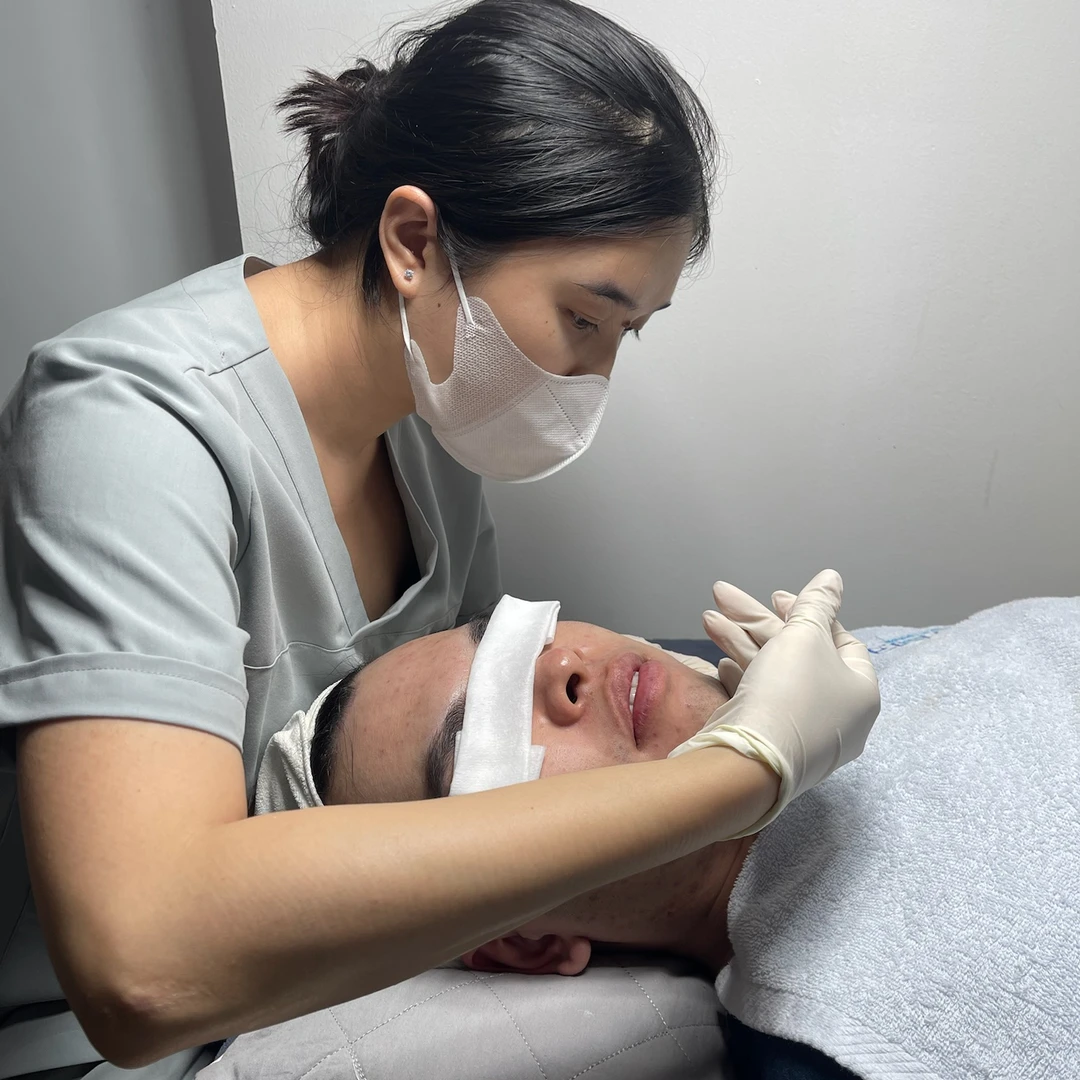
The AAD 2024 guideline concluded that current evidence is not sufficient to make recommendations on procedures such as comedone extraction, chemical peels, lasers and light-based devices. A 2018 systematic review of randomised trials in BMJ Open found chemical peels were well tolerated and may perform similarly to some other treatments for mild to moderate acne, but the evidence was of low quality. A 2016 Cochrane review of light therapies, pooling 71 studies with 4,211 participants, could not draw firm conclusions that light worked better than the comparisons.
So why do doctors still use procedures? Because they speed up what topicals do slowly: releasing comedones that have already formed, and making the surface clearer and smoother in the first few weeks, which helps people see progress and stay with the plan. What keeps acne from coming back is still the daily topical. What peels can and cannot do for acne, marks and scars is discussed separately in peeling for acne, marks and shallow scars.
How long to try before reassessing
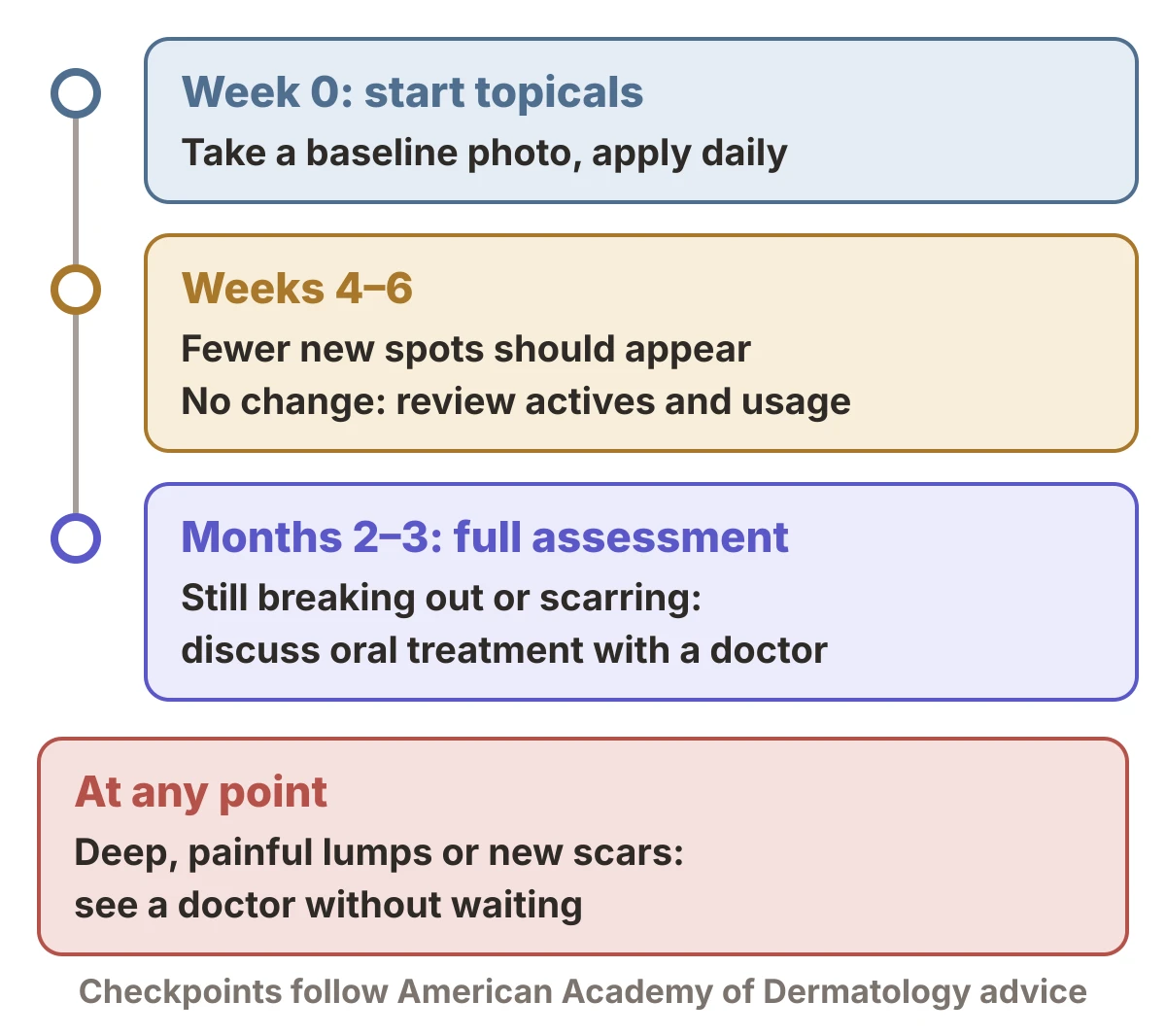
According to the AAD, an acne treatment needs at least four weeks to work. If it suits you, improvement usually shows within four to six weeks, while clearing can take two to three months or longer. Switching products after a few days because "nothing is happening" is one of the reasons acne drags on.
Three checkpoints help you keep track:
Weeks 4–6: fewer new spots should be appearing. If nothing has changed, review the actives or how they are used before concluding you need tablets.
Months 2–3: the point for a full assessment. If inflamed spots keep appearing, or dents remain after spots settle, it is time to discuss oral medication with a doctor.
At any point: deep or painful lumps, or new scars, mean there is no need to wait for a checkpoint.
Photos taken from the same angle and in the same light every two to four weeks are more objective than memory; how to track skin changes with photos shows how.
Two situations that call for different thinking
Pregnancy and breastfeeding
This is the group with the strongest reason to avoid oral medication. Isotretinoin is absolutely contraindicated during pregnancy or when pregnancy is planned, and tetracyclines, spironolactone and topical retinoids are generally avoided as well. According to a 2016 review by Chien and colleagues, a topical antibiotic combined with BPO is the recommended choice for inflammatory acne in pregnancy. The authors note that there are no randomised trials of acne medicines in pregnancy, so recommendations rest mainly on observational studies. Tell your doctor if you are pregnant, breastfeeding or planning a pregnancy, because both topicals and procedures need adjusting.
When "acne" is actually something else
Rosacea, perioral dermatitis and fungal folliculitis can look very much like acne but have no comedones and respond to quite different treatment. Adding more acne actives, or worse, a topical corticosteroid, can make them flare. If your bumps are uniform, itchy, or your face flushes in episodes, read facial skin conditions mistaken for acne before moving on to the next regimen.
Four acne approaches without oral medication at Eternal
At Eternal Beauty Center, the approach is chosen after an examination with dermatologist Dr. Le Hien (Specialist Level I), based on the type of lesions, how severe the acne is, the underlying skin, how it is likely to respond and your wish to limit oral medication. The four options below are not rungs to climb one by one; many people with mild acne may need only the first.
Routine by Dr. Le Hien
For mild acne, or persistent acne driven by a skincare routine that does not suit the skin. The doctor builds a personalised at-home routine: actives matched to the acne type, the order of use, a gradual increase in frequency and the steps that protect the skin barrier, aiming to control breakouts and restore the skin. The routine is also the base the other three approaches rely on.
Multilayer Acne
Several layers of treatment combined in a single plan according to the skin's condition, centred on a multi-layer, multi-target peel, so that different acne problems are addressed at once, for instance skin that has both clogged comedones and inflamed spots. As with any peel course, results depend on keeping up the routine between sessions.
E-Acne
A combination of care and acne treatment methods matched to each skin, supporting clearer skin and improving acne. The E-Acne technique delivers a blend of anti-inflammatory and antibacterial actives through the outer skin layer using fine micro-point tips, so that the actives reach inflamed areas better than surface application alone. The process and the methods used alongside it are on the E-Acne medical acne treatment page.
Ultimate Acne
An in-depth plan for acne that needs closer assessment and a more structured approach, typically mixed acne with fresh marks or early scars. Ultimate Acne combines four methods: medical-grade comedone extraction, Acne Peel, E-Acne and DPL (narrow-band pulsed light). It works toward four goals: clearing comedones with proper technique, controlling inflammation and reducing new breakouts, regulating keratinisation to limit blocked follicles, and restoring the skin barrier after treatment. The doctor decides how the methods are balanced based on the skin's actual condition.
Going without oral medication is not suitable for everyone. If your acne falls into the group that needs oral treatment described above, the doctor will say so during the examination, and the in-centre treatments then support a fuller treatment plan. A selection of real acne, mark and scar cases at Eternal shows how skin changes stage by stage; results vary between individuals.