
Superficial peels — salicylic, mandelic, glycolic, lactic and Jessner — are safe at 2–4 week intervals, in a course of 3–6 sessions. Medium-depth peels using 20–35% TCA need 3–6 months between treatments. But those numbers are only a starting point. The right interval for you depends on which acid, what you are treating, and — most overlooked — how much exfoliation you are already doing at home. This article works through all three.
If you are not yet clear on what a chemical peel is, how it works and what the depth levels mean, read the overview What is a chemical peel? first. This article assumes that groundwork and focuses purely on timing: how often, why, and how to tell when you are peeling too frequently.
Safe peel intervals: quick reference
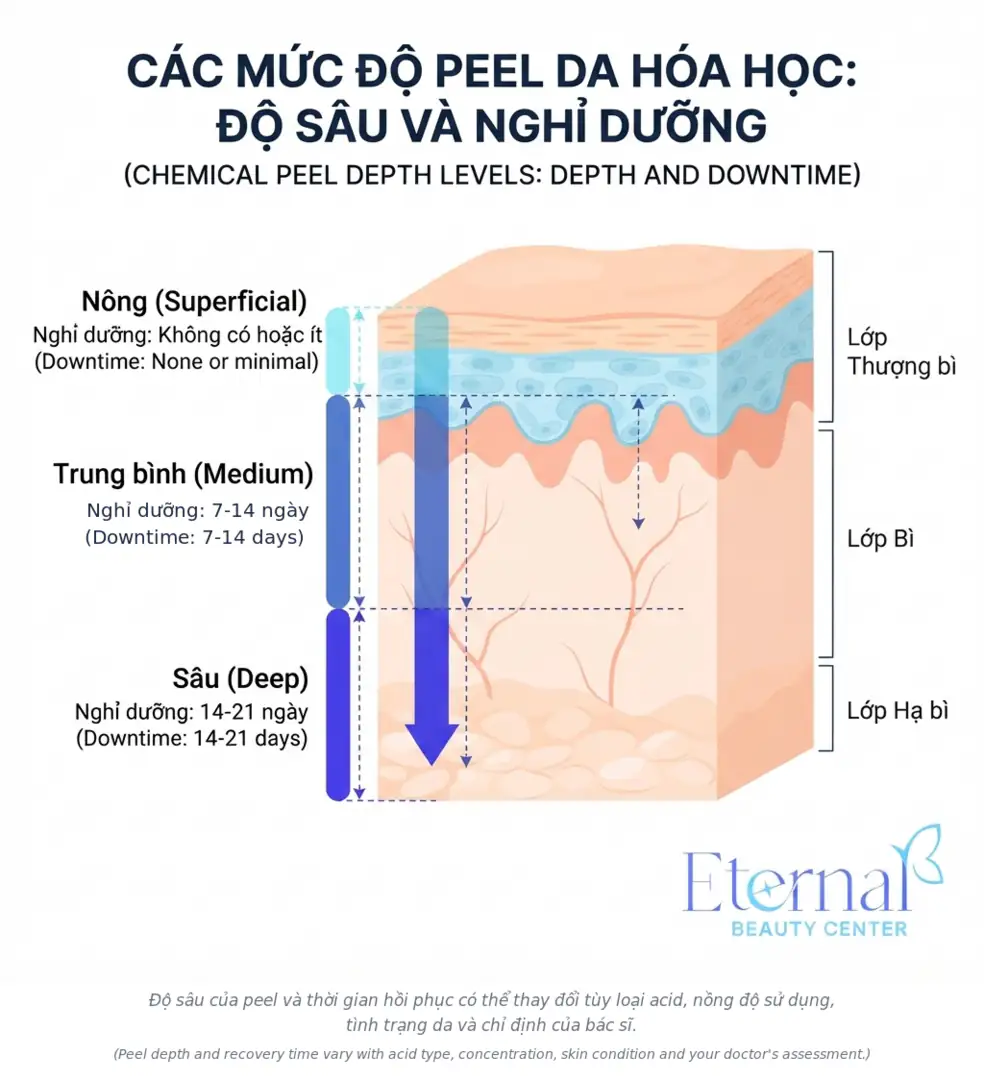
| Peel type | Interval between sessions | Sessions per course | Downtime |
|---|---|---|---|
| Very superficial (salicylic 10–20%, glycolic 20–30%, lactic, mandelic) | 2–3 weeks | 4–6 | Essentially none |
| Superficial (salicylic 30%, glycolic 30–50%, Jessner) | 2–4 weeks | 3–6 | 0–3 days |
| Medium-depth (TCA 20–35%, Jessner + TCA) | 3–6 months | 1–2 per year | 7–14 days |
| Deep (phenol) | Usually once in a lifetime | 1 | 2–3 weeks or more |
Three things to take from this table:
The deeper the peel, the longer the gap. The interval tracks how long the skin needs to heal completely, not how fast you want results.
Superficial peels work as a course, not as one event. Results come from a cumulative effect across sessions, not from a single aggressive treatment.
There is no universal schedule. With the same acid, thick oily skin and thin sensitive skin will need different intervals.
Why 2–4 weeks, and not weekly?
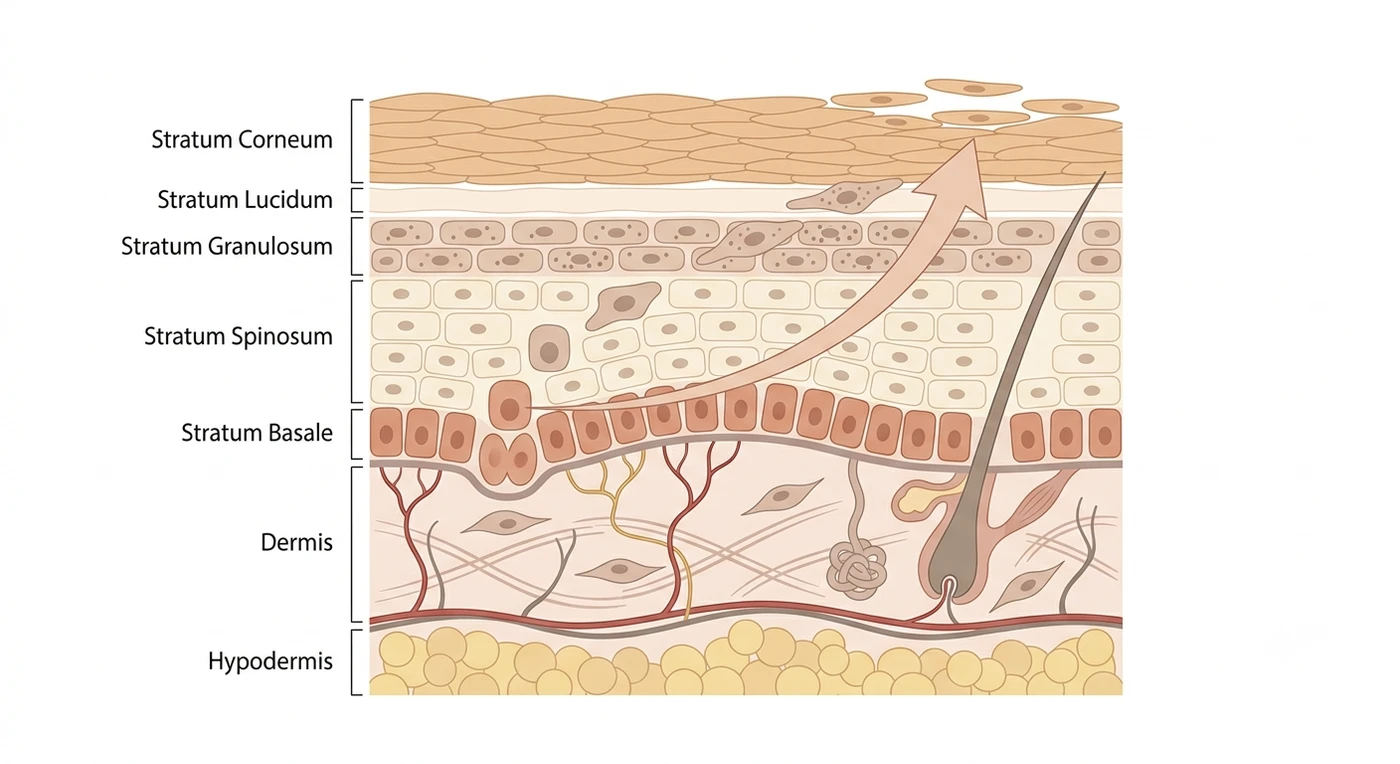
The gap between two peels is set by how long the epidermis takes to renew itself — not by how long it takes for visible flaking to stop.
Keratinocytes born in the basal layer take roughly 28 days to travel up to the stratum corneum, the number most people have heard. But research on epidermal turnover shows the full renewal of the epidermis takes longer — around 40–45 days in adult skin — and it slows with age: the outer layers of a 20-year-old's skin turn over about every two weeks, while more mature skin can take twice as long.
Two practical consequences follow:
1. Peeling again before the stratum corneum has re-formed compounds the injury, not the benefit. Skin that looks "clear" five to seven days later does not mean the barrier has recovered — studies of barrier disruption show transepidermal water loss takes days to return to baseline, and trials tracking recovery after glycolic acid peels measure out to the 14-day mark.
2. Older skin generally needs wider intervals than younger skin at the same acid and concentration, simply because it renews more slowly.
This is why every evidence-based protocol lands in the 2–4 week window: long enough for the skin to rebuild, short enough to keep the cumulative effect going.
Intervals by acid
The pillar article gives a general 2–5 week figure. Clinical practice is more specific, because each acid behaves differently.
Salicylic acid (BHA) — 2 weeks
This is the best-studied acid for acne-prone skin. A systematic review of randomised controlled trials of chemical peels for acne found that most studies used a 2-week interval, with session counts ranging from 3 to 12 depending on the protocol; salicylic acid concentrations studied were 10%, 20%, 30% and 50%. Typical 30% salicylic trials ran 3–6 sessions two weeks apart.
Because it is oil-soluble, salicylic acid penetrates congested pores — which makes it the default choice for oily, acne-prone skin. Eternal's Acne Peel course is likewise scheduled around the 2-week mark, adjusted by the doctor according to how your skin actually responds.
Mandelic acid — 2–3 weeks
The mandelic acid molecule is larger than glycolic, so it penetrates more slowly and evenly, with less abrupt irritation. That profile makes it a preferred option for deeper skin tones and sensitive skin — which describes most Vietnamese patients. Intervals of 2–3 weeks are standard.
Glycolic acid (AHA) — 2–4 weeks
Glycolic is the smallest AHA molecule, penetrating quickly and working well on dull, rough skin. Standard-of-care guidance for chemical peels recommends a series of 3–4 peels at 3–4 week intervals to build an additive effect while limiting complications. The higher the concentration (50–70%), the wider the interval should be.
Lactic acid — 2–4 weeks
Gentler than glycolic and additionally hydrating, lactic acid suits dry skin or anyone new to peels. Intervals are similar to glycolic.
Jessner — 3–4 weeks
A combination formula (14% salicylic + 14% lactic + 14% resorcinol) acts more strongly than any single component, so the interval is usually widened to 3–4 weeks.
TCA — depends entirely on the concentration
This is the most misunderstood agent, because the same name spans two very different depths:
TCA 10–20% is a very superficial peel and can be repeated after a few weeks.
TCA 20–35%, or TCA combined with Jessner, is a medium-depth peel — and DermNet advises waiting 3 to 6 months before repeating it.
In other words, "I had a TCA peel" is not an answer on its own. The concentration is the question.
About the concentrations above: they are given so you can understand why schedules differ, not so you can apply them yourself. A peel is a medical procedure; concentration, contact time and neutralisation must be decided by a trained professional after examining your skin.
Intervals by treatment goal

The same skin needs different rhythms depending on what you are treating.
Active inflammatory acne
Here the priority is controlling inflammation first, with the peel in a supporting role rather than the lead. A common schedule is every 2 weeks for 3–6 sessions, combined with cleansing and extraction. Peeling more often does not clear acne faster — it raises the risk of leaving marks behind.
Post-inflammatory hyperpigmentation (PIH)
Dark marks require more patience than the acne that caused them. The key point: PIH typically appears 3–6 weeks after an inflammatory insult, so peeling too frequently can create new pigmentation faster than you are fading the old. For this goal, a 3–4 week interval with strict sun protection usually makes more sense than a 2-week rhythm. Why Vietnamese skin is especially prone to this is explained in Why dark marks form after acne.
Melasma and pigment disorders
Melasma is a chronic pigmentary condition, not a surface problem — a peel is one link in a long-term protocol, and peeling on the wrong rhythm can trigger a rebound. Here the schedule must be set by a doctor after a skin assessment; at Eternal, pigment work runs through Mela Peel or the deeper E-Mela protocol depending on the type of melasma.
Maintaining healthy, clear skin
Once the goal is reached, the maintenance rhythm is far more spaced out: every 4–8 weeks, or seasonally. This is where many people slip — they keep the 2-week treatment rhythm running all year and gradually erode the barrier. Eternal Peel is typically used at this maintenance cadence.
Signs you are peeling too often
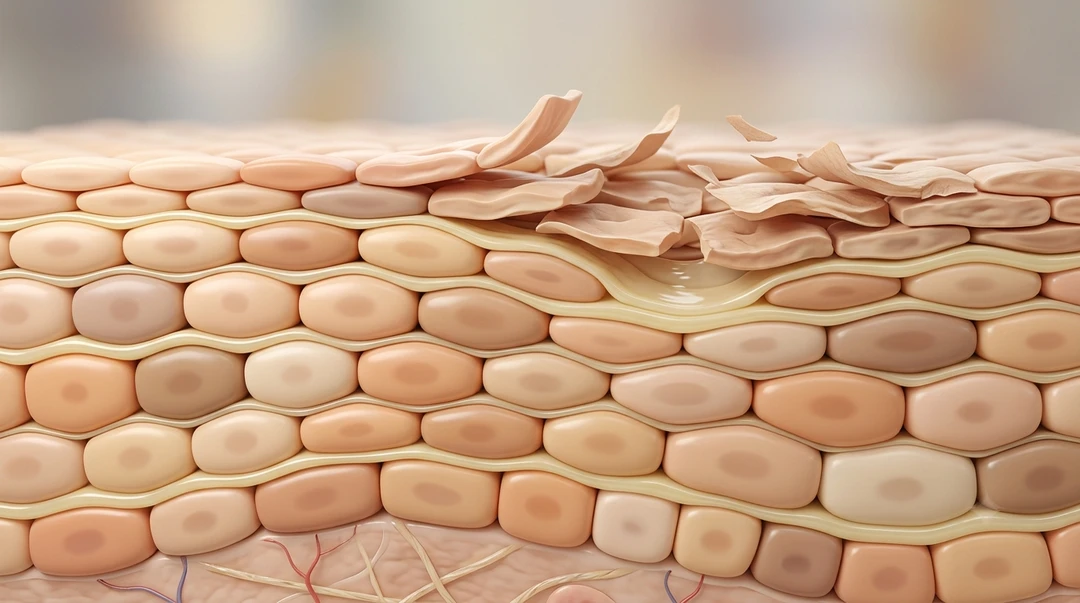
Peeling more frequently does not produce faster results — it produces skin that looks deceptively polished for a few days and grows more reactive over time. These are the signals to stop and reassess:
Stinging from products you have always tolerated — even a gentle moisturiser or micellar water.
Persistent redness that does not settle within 3–5 days, or flushing with temperature changes.
Skin that feels tight and dry yet still looks oily — a classic sign of a damaged barrier overproducing sebum to compensate.
Small, shallow, evenly scattered bumps appearing — distinct from ordinary inflammatory acne.
Skin that looks waxy and shiny, thinner, with capillaries more visible than before.
New dark marks appearing after each peel instead of fading.
Burning in sunlight despite wearing sunscreen.
How to check at home
A simple test: stop all exfoliating actives for 7–10 days and use only a gentle cleanser, a repairing moisturiser and sunscreen. If the stinging, redness and shine settle in that window, you were most likely overloaded — rather than having "naturally weak skin". If nothing improves after two weeks, see a doctor instead of continuing to self-adjust.
Total load: clinic peels plus home exfoliation
This is the part most often left out of the calculation.
Your skin cannot tell whether an acid came from a clinic or from a bottle on your shelf — it only registers the total load. Someone peeling every two weeks at a clinic while also using BHA nightly, retinol, and a weekend AHA toner is effectively exfoliating continuously, even though the peel schedule looks correct on paper.
Practical rules:
Pause home exfoliating actives for 3–5 days before and after each peel — retinol, AHA/BHA, high-strength vitamin C, benzoyl peroxide — unless your doctor advises otherwise.
While a peel course is running, scale home actives down rather than stacking them. The clinic peel is already doing the exfoliating.
If you want to keep a strong home routine, widen the peel interval to 3–4 weeks instead of 2.
How to combine and pace the home actives themselves — especially BHA and retinol — is covered in depth in Can you use BHA and retinol together?; this article does not repeat it. For the full picture on combining actives, see the skincare actives guide.
The Vietnamese context: sun, seasons and pigmentation risk
Three factors mean peel schedules in Vietnam cannot be copied wholesale from foreign guidance.
First, most Vietnamese skin falls into Fitzpatrick types III–V. In this group the complication that matters most is not burning but post-inflammatory hyperpigmentation — and as noted above, PIH surfaces late, 3–6 weeks after the procedure. Peel every two weeks and you will have had your third session before the consequences of the first become visible. This is the strongest argument for widening intervals on deeper skin tones.
The good news: superficial peels remain safe for these skin types when the acid is well chosen. A narrative review of cosmetic treatments in Fitzpatrick IV–VI skin lists salicylic 5–30%, glycolic 30–50% and Jessner solution as first-line superficial options precisely because of their safety record.
Second, year-round sun. There is no distinct "peel season" as in temperate countries, so sunscreen is not an optional add-on but the condition that makes the whole schedule worthwhile. Freshly peeled skin exposed without protection loses much of the benefit and gains pigmentation risk.
Third, periods when you should deliberately stretch the schedule: weeks with beach trips or long outdoor activity; when skin is already irritated by a weather change; and immediately before an important event, because skin responses are not always predictable.
What happens after the course ends?
The results of superficial peels are not permanent — professional guidance is explicit that AHA peel results are temporary and require periodic treatment to maintain. But "periodic" during maintenance is much less frequent than during treatment:
Treatment phase: every 2–4 weeks, 3–6 sessions.
Maintenance phase: every 4–8 weeks, or less often once skin is stable.
What actually holds the result is done at home, not at the clinic: consistent sun protection, barrier-repairing moisturiser, and a routine of actives your skin can handle.
Put differently, peels maintain results best when they supplement a stable routine — not when they compensate for an unstable one.
When to postpone or stop
Postpone a peel when: you have an open wound, active flaking or visible irritation; an active skin infection or cold sore; recent facial laser, microneedling or hair removal; or sunburned skin.
Discuss carefully with your doctor first if: you are taking or recently took oral isotretinoin (medium and deep peels generally require stopping beforehand, with six months commonly cited); you have a history of keloids or poor wound healing; you are pregnant or breastfeeding; you have active melasma; or you have a history of severe post-inflammatory hyperpigmentation.
Medical disclaimer: This article is for general information and does not replace an in-person consultation. An appropriate peel schedule must be determined after a doctor assesses your skin type, current condition and treatment goals. Individual responses vary.
How peel schedules are personalised at Eternal Beauty Center

At Eternal, peels are not sold as a one-formula-fits-all service. Every client has a skin analysis and consultation with a dermatologist before the acid, concentration and interval are chosen. The rhythm is then adjusted session by session according to how the skin responds, rather than fixed at the outset.
Acne Peel — for oily, acne-prone skin; typically scheduled around 2 weeks, combined with cleansing and extraction.
Eternal Peel — brightening and smoothing, usually used at the maintenance cadence.
Mela Peel and E-Mela — pigment-focused, scheduled by the doctor according to the type of melasma.
You can see a real combined acne–pigmentation–scarring journey in our treatment case files (results vary between individuals).
Frequently asked questions
Can I get a chemical peel once a week?
For clinic superficial peels, no. A one-week gap is shorter than the time the stratum corneum needs to re-form, which risks eroding the barrier and increasing pigmentation. Evidence-based acne peel protocols use intervals of two weeks or more.
Is once a month too infrequent?
No. For many goals — particularly pigmentation and maintenance — monthly is a sensible, safe rhythm, especially on deeper skin tones. Spaced but consistent peeling usually produces more durable results than frequent peeling followed by a long break due to irritation.
How many sessions before I see a change?
Superficial peels need a course of 3–6 sessions for a clear difference; changes accumulate session by session rather than appearing after one. Any clinic promising bright, smooth skin after a single peel is a warning sign.
Should I peel while I have severe inflammatory acne?
A doctor should assess you first. Peels can help, but severe inflammatory acne usually needs the inflammation controlled with an appropriate protocol first; frequent peeling on heavily inflamed skin increases the risk of post-acne marks.
How long after a peel can I use retinol or BHA again?
Usually about 3–5 days after a superficial peel, and only once stinging and redness have fully settled. If your skin still feels reactive, wait longer. The detailed rules for combining these actives are in BHA and retinol.
How long between medium-depth TCA peels?
DermNet advises waiting 3–6 months before repeating a medium-depth peel. This depth involves 7–14 days of downtime and requires an experienced practitioner, particularly on Asian skin.
Can sensitive skin have peels?
Often yes, but with gentler acids (mandelic, lactic), lower concentrations, shorter contact time and wider intervals. Most importantly, get your skin assessed first — "sensitive skin" is sometimes a barrier damaged by overusing actives, and that needs repairing before any peel.
Summary
Superficial peels: every 2–4 weeks, 3–6 sessions. Medium-depth (TCA 20–35%): every 3–6 months.
The interval is set by how long the epidermis takes to renew, not by when flaking stops.
Each acid has its own rhythm: salicylic ~2 weeks, mandelic 2–3, glycolic 2–4, Jessner 3–4, TCA depending on concentration.
The goal sets the pace: active acne ~2 weeks, post-acne marks 3–4 weeks, maintenance 4–8 weeks.
Count home exfoliation into the total load — this is the most common mistake.
On Fitzpatrick III–V skin, PIH appears late at 3–6 weeks, so wider intervals and strict sun protection are essential.
References
DermNet NZ — Chemical peels (face peels): depth classification, the 3–6 month interval for repeating medium-depth peels, and dyspigmentation risk in darker skin.
StatPearls / NCBI Bookshelf — Chemical Peels for Skin Resurfacing: concentration ranges by depth, contraindications, complications and re-epithelialisation times.
PMC — Chemical peels for acne vulgaris: a systematic review of randomised controlled trials: 2-week intervals, 3–12 sessions, agent concentrations.
Indian Journal of Dermatology, Venereology and Leprology — Standard guidelines of care for chemical peels (IADVL): series of 3–4 peels at 3–4 week intervals, pre-peel priming, temporary nature of AHA results.
PMC — Noninvasive Cosmetic Treatments for Fitzpatrick IV–VI: A Narrative Review of Safety and Efficacy Guidelines: first-line agents for deeper skin tones, PIH appearing at 3–6 weeks.
PubMed — Epidermal turnover time: epidermal renewal times and how they change with age.
Cleveland Clinic — Chemical Peels: procedure overview and expectations.
Book a skin analysis and peel-schedule consultation
The right peel schedule starts with a skin analysis, not with a number copied from the internet. Our dermatologist will assess your skin type, barrier condition and goals, then build a peel rhythm that fits.
Eternal Beauty Center
Hotline / Zalo: 0334 713 610
Address: An Hội Đông Ward (formerly Go Vap District), Ho Chi Minh City