Acne scar treatment usually works from deep to shallow. Active acne and the skin's condition are settled first. Next, the fibrous bands pulling scars down are released and narrow, deep scars are treated one by one. Only then is the whole surface resurfaced, followed by fine-tuning and a reassessment a few months later. Several steps can share a session. No international guideline sets a mandatory order, so the exact sequence depends on each person's scar types and skin.
Our guide to atrophic acne scars covers what each technique does and which scar type it suits. This article picks up the question patients are usually told to "leave to the doctor": why one technique goes before another, which steps can be done together, how far apart sessions should be, and when it is worth looking in the mirror to judge the result.
Why the order matters
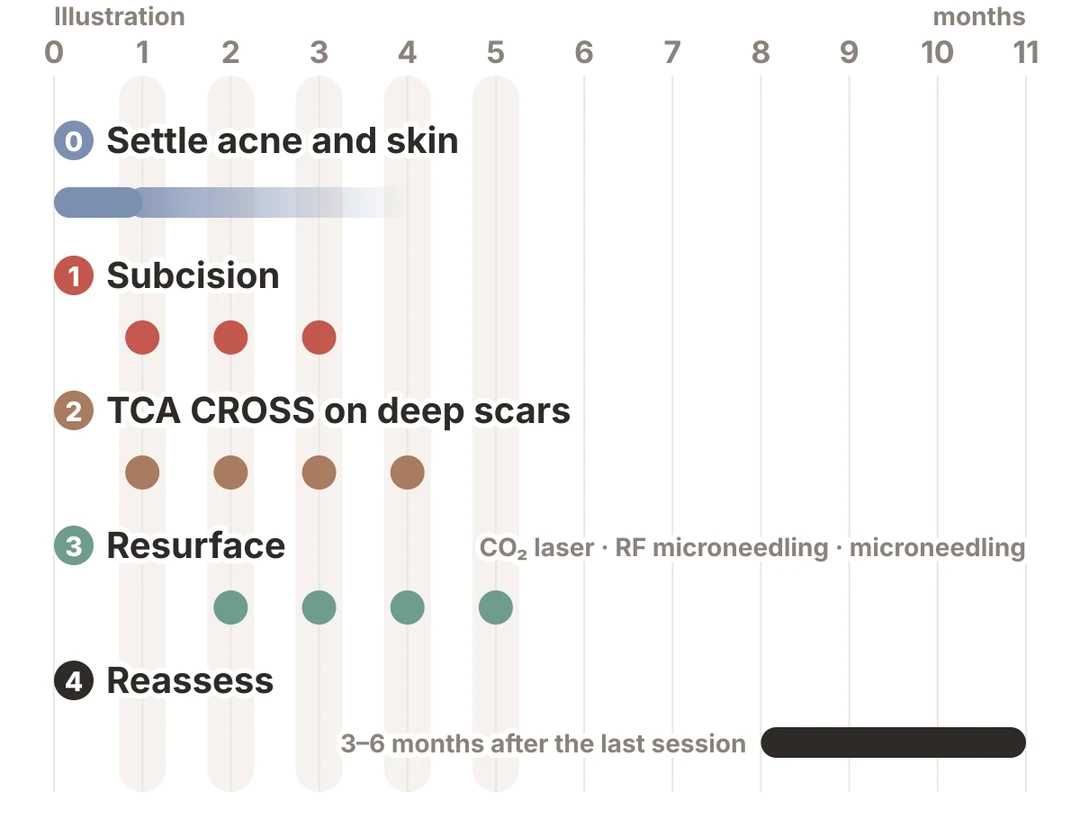
A scarred face rarely has a single problem. Three usually overlap. The first is tethering: in rolling scars, fibrous bands anchor the base of the scar to deeper tissue and pull whole patches of skin downward. The second is narrow, deep pits: ice pick scars and narrow boxcar scars, each a small channel running down into the dermis. The third is the surface: scar edges, uneven texture and shallow boxcar scars. How to tell the types apart is covered in distinguishing the 3 types of acne scars.
Each technique works well on only one of these. Lasers and microneedling stimulate collagen in the dermis, but they cannot cut a band that is holding a scar down. Fillers push tissue up, but they cannot lift a scar that is still tethered. Dermatologic surgery reviews therefore place release before, or in the same session as, filling and resurfacing, and place excision and punch techniques before resurfacing (Gupta et al., 2020). Dermatologist Greg Goodman frames scar treatment around three components, surface, volume and movement, and is explicit that the goal is improvement, not eradication.
A few head-to-head studies support this thinking. In a split-face trial of 30 patients in Iran, the side treated with subcision plus fractional CO₂ laser improved by an average of 54.7%, against 43.0% on the laser-only side. Another trial of 25 patients with skin types II–IV found that adding subcision to RF microneedling beat RF microneedling alone. The limits need stating plainly: these studies are small, and a 2016 Cochrane review rated the overall evidence on acne scar treatments as very low quality. Combining techniques is common practice and makes sense mechanistically, but large trials have not proven it.
Step 0: settle the skin before touching the scars
Before treating scars, a doctor usually needs to answer three questions.
Is the acne still active? The usual advice is to treat active acne before starting scar procedures (Fife, 2011). The reason is practical: each new inflamed spot can leave a new scar, and inflamed skin is more prone to darkening after a procedure. The skin does not have to be completely clear; with mild acne that is under control, a doctor may start on scars in parallel. If acne is still frequent, the first step is acne treatment.
Does the skin darken easily? Vietnamese skin is prone to post-inflammatory hyperpigmentation, and nearly every scar technique creates a controlled injury. Preparing the skin and protecting it from the sun, including which measures have evidence and which are overstated, is covered in does CO₂ laser cause hyperpigmentation on Vietnamese skin.
Are you taking, or have you recently taken, isotretinoin? The old "wait six months after stopping" rule has been revisited. A 2017 systematic review with consensus recommendations found insufficient evidence to require delaying superficial peels or fractional lasers, while still advising against mechanical dermabrasion and fully ablative laser during this period. Details are in our fractional CO₂ laser guide, and the specific decision needs a doctor to review your dose and timing.
Step 1: release tethering before filling or resurfacing
Subcision passes a needle under the skin to cut the fibrous bands anchoring a scar, letting the skin above it lift. It is the step for rolling scars and for rounded scars that are pulled down, the kind that look worse under light coming from the side.
It usually comes first because everything after it, whether microneedling, laser or filler, works fully only once the base of the scar has been freed. Subcision can be repeated every 2–4 weeks until the best response is reached (Gupta et al., 2020); in trials, about three sessions a month apart is common.
Two things are worth knowing in advance:
Bruising is normal. In the Iranian trial above, bruising lasted about one week in 57% of patients and about two weeks in 43%.
Lumps under the skin can mislead you. In a trial in Ho Chi Minh City, about two-thirds of the treated sides developed small lumps under the skin. They resolved on their own, after a median of about two months, though roughly one in five lasted more than five months. The authors noted that these lumps can temporarily push the scar up like a natural filler, so a scar may look shallower for a few weeks and then partly sink back as the lump resolves. That is not failure; the real result simply has not shown yet.
Step 2: treat narrow, deep scars one by one
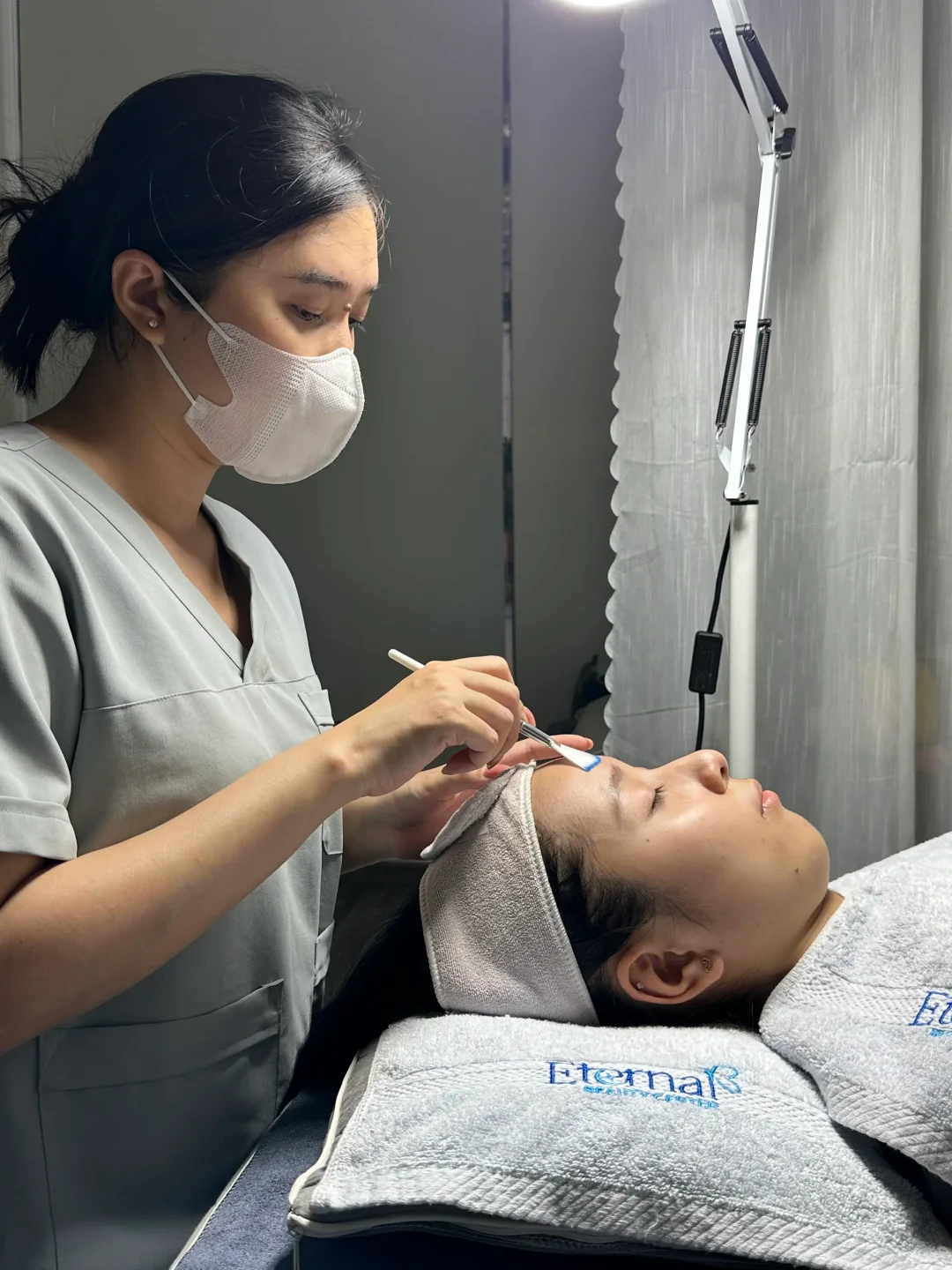
Ice pick scars are too narrow for laser or microneedling to reach their base effectively. TCA CROSS places high-concentration trichloroacetic acid precisely inside each scar to stimulate healing tissue to fill it from the bottom.
Much of the evidence for this technique comes from Asian and darker skin. The original study of 65 patients with skin types IV–V reported a good response in 82% of those treated with 65% TCA and 94% of those treated with 100% TCA. A study of 30 patients with skin types IV–V, treated four times at two-week intervals, recorded darkening in 2 patients and temporary lightening in 1. More recently, a split-face trial of 31 patients in Ho Chi Minh City compared 50% and 80% TCA: efficacy was similar, but side effects were more severe on the 80% side. In other words, a higher concentration does not mean a better result.
For scars too wide or too deep for TCA CROSS, some providers use punch techniques to cut out the scar or lift its base. These always come before resurfacing, because the small outline they leave needs resurfacing afterwards to blur it (Gupta et al., 2020).
Steps 1 and 2 do not have to be scheduled separately. They target different scars, so in practice they are often done in the same session on different areas of the face.
Step 3: resurface the whole area
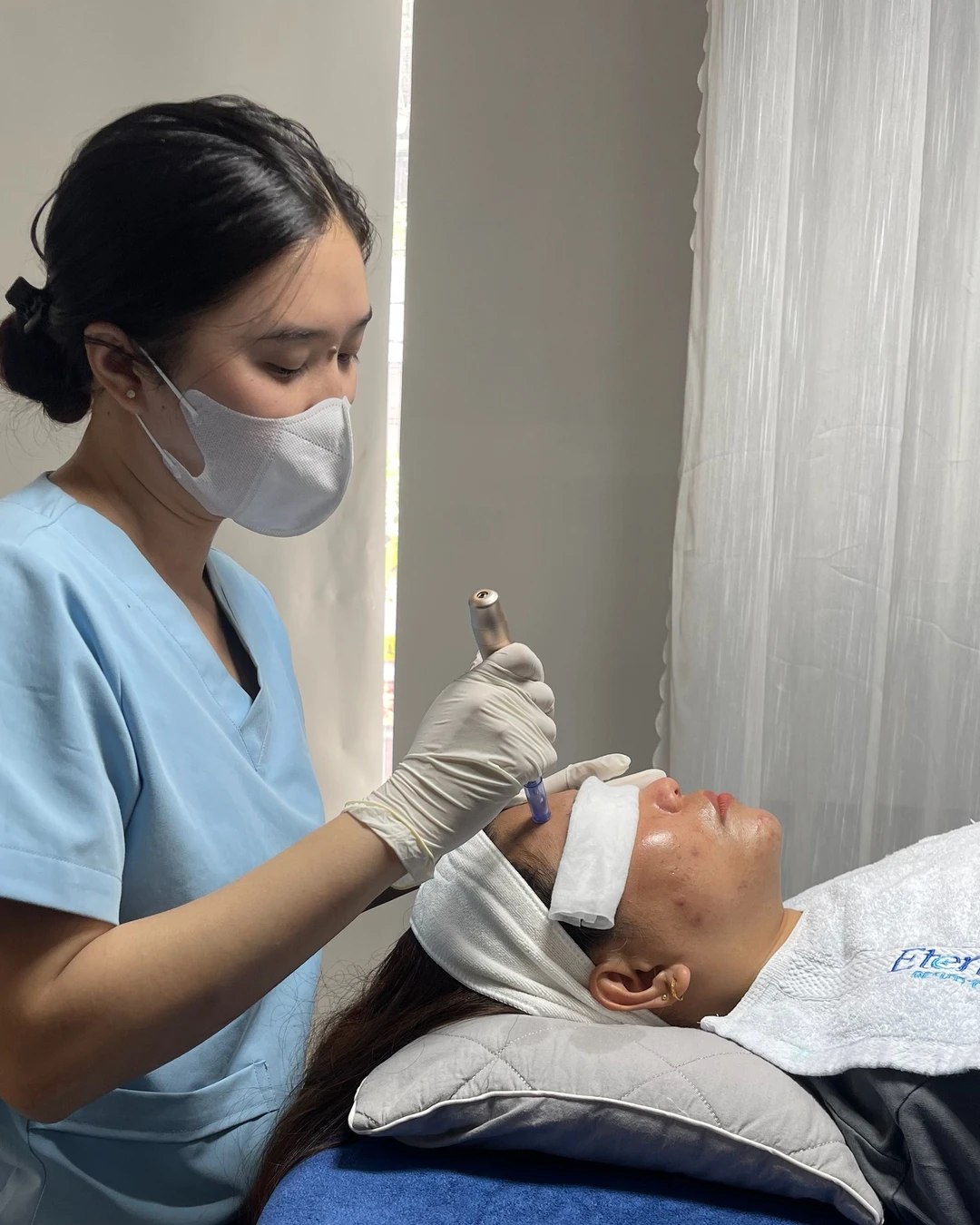
Once the tethering has been released and the deep pits treated individually, what remains is the surface: scar edges, shallow boxcar scars and general texture. This is the job of techniques that work across the whole area:
Fractional CO₂ laser: the most effective of the group, and also the one with the highest risk of post-inflammatory hyperpigmentation. Mechanism, session numbers and recovery milestones are in our fractional CO₂ laser guide.
RF microneedling: according to one systematic review, less effective than ablative laser but safer on darker skin, because radiofrequency energy is not absorbed by melanin the way laser light is. A separate review of 35 studies in skin types III–VI recorded temporary darkening in 7 studies, mild prolonged darkening in 1 and permanent scarring in 1, and noted that much of the evidence is of limited quality.
Microneedling: the gentlest. In one controlled trial using three sessions two weeks apart, average pain was only about 1 out of 10.
Choosing among them comes down mainly to two things: how easily your skin darkens, and how many days of downtime you can accept. For skin that has darkened for a long time after previous procedures, doctors often lean towards RF microneedling or microneedling, or use laser at a lower density with longer gaps between sessions.
Step 4: fine-tune and reassess
After the main steps, a few smaller jobs usually remain: red or brown marks after procedures that need their own treatment (which treatment for acne marks), a surface that benefits from a superficial peel, or a few remaining scars that need another round of TCA CROSS. Some providers use fillers at this stage for scars that are still soft, meaning they flatten when the skin is stretched; how long fillers last varies widely by product.
The easiest thing to get wrong is timing the assessment. New collagen takes months to form and reorganise. In the microneedling trial above, improvement only reached statistical significance at six months, not at three. In a trial combining punch elevation with fractional CO₂ laser, the difference from laser alone was not visible at one month but was clear at four. A sensible point to judge results is therefore about 3–6 months after the last session, once redness has settled. Before-and-after photos are only comparable if they are taken in the same light and from the same angle (how to track skin changes with photos).
Same session or separate sessions?
This question has an answer from Ho Chi Minh City itself. A split-face trial supported by the Ho Chi Minh City Hospital of Dermato-Venereology, published in 2024, followed 34 patients with atrophic acne scars, mostly skin types III–IV. Each had three sessions one month apart. On one side of the face, fractional CO₂ laser was applied immediately after subcision; on the other, laser was applied two weeks after subcision.
Efficacy was similar. The ECCA scar score fell by about 26% on the same-day side and about 20% on the two-week side, a difference that was not statistically significant.
Same-day treatment meant less total downtime: a median of 7 days versus 11, because patients went through one recovery instead of two.
The trade-off was more swelling and more pain during the laser: median swelling of 4 days versus 3, and pain of 6 versus 5 out of 10.
Post-inflammatory hyperpigmentation occurred on both sides: 64.7% of same-day sides and 52.9% of staged sides, a difference that was not statistically significant. This figure is a reminder that preventing pigmentation is part of the plan, not a side issue.
Two other points from this study deserve mention. A score reduction of about 20–26% after three sessions is far more modest than advertising usually promises. And the trial excluded people who had taken isotretinoin in the previous six months or had moderate-to-severe active acne, so its results do not transfer directly to them.
For patients, the practical meaning is clear. Combining techniques in one session saves recovery periods; splitting them makes each visit easier to tolerate. Reviews report that both approaches outperform a single technique used alone (Gupta et al., 2020). The choice can rest on your schedule and your tolerance.
How far apart each technique is spaced
The table below is for reference only, not a fixed appointment schedule. The actual interval between sessions is decided by the doctor at each follow-up, depending on your overall health, your skin, how quickly it recovers and your individual treatment plan.
Technique | Usually used for | Interval between sessions in studies | What to know on darker skin |
|---|---|---|---|
Subcision | Rolling scars, tethered scars | 2–4 weeks, commonly 1 month | Bruising for 1–2 weeks; lumps under the skin resolve, median about 2 months |
TCA CROSS | Ice pick and narrow boxcar scars | 2 weeks to 3 months; no standard yet | Darkening in 2 of 30 patients in one skin type IV–V study; 50% TCA gentler than 80% |
Microneedling | Widespread shallow scars, rough texture | About 2–4 weeks | Low but not zero risk of darkening |
RF microneedling | Rolling and shallow boxcar scars; skin prone to darkening | About 4–6 weeks | Temporary darkening reported in 7 of 35 studies in skin types III–VI |
Fractional CO₂ laser | Surface, boxcar and rolling scars | 4–8 weeks | Post-inflammatory hyperpigmentation more common than with the techniques above; needs lower density and careful sun protection |
The intervals in the table come from the studies cited at the end of this article, each using its own protocol, so your actual schedule may be shorter or longer.
When the order changes
Deep-to-shallow is a way of thinking, not a formula. A few situations make a plan look quite different:
Mild scars that makeup can cover. On Goodman and Baron's grading scale, this is grade 2. Many cases need only one main technique; combining several is mostly for grade 3–4 scars, the kind that are obvious from about 50 cm away.
Mostly scattered ice pick scars. TCA CROSS becomes the main tool, with resurfacing in a supporting role.
Mostly widespread rolling scars. Subcision combined with RF microneedling or laser forms the backbone of the plan.
Skin that has darkened for a long time after earlier procedures, or melasma alongside the scars. Lower-heat techniques, longer gaps between sessions and pigment control come first.
An important event coming up. Steps with long recovery, such as CO₂ laser, are best scheduled after it; a countdown is in how to prepare your skin before a big day.
Mistakes that drag treatment out
Starting with the "strongest" technique for every scar. Laser cannot cut fibrous bands; a face with many rolling scars can go through several laser sessions and still look uneven.
Switching provider or method after one or two sessions. When results can only be read after several months, switching midway means nobody knows which step worked.
Judging too early. At weeks 2–4 the skin is still swollen and may still have lumps after subcision, so scars look shallower than they are, and disappointment tends to follow.
Booking sessions closer together to finish faster. Treating more often than recommended only stacks up inflammation and the risk of darkening, not collagen.
Leaving acne active. Each new flare can add new scars to the very area being treated.