Preparing your skin for a big day follows one rule: the closer the date, the gentler everything you do to it. With four weeks or more, there is still time to try a new product or have a procedure that needs days to recover. With about two weeks, stop at light peels, Aquapeel or acne extraction. The final week is only for keeping the skin steady, and the night before is not the time to try anything new.
The most common mistake comes from wanting to do as much as possible in time: a stronger peel, squeezing every spot, a sheet mask every night, a serum bought last week. Most of these need time, either for the skin to heal or for a reaction to show itself. When the reaction arrives on the day itself, there is no way to take it back.
Why the closer the date, the gentler you should be
Every time the skin is treated, whether with a peel, an extraction or a new product, three clocks start running at once. Before answering "is it too late for this?", a doctor has to look at all three.
Surface healing time. This is the stretch when the skin visibly looks like it is recovering: red, flaking, darker. According to the American Academy of Dermatology (AAD), a light peel takes 1–7 days to heal, and once the redness fades the skin may flake for another 3–7 days; a medium-depth peel takes 7–14 days. After CO₂ laser, new skin usually covers the surface in 7–10 days, but background redness can last for weeks.
Delayed reactions. Some problems do not appear straight after the session. Folliculitis after laser hair removal typically shows up around day 5 to 7. Darkening after CO₂ laser usually appears between weeks 2 and 4 and is more common in darker skin (does CO₂ laser cause dark marks on Vietnamese skin). Irritation from starting a retinoid is usually strongest in the first 1–2 weeks. Skin that looks fine on day two can still turn red on day six.
Time to see results. Real structural change, such as collagen remodelling after laser or microneedling, takes months. With an occasion only a few weeks away, these treatments only have time to get through recovery, not to show improvement.
Something only truly fits when all three clocks have run out before the date, plus a few spare days for anything unexpected. That is why the plan below counts backwards from the day.
Preparing for the day: a quick reference
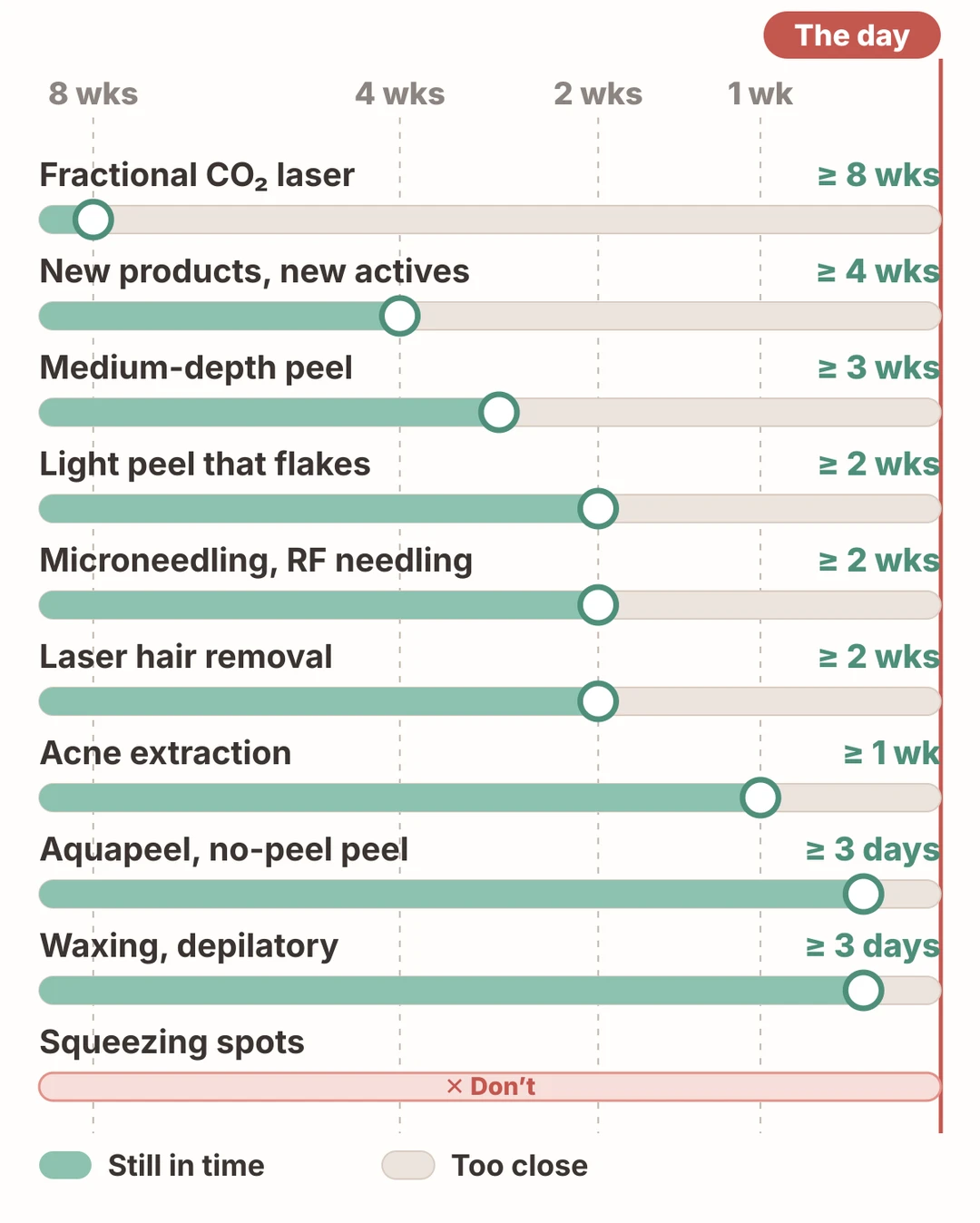
Before the day | What | Main reason |
|---|---|---|
≥ 8 weeks | Fractional CO₂ laser | Best left until after the day: darkening can appear in weeks 2–4 and takes a few more weeks to fade |
≥ 4 weeks | New products, new actives | A patch test takes 7–10 days; retinoid irritation tends to fall in the first 2–4 weeks |
≥ 3 weeks | Medium-depth peel | Heals in 7–14 days and darkens easily on darker skin |
≥ 2 weeks | Light peel that flakes | Heals in 1–7 days, may flake for another 3–7 days |
≥ 2 weeks | Microneedling, RF needling | Redness for a few days to a week |
≥ 2 weeks | Laser hair removal | If the area will be on show: folliculitis can appear on days 5–7 |
≈ 1 week | Acne extraction | Extracted areas are red, slightly swollen and need a few days to settle |
≥ 3 days | Aquapeel, no-peel peel | Practically no downtime, but still worth a margin |
≥ 3 days | Waxing, depilatory cream | Redness, bumps and folliculitis are common; never try it for the first time this close |
Never | Squeezing spots yourself | Dark marks, scarring and infection |
No official guideline sets how long before an event each step should happen. The timings in the table come from documented recovery times, in the medical literature and in Eternal's own protocols, plus a few days in reserve. Peel strength, needle depth, laser settings and individual skin can stretch them, so the specific instructions after each session always come first.
Four weeks or more: time for anything that needs recovery
Four weeks is the latest point to put anything new on your face. The AAD advises testing a new product on a coin-sized patch on the inner arm or in the bend of the elbow, twice a day for 7–10 days, and only using it if there is no redness, itching or swelling. Even after that, a product is best introduced gradually, a few times a week (how to avoid breakouts with a new skincare product). Added up, four weeks is just enough.
Retinoids are the clearest example. In clinical trials, retinoid irritation (dryness, redness, peeling) usually peaks in the first 1–2 weeks and is most likely in the first 2–4 weeks; on darker skin, that irritation can itself leave dark marks. The benefit for acne takes at least 6–8 weeks to show. If you have never used one, leave it until after the occasion. If you still want to start now, this is the latest point to do it, and use it every other day. How to combine retinoids with other actives is covered in can salicylic acid and retinol be used together.
This is also the last call for a medium-depth peel, which needs at least three weeks. Fractional CO₂ laser is different: with only four weeks to go, the sensible time is after the occasion (how fractional CO₂ laser works and how recovery unfolds).
If you have a lot of inflamed acne, do not wait. According to the AAD, acne treatment takes at least 6–8 weeks before breakouts start to ease, so the sooner you see a doctor the better.
If you are planning laser hair removal for the occasion, stop waxing and plucking now, because the laser needs the follicle intact. Four weeks only allows one or two sessions, because the gap between sessions is not fixed, roughly 2 weeks to 1 month depending on the person. The hair will be sparser but not gone, so shaving remains the reliable option for the day itself (what to do before and after laser hair removal).
Finally, take sun protection seriously from this point on. A sunburn or a strap tan line does not fade in a few days, and the AAD notes that a dermatologist cannot laser skin that is tanned or sunburned (how to use sunscreen properly).
About two weeks out: light treatments, booked early
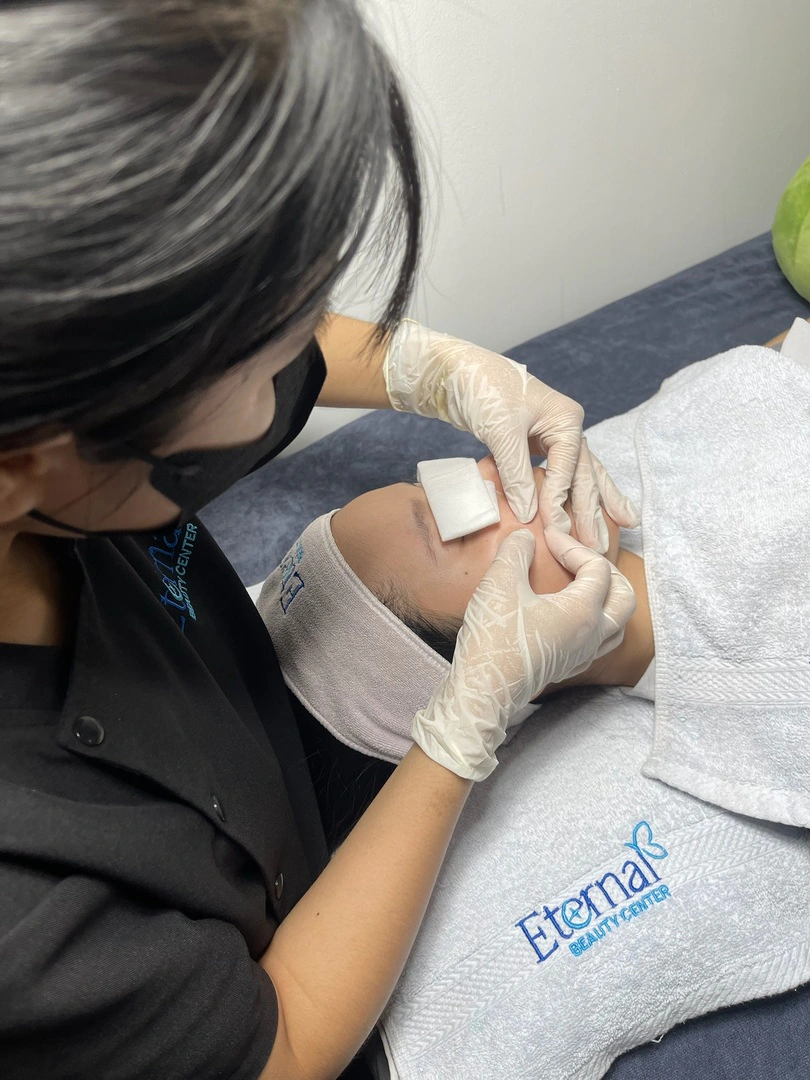
Two weeks is the latest point for a light peel that flakes, microneedling and RF microneedling; according to the AAD, redness after microneedling usually clears within a few days to a week. Treatments with practically no downtime, such as the no-peel Eternal Peel or the cleansing and hydrating Aquapeel, can be done later. Even so, booking early in this window is better, so there is time to see how your skin responds.
Acne extraction is best done about a week before the day, or earlier. Freshly extracted areas are usually red and slightly swollen, heavy makeup should wait 24–48 hours, and the spots need a few days to settle completely. Only comedones that are ready should be extracted; a swollen, inflamed spot is left alone (O2 Peel – medical-grade manual acne extraction).
Do not stack treatments. After an in-centre peel, pause home exfoliation and AHA or BHA products for a few days: it is the total acid load on the skin that decides whether it gets irritated (how often you can safely get a chemical peel).
For laser hair removal, the last session should be at least two weeks before the day if that area will be on show, such as the underarms in a strappy dress. After each session the skin usually looks like a mild sunburn for a few hours to a few days, and the treated area needs to be kept out of the sun.
If your lips tend to get dry and cracked, start at this point. The AAD says that with the right self-care, dry, chapped lips usually heal in 2–3 weeks: apply a non-irritating lip balm several times a day and before bed, use a petrolatum-based ointment if they are badly cracked, and stop licking them, because evaporating saliva dries them further.
The final week: keep your skin steady
In the final week, the goal is to keep your skin as stable as it is now. Keep the routine as it is: a gentle cleanser, moisturiser and sunscreen. Add nothing new, including a new sheet mask or foundation. If you want to change your makeup, do a full trial run a few days earlier.
The only procedures left are those with practically no downtime, such as Aquapeel or a no-peel peel, done early in the week and at least three days before the day. Extraction, if needed, belongs at the very start of the week. No peels that flake, no microneedling, no laser.
If you wax regularly, wax at least three days before; the AAD advises seeing a dermatologist if redness or swelling after waxing lasts more than two days. If you have never waxed, this is not the week to try. Shaving is the lower-risk choice close to the date: wet the skin, use shaving cream and shave in the direction the hair grows to limit bumps and razor burn.
Avoid sunburn. Its symptoms usually appear a few hours after exposure, the skin may peel a few days later, and it often takes about a week to settle, which lands right on the day.
Sleep in the last few nights makes a visible difference, if a small one. In a small experimental study, photographs of people who had been awake for 31 hours were rated by observers as having droopier eyelids, redder and more swollen eyes, darker under-eye circles and paler skin than photographs of the same people after a normal night's sleep.
If you flush easily, go easy on alcohol in these days. The AAD lists alcohol among the common triggers of rosacea flare-ups.
The night before
The night before, a gentle cleanse, moisturiser and an early night are all you need. No exfoliating, and no mask you have never used before.
If you tend to wake up with puffy eyes, cut back on salt and on drinking a lot right before bed, sleep with your head slightly raised, and hold a cool, damp cloth over the eye area for a few minutes after you wake up. Mayo Clinic suggests these steps to reduce the fluid retention behind puffiness; they do nothing for under-eye bags caused by structure or age. A thick layer of lip balm before bed helps lipstick go on evenly the next morning.
If you find a new spot, do not deal with it in front of the mirror at midnight. The next section explains what to do instead.
A breakout right before the day: what to do and what to avoid
The first instinct is to squeeze, and it is also the choice most likely to make the spot look worse the next day. The AAD warns that popping a spot yourself can make it more noticeable, more painful and slower to clear, and raises the risk of infection, scarring and dark marks, especially on darker skin. On Vietnamese skin, post-inflammatory darkening can last weeks to months (why post-acne dark marks are slow to fade).
What you can do at home:
A spot treatment such as benzoyl peroxide, if your skin is already used to it. Apply a thin layer, as more only irritates. Do not expect the spot to vanish overnight, and remember that benzoyl peroxide can bleach fabric, so let it dry completely before putting on your party clothes.
A few minutes of cold, with ice wrapped in a clean cloth, to calm the inflammation and bring the swelling down.
A hydrocolloid patch on a spot that has come to a head: it absorbs fluid and keeps fingers off it. The evidence is limited, mainly one small trial in 20 people over a week, and a patch does nothing for a deep, swollen spot without a head.
Cover it with a non-comedogenic concealer, then remove your makeup thoroughly the same night.
For a large, painful cyst, a dermatologist can inject a small amount of diluted corticosteroid into it. According to the AAD, this flattens most acne cysts within about 48–72 hours, so it needs to happen at least three days before the day. It is a medical procedure, reserved for one or two especially large and painful spots, because it can leave a small dent or a lighter patch of skin at the injection site, sometimes only visible a few weeks later.
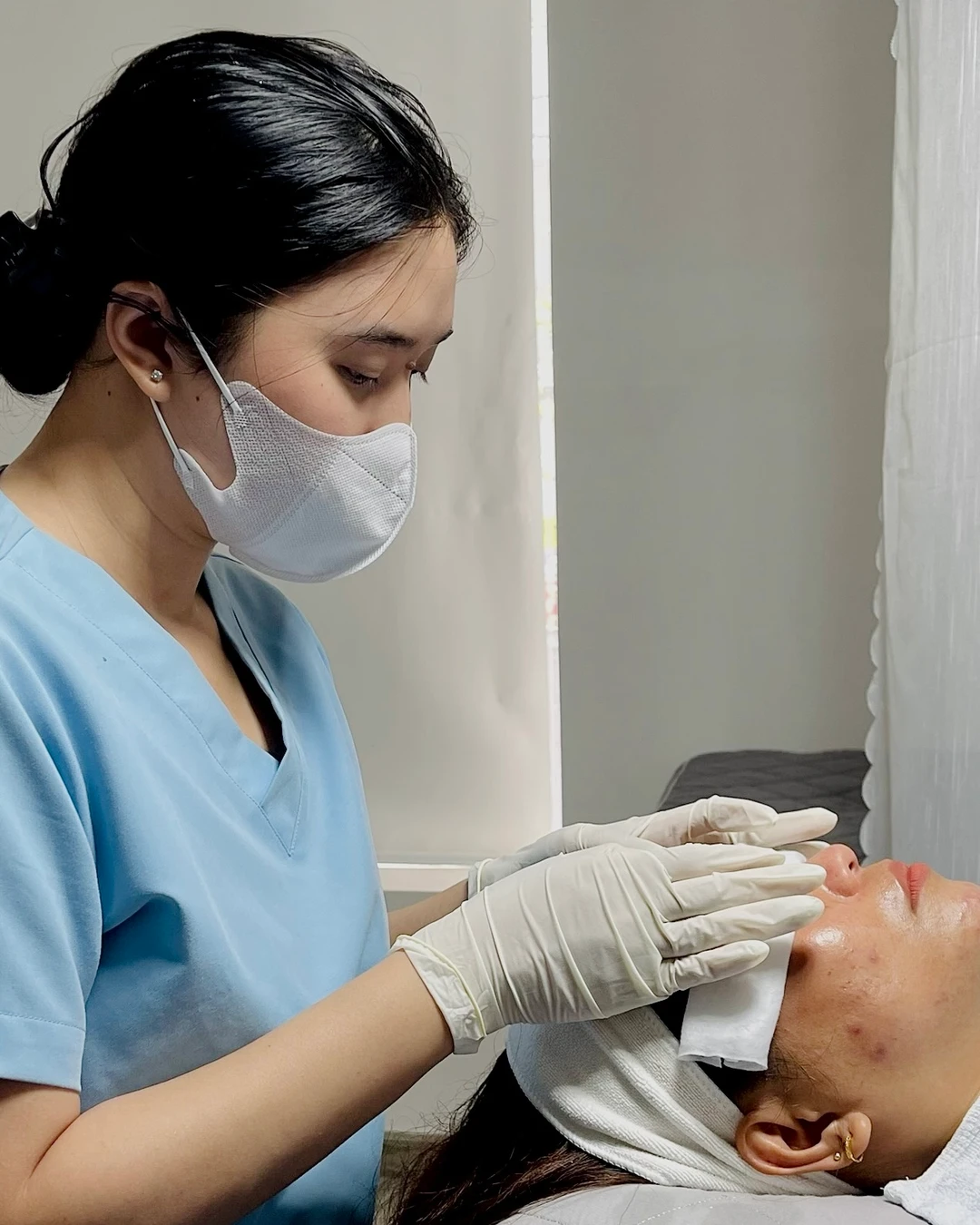
If you still have about a week and the problem is comedones (blackheads, whiteheads) rather than inflamed spots, extraction in a treatment setting with sterile instruments is a safer choice than squeezing them yourself.
What cannot change in a few weeks
Some goals will not be met before the day even if you start today, and forcing them usually does more harm than good:
Melasma takes months of treatment and tends to recur; treating it too aggressively can make it darker (melasma: causes and evidence-based treatment).
Acne scars improve through collagen remodelling, which takes several sessions and several months (what atrophic acne scars are).
Post-acne marks fade over weeks to months depending on the type of mark (which treatment for acne marks).
Enlarged pores cannot be shrunk permanently; what can change is how clear they are and the texture around them (can enlarged pores be shrunk).
For these, makeup is the sensible tool for the day itself. A real treatment plan is better started after the occasion, when there is time for the skin to recover between sessions.
When to see a doctor before the day

You have a lot of inflamed acne, cysts, or a breakout that started after switching products.
Your skin is red, burning or stinging even with gentle products, a sign the skin barrier is damaged (what the skin barrier is).
You are taking isotretinoin, tretinoin or another prescribed treatment and plan to wax, have a peel or laser. The AAD advises against waxing if you have taken isotretinoin in the past six months; the safe timing for other procedures needs a doctor's review.
You are pregnant or breastfeeding and want to add an active ingredient or have a procedure.