Scar creams and topical medicines work on some of the things people call scars, but they cannot fill a depressed scar. Post-acne marks fade with sun protection and brightening actives, and a raised scar may flatten with silicone used consistently over time. A depressed scar, such as an acne or chickenpox scar, is a place where the supporting tissue of the dermis has been lost, and no cream can put that tissue back. Changing that structure takes a procedure that works down in the dermis, such as fractional CO₂ laser.
If you have tried countless products and the scars are still there, the products may not be bad at all; skincare is simply not the right tool for this problem. Before choosing a product or a treatment, you need to know which kind of scar you have, because each sits at a different depth in the skin and responds very differently to topicals.
Four things people call a scar
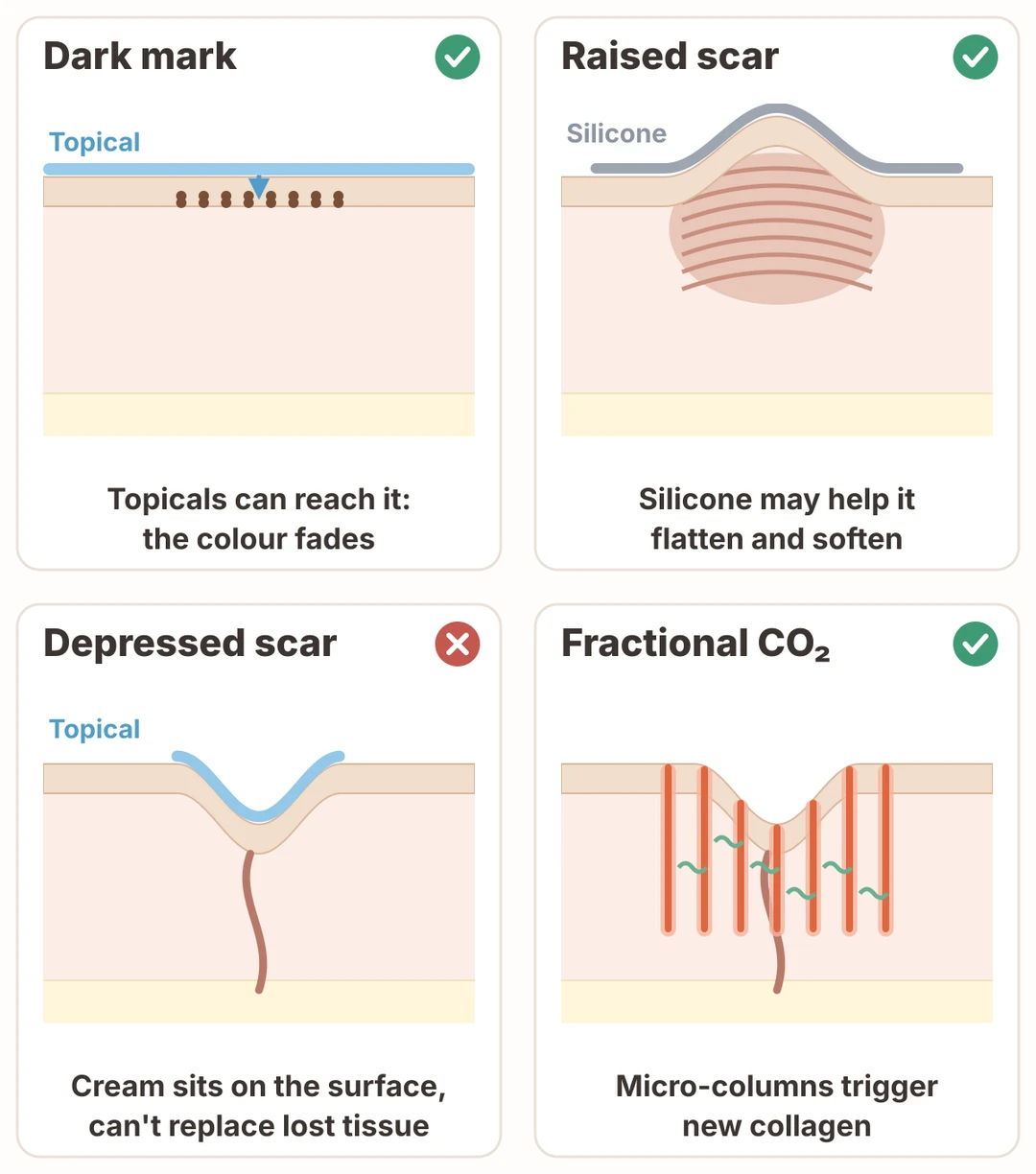
When someone says a scar "won't go away no matter what I put on it", they usually mean one of these four conditions, or several at once.
Post-acne marks. Flat brown, red or blue-grey spots where acne used to be. The American Academy of Dermatology (AAD) notes that these flat spots are usually not scars and usually fade, although on darker skin this can take 6 to 12 months, or longer if the pigment sits deep (why post-acne dark marks are slow to fade).
Raised (keloid and hypertrophic) scars. Too much collagen builds up, so the scar stands proud of the skin and may itch or stay red.
Depressed scars. These include acne scars, chickenpox scars and some scars from injuries. Inflammation destroys collagen in the dermis, so the surface sinks. In rolling scars, fibrous bands also tether the base of the scar down to the fat beneath (the 3 types of acne scars).
New scars. For about the first year, scar tissue is still remodelling, so it is often red and still changing. Good care during this phase can make a real difference to how the scar ends up.
A simple way to tell them apart is to look in side light, next to a window or with a lamp held to one side. A mark stays flat and only differs in colour. A depressed scar casts a shadow, even once the colour around it has evened out.
Which scars do scar creams actually help?
Type | Do topicals help? | Notes |
|---|---|---|
Post-acne marks | Yes | Sun protection and brightening actives help them fade; for stubborn marks, peels or lasers chosen by type |
Raised scars | Partly | Silicone may help them flatten and soften (weak evidence); if not enough, steroid injections by a doctor |
Mild depressed scars | A little | Retinoids or salicylic acid can make them less noticeable |
Deep depressed scars | No | Needs a procedure: fractional CO₂ laser, TCA CROSS, subcision |
New scars | Supportive | Sun protection; silicone for wounds prone to raised scarring |
The table draws on AAD guidance, international consensus papers on scar management and Cochrane reviews. For most topical scar products the quality of evidence is still low, so what is most certain is their limits.
Prescription topicals and common "scar" ingredients
This section goes through the products most often prescribed or advertised for scars, judged on the research rather than on the label.
Retinoids: better at preventing new scars than filling old ones
The best evidence for retinoids comes from a 2018 trial in 67 people with moderate to severe acne. Each person applied adapalene 0.3% with benzoyl peroxide 2.5% gel to one half of the face and a vehicle gel to the other half for 24 weeks. Depressed scars on the treated side fell by 15.5%, while on the vehicle side they rose by 14.4%. The trial was funded by the drug's manufacturer and the difference amounted to roughly four scars per half-face, so the most reasonable reading is that treating active acne effectively limits new scars, while its ability to smooth existing ones is modest.
For scars that remain once the acne has gone, the data are weaker still. A small uncontrolled study gave 20 people adapalene 0.3% for 24 weeks: participants and investigators rated the skin surface as improved, but the number of scars counted did not change significantly. The AAD likewise says only that a retinoid or salicylic acid can make mild scarring less noticeable. Retinoids remain worth using to control acne and refine the surface; just do not rely on one to fill a deep pit. On darker skin, applying too much and causing irritation can itself leave dark marks.
Topical corticosteroids: no place on a depressed scar
Potent topical corticosteroids applied daily for months can thin the skin and cause stretch marks and visible blood vessels. In scar care, corticosteroids are used mainly for raised and hypertrophic scars, usually injected into the scar or applied under a dressing as a doctor directs. On a scar that is already sunken from lost tissue, there is no reason to apply one yourself. Be wary of unlabelled creams too: DermNet reports that some products sold without a prescription have been found to contain potent steroids illegally.
Silicone: first choice for raised scars, not for depressed ones
Silicone gel and sheets are ranked by several international consensus papers as the first-line, non-invasive option for preventing and treating raised and hypertrophic scars. Even so, Cochrane reviews rate the evidence as weak: there are signs of benefit in people at high risk of raised scarring, but the trials are of poor quality. For depressed acne scars there is almost no research; one 2018 trial used silicone only as an add-on after laser.
When silicone is not enough, a doctor can inject a corticosteroid into a keloid. According to the AAD, between 50% and 80% of keloids shrink after injection, but many regrow within five years, so these scars usually need long-term follow-up.
Vitamin E, onion extract and "filling" creams
Topical vitamin E is the clearest case of a popular ingredient without evidence behind it. In a small study of 15 people after surgery, vitamin E either had no effect on or worsened the appearance of the scar in 90% of cases, and 33% of people developed contact dermatitis to it. A 2016 systematic review concluded there is not enough evidence to recommend vitamin E on its own for scars.
Onion extract gel has mixed results. It beat no treatment in some trials, but a 2021 meta-analysis of 13 trials found no difference compared with other common topical treatments, along with more side effects. There are no data for depressed acne scars.
Creams marketed as "filling" scars with collagen or hyaluronic acid run into a different limit. Under a widely cited rule of thumb, molecules heavier than about 500 daltons struggle to cross the outer skin barrier, and native collagen weighs around 300,000 daltons. Hyaluronic acid helps the surface hold water and look plumper for a while, but that is not enough to replace lost tissue. Fillers only have evidence (of moderate quality, according to Cochrane) when a doctor injects them in the right place beneath the scar.
How new scars differ from settled ones
After a wound or an inflamed spot heals, the scar tissue keeps remodelling for months, often around a year and sometimes longer. The UK's NICE acne guideline therefore advises considering scar treatment only once the acne has been clear for about a year. During that time a scar may become less red and softer, and for wounds prone to raised scarring, sun protection and silicone are most useful.
Once it has settled, a depressed scar does not fill back in by itself. The AAD notes that acne scars can fade but rarely go away completely on their own, and a review in the BMJ states plainly that scars cannot yet be made to disappear. Another year of creams will not change that, because the missing part is in the dermis, and topicals do not lay down new tissue there.
The most effective step comes before a scar forms. In a survey of nearly 2,000 acne patients in the United States, more severe acne and a longer delay before effective treatment were both linked to scarring. NICE also notes that picking and squeezing spots raises the risk of scars. Treating inflammatory acne early is the best-supported way to prevent acne scars (what acne is and how it is treated).
A depressed scar only fills in after a controlled injury
The amount of new collagen needed to fill a depression only forms when the skin heals an injury. Every treatment with evidence for depressed scars relies on this: it creates a controlled injury at the depth of the scar so the skin rebuilds itself. Microneedling and RF microneedling make tiny channels in the dermis. TCA CROSS places concentrated acid into the base of each narrow scar. Subcision cuts the fibrous bands tethering the scar. Fractional CO₂ laser vaporises very small columns of tissue down into the dermis.
No single method suits every scar, and combinations generally do better than one method alone. How to choose by scar type is covered in what atrophic acne scars are and how they are treated.
What fractional CO₂ laser does to a depressed scar
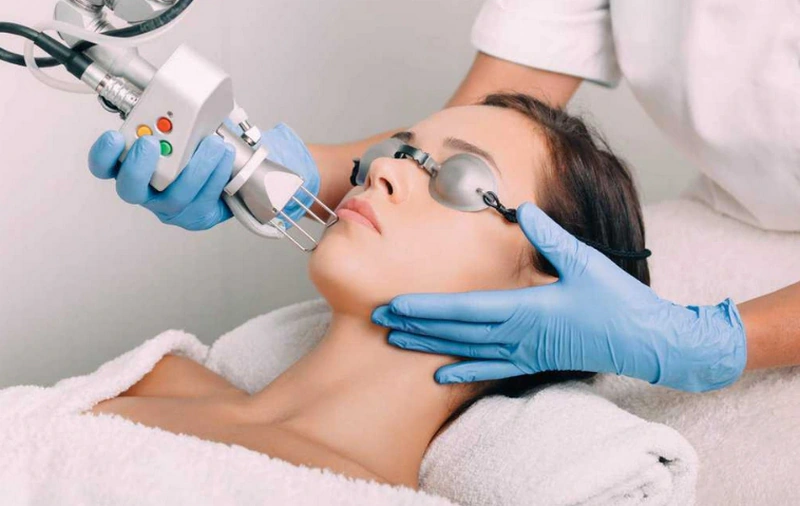
The 10,600 nm CO₂ laser beam is absorbed by water in the tissue. It vaporises microscopic columns and leaves healthy skin in between. As those columns heal, the skin produces new collagen, so the base of the scar gradually becomes shallower and the surface smoother (how fractional CO₂ laser works).
It is one of the most studied treatments for acne scars. NICE advises considering CO₂ laser, alongside a glycolic acid peel, for severe acne scarring that persists a year after the acne has cleared. In a 2023 network meta-analysis of 26 trials, ablative fractional lasers, the group that includes CO₂, did better than non-ablative fractional lasers and radiofrequency. A 2025 systematic review found that most patients improved by about 30–70%. In 13 Asian patients with skin type IV who had three sessions, 85% improved by at least 25–50%, and the improvement kept growing between the first and sixth month after the last session.
Results also vary a great deal between studies. In 60 Indian patients who had three or four sessions, 43.3% improved by more than 50%, while 31.7% improved by less than 25%. In a retrospective analysis of 107 Asian patients in Singapore, around two thirds improved by less than 25%. The AAD is clear that laser makes a scar less noticeable rather than removing it, and that results often take months to show.
Three things matter most: the scar type, how treatments are combined, and the settings.
Scar type. Icepick scars respond least, because they run deeper than the laser beam reaches; they usually need TCA CROSS. Rolling and boxcar scars respond better.
Combination. A 2026 network meta-analysis found that combinations generally beat single treatments, and that CO₂ laser combined with subcision or PRP gave the most consistent benefit.
Settings and Asian skin. In the study of 13 Asian patients above, 92% developed mild darkening after laser, which cleared on average within five weeks. Lower density, wider gaps between sessions and careful sun protection help reduce the risk (does CO₂ laser cause dark marks on Vietnamese skin).
Skin care still matters, in a different role
Skincare looks after the skin surface and its barrier, and it does jobs no procedure can do for you: controlling acne so no new scars form, fading the marks that come with scars, keeping the skin barrier healthy before treatment, protecting against the sun to lower the risk of darkening after laser, and maintaining the result once a course of treatment ends. It supports scar treatment; it does not replace professional scar treatment. A routine for each stage of scar treatment is covered in can acne scars be treated at home.