The ingredient list is the most trustworthy part of a cosmetic's packaging, because the law decides how it is written, not the marketing team. Read properly, it tells you whether a product contains something you need to avoid, which ingredients make up most of the formula, and where the ingredient advertised on the front actually sits. It does not tell you the concentration of an active ingredient, the pH, or whether the product will suit your skin. Phrases such as "non-comedogenic", "hypoallergenic" and "paraben-free" mostly rest on no mandatory definition or test.
There is one condition: the product has to come from a traceable source. A tub of unlabelled mixed cream can print anything on its label, and the most dangerous substances in unregulated cosmetics are usually the ones that never appear on the ingredient list at all.
Reading the order of an ingredient list
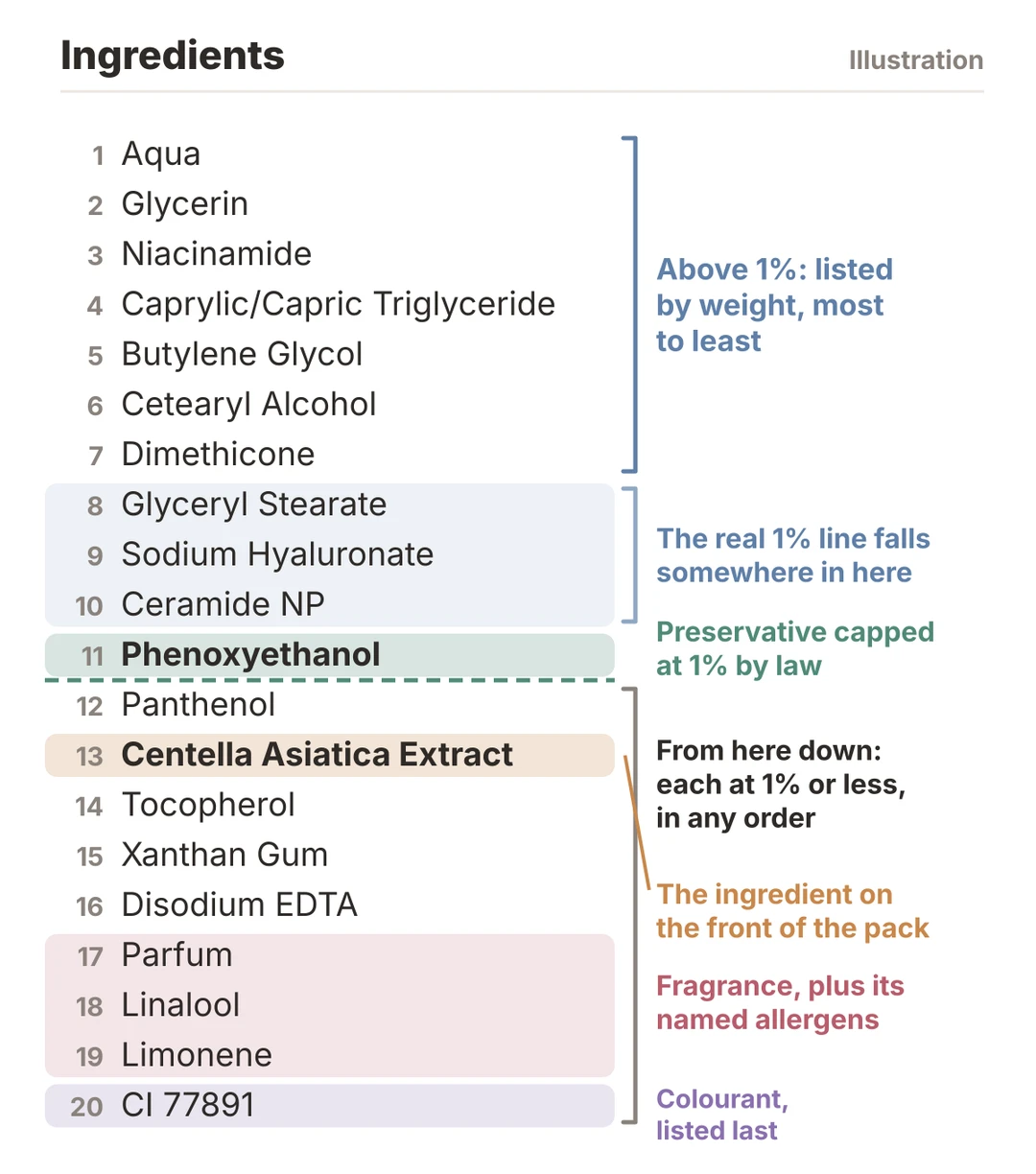
In Vietnam, cosmetic labels follow the ASEAN labelling requirements: every ingredient must be listed by its international INCI name, and percentages are not required. The ordering rule matches Europe and the United States. Ingredients are listed in descending order of weight at the time they are added to the formula, so the largest goes first. The exception sits at the end of the list: ingredients below 1% may appear in any order, as long as they come after everything above 1%. Colourants can go last, often as Colour Index codes such as CI 77891, and a whole fragrance blend may be declared with the single word "Parfum" or "Fragrance".
That rule makes the first half of the list a fair picture of what the product is built from. Water (Aqua) in first place is normal; it is the base of most creams, gels, toners and serums, and it does not mean the product has been watered down. The next ingredients, such as humectants (glycerin, butylene glycol), oils and esters, thickeners and emulsifiers, create the texture you feel when you apply it.
The 1% line is never printed, but you can estimate it. Some ingredients are capped at 1% by law. The most common is phenoxyethanol, a preservative found in a great many products, and the 1% ceiling appears in both the ASEAN and the European lists of permitted preservatives. Because everything above 1% must come first, any ingredient listed after phenoxyethanol is present at no more than 1%. The real line may sit higher, since ingredients below 1% are also allowed to appear before the preservative.
Two practical consequences follow:
An advertised ingredient listed after the preservative is present only in a small amount. An extract printed in large letters on the front of the box is not evidence that the product contains enough of it to do anything.
Sitting below the 1% line does not make an ingredient useless. The preservative protects the whole jar from contamination at no more than 1%. In Europe, fragrance allergens have to be named individually once they exceed 0.001% in leave-on products; at levels that low, they still matter to someone who is already allergic. Equally, a place near the top of the list is no guarantee that a product works.
What an ingredient list doesn't tell you
An ingredient list is a list of names, not a recipe. The following information is almost always missing.
Concentration. The rules only require names and order. Some brands print a percentage, such as "niacinamide 10%"; that is information the brand has chosen to disclose.
pH. For exfoliating acids such as AHAs and BHAs, and for vitamin C as L-ascorbic acid, pH decides much of both the effect and the irritation. In an absorption study on pig skin, L-ascorbic acid only entered the skin when the formula's pH was below 3.5. Labels almost never state pH. How each group of actives is best used is covered in our guide to skincare actives.
The form of an active. "Vitamin C" on the front of a pack may correspond to Ascorbic Acid in the ingredient list, or to a derivative such as Magnesium Ascorbyl Phosphate, Sodium Ascorbyl Phosphate, Ascorbyl Glucoside or Ascorbyl Palmitate. Derivatives are usually more stable, but in the same pig-skin study, magnesium ascorbyl phosphate and ascorbyl palmitate did not raise vitamin C levels in the skin. That is animal data rather than a treatment result in people, but it shows how far apart two products that both say "vitamin C" can be.
Formula and packaging. Two formulas with identical ingredient lists can differ in stability, penetration and feel. The label also cannot tell you whether an active ingredient is still intact or has oxidised during storage.
How your own skin will react. A product made entirely of "gentle" ingredients can still irritate your skin, and the reverse is also true. The list helps you rule out ingredients you already know you don't tolerate; it cannot predict a new reaction.
Front-of-pack claims with no shared standard
The front of the pack belongs to marketing. Many phrases sound clinical but are not tied to any mandatory definition or test, so they tell you more about what the brand wants you to think than about what the product does.
Label claim | What it usually means | What it does not guarantee |
|---|---|---|
"Non-comedogenic" | The formula is designed to be less likely to clog pores | No mandatory shared definition or test; some people still break out |
"Hypoallergenic" | Common allergens have been left out | The US has no standard for the term; in Europe, even when used correctly, it does not mean an allergy is impossible |
"Paraben-free", "free from…" | The named ingredient is absent | Says nothing about what replaced it |
"Natural", "organic", "clean" | Contains plant-derived ingredients | No common definition for cosmetics; an ingredient's source does not determine its safety |
"Dermatologically tested" | Tested on people under a doctor's supervision | Does not say how many people, for how long, or with what result |
"Alcohol-free" | Contains no ethanol (Alcohol, Alcohol Denat.) | May still contain fatty alcohols such as cetyl, stearyl or cetearyl alcohol, which soften the skin |
Two other kinds of label have their own articles: SPF, PA and "broad spectrum" on sunscreens in how to use sunscreen properly, and "anti-pollution" claims in how air pollution affects skin.
"Non-comedogenic": a reasonable filter, not a guarantee
A 2018 review noted that terms such as "non-comedogenic" and "oil-free" are not regulated by any governing body. Even so, the American Academy of Dermatology (AAD) advises people with acne-prone skin to use makeup, sunscreen, skin care and hair care labelled "non-comedogenic" or "won't clog pores", because these products don't cause breakouts in most people. Treat the claim as a first filter; how your own skin responds only shows up with use. The AAD also points out that even non-comedogenic makeup can cause acne if you sleep in it.
"Paraben-free" and other "free from" labels
Many brands avoid parabens, yet in dermatology they remain one of the least allergenic groups of preservatives. Europe banned five parabens because there were not enough data to assess their safety and tightened the limits on propylparaben and butylparaben; the others are still permitted within set limits. The European Commission's guidance on cosmetic claims, applied since July 2019, says a "free from parabens" claim should not be accepted, because it denigrates a whole group of legally permitted ingredients.
Nor is a replacement automatically safer. Methylisothiazolinone (MI) is the clearest example: in 2015, 6% of patients patch tested at participating European dermatology centres reacted to this preservative. The EU banned MI in leave-on products from February 2017, and a follow-up survey found that MI allergy had roughly halved by 2017 compared with 2015. "Free from X" tells you nothing about whether whatever replaced X is any kinder to skin.
"Natural", "organic", "clean"
The US Food and Drug Administration (FDA) has no legal definition of "natural" or "organic" for cosmetics, and states plainly that an ingredient's source does not determine its safety. A 2022 analysis of 1,651 products listed under "natural" by three major US retailers found that 94% contained at least one known contact allergen, with an average of 4.5 per product. Containing an allergen does not mean a product will cause a reaction in everyone, and the study made no comparison with conventional products, but it shows that a "clean" label is not a filter for sensitive skin. Essential oils are an easy example: tea tree oil becomes a stronger allergen once it oxidises.
Sensitive skin: using the list to find what you actually need to avoid
If your skin reacts easily, the ingredient list is most useful when you know what you are looking for. Avoiding every hard-to-pronounce chemical name doesn't help much, since water, glycerin and vitamin E (tocopherol) have chemical names too. What is worth looking for is the specific substance that has been shown to cause problems for you.
Fragrance and preservatives are the two leading causes of contact allergy to cosmetics. In a study that patch tested 3,119 adults randomly drawn from the general population of five European countries, a conservative estimate was that about 1.9% had a contact allergy to fragrance, with women affected about twice as often as men. Among dermatitis patients referred for patch testing, positive results to the fragrance mix are far more common, around 6–13% depending on the network and the year.
"Parfum" or "Fragrance" is one word standing in for a whole blend. In Europe, allergenic fragrance substances such as linalool, limonene, citronellol and geraniol must be named individually when they exceed 0.001% in leave-on products or 0.01% in rinse-off products, and in 2023 the list grew by 56 substances on top of the existing 24. In the US, an equivalent rule is still waiting for the FDA, so many products simply say "Fragrance". The same blend can also be declared as "Parfum", "Fragrance" or "Aroma".
Two terms are easily confused: "fragrance-free" and "unscented". According to the AAD, "unscented" means a product's scent has been covered up, and the masking fragrance can still cause an allergic reaction; people who need to avoid fragrance should choose products labelled "fragrance-free". Neither term is tightly regulated, so it is still worth checking the ingredient list, including for essential oils.
Alcohol (Alcohol, Alcohol Denat.) tends to be feared more than it deserves. In a study of healthy volunteers, 60–100% alcohol solutions reduced the hydration of the outer skin layer but did not significantly increase water loss through the skin or cause redness, and they were less irritating than washing with a 0.5% solution of the detergent SLS. That study modelled hand disinfection, not facial skin care. When your skin is irritated or your barrier is damaged, it is still sensible to avoid products with drying alcohol near the top of the list, as explained in our skin barrier guide.
If a doctor has identified your allergen with patch testing, ask for its other names too, since the same substance can be written several ways on a label, and reread the ingredient list each time you buy, because the formula of the same product can change.
For a new product, the AAD suggests a test first: apply it to a coin-sized area on the inner arm or the bend of the elbow twice a day for 7–10 days before using it on your face. If your skin reacts, stop and keep the packaging, or take a photo of the ingredient list; that is the information a doctor needs to narrow down the cause.
An ingredient list is only as reliable as the product's origin

An ingredient list is a declaration by whoever places the product on the market. In Vietnam, that company may only put a cosmetic into circulation after the authorities have issued a receipt number for its product notification, and it carries full responsibility for the product's safety, efficacy and quality. The receipt number only confirms that the product has been declared: under Circular 06/2011/TT-BYT itself, it does not certify that the product is safe or effective. Checks happen afterwards, once the product is on sale.
Those post-market checks still find labels that don't match what is inside. In 2025, the Drug Administration of Vietnam suspended and recalled a whitening cream that failed the limit for mercury, a substance banned in cosmetics and tolerated only as an impurity of no more than 1 part per million. In January 2025 and January 2026, it recalled products containing preservatives that were not in their declared formulas; in one case, the preservative named on the label could not be found at all. The Ho Chi Minh City Department of Health has also suspended products that tested positive for clobetasol propionate, a very potent corticosteroid. Substances like these never appear on an ingredient list; what long-term use of corticosteroid creams does to the face is described in facial skin conditions mistaken for acne.
Imported products sold in Vietnam must carry a Vietnamese sub-label while keeping the original label. Ingredient names stay in their international form, but the directions for use, safety warnings, and the name and address of the responsible company must be in Vietnamese. The notification receipt number does not have to be printed on the label, so you can ask the seller for it; a legally marketed product always has one. At the time of writing (November 2026), the cosmetics notification lookup on the Drug Administration of Vietnam's online services portal shows a notice that the function is under construction, so buyers cannot yet check a number online; suspension and recall notices, however, are still published openly on dav.gov.vn.
Signs that should make you stop before buying:
No Vietnamese sub-label, or no name and address of the company responsible for the product.
Sold in an unlabelled tub, decanted from a larger container, or offered as a "custom-mixed cream".
Promises such as "visibly whiter in a few days" or "melasma and acne gone fast".
The seller cannot provide the product's notification receipt number.
Expiry dates and the open-jar symbol
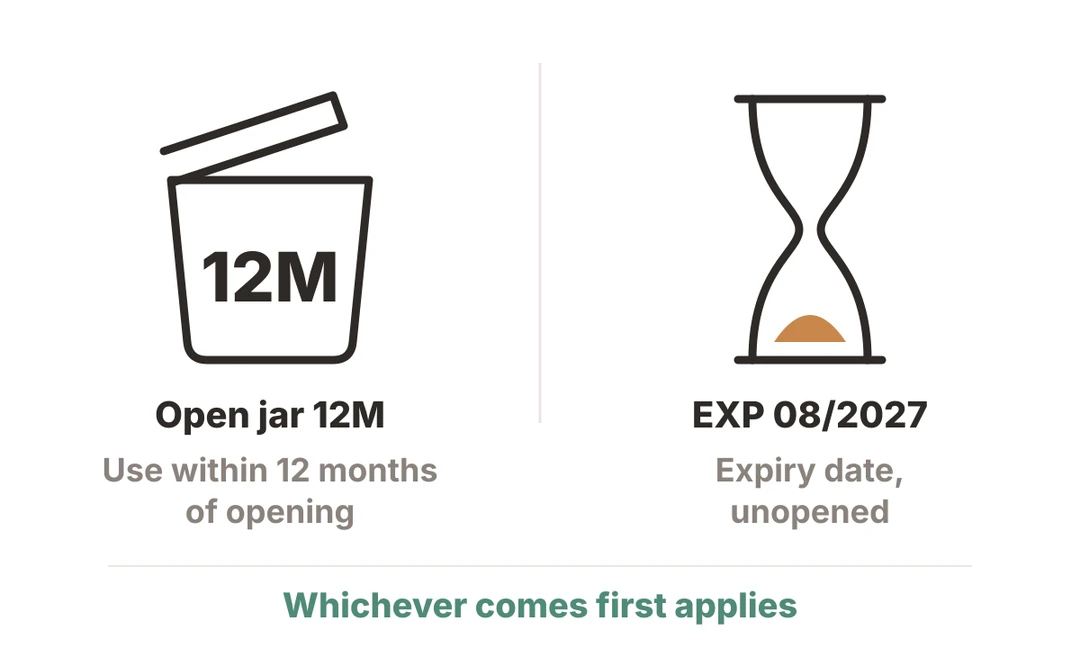
Under Vietnamese rules, a cosmetic label must show either the manufacture date or the expiry date, and products that stay stable for less than 30 months must show an expiry date. So a more stable product may carry only a manufacture date. The open-jar symbol with a number such as 6M or 12M (period after opening, PAO) is not required in Vietnam, but it often appears on products made for the European market, where it is mandatory for products that keep for more than 30 months. The number tells you how many months the product can be used after it is first opened. When a label shows both an expiry date and an open-jar symbol, whichever comes first applies.
The number on the open-jar symbol is an estimate for normal use. Each time a finger dips in, a brush touches the product or the lid is left open, bacteria can get in. A UK study that cultured 467 used makeup products found bacteria in most samples, including E. coli; makeup sponges carried very high bacterial loads, and 93% of the sponges had never been cleaned. Packaging matters as well: in an older trial using deliberately unpreserved products, 71% of screw-cap lotion bottles became contaminated during consumer use, compared with 10% of pump bottles.
The FDA notes that manufacturers usually recommend discarding mascara two to four months after purchase, because the wand meets bacteria and fungi with every use. It also advises against leaving cosmetics somewhere hot, such as a car, because heat can break down preservatives and let bacteria and fungi grow faster; bathroom humidity helps them too. In Ho Chi Minh City, a motorbike seat compartment at midday is the worst place to keep sunscreen or a serum. Throw out anything that has changed colour, smell or texture, but a normal-looking product is not necessarily still good, so write the opening date on the pack.
A one-minute label check
When you pick up a product, check in this order:
1. Origin: a Vietnamese sub-label, the responsible company's name and address, and a seller who can give you the notification receipt number.
2. Anything you know you are allergic to, searched under every name your doctor has given you.
3. Your skin right now: if it is irritated, look for fragrance, essential oils and drying alcohol near the top of the list.
4. The advertised ingredient: is it there, in what form, and before or after the preservative?
5. The expiry date and open-jar symbol. Claims with no shared standard can be ignored.
When to have a doctor look at your products' ingredient lists
Reading labels helps you avoid what you already know about. It cannot replace an examination in these situations:
Redness, itching or flaking that keeps coming back despite switching products. Patch testing identifies the exact allergen, which reading labels cannot do.
You suspect you have used a cream containing a corticosteroid: thin, red skin that breaks out in bumps when you stop.
You are pregnant or breastfeeding and want to know which actives to avoid (our article on melasma after pregnancy covers actives considered usable while breastfeeding).
You want to combine several strong actives such as retinoids, acids and vitamin C (see can salicylic acid and retinol be used together).