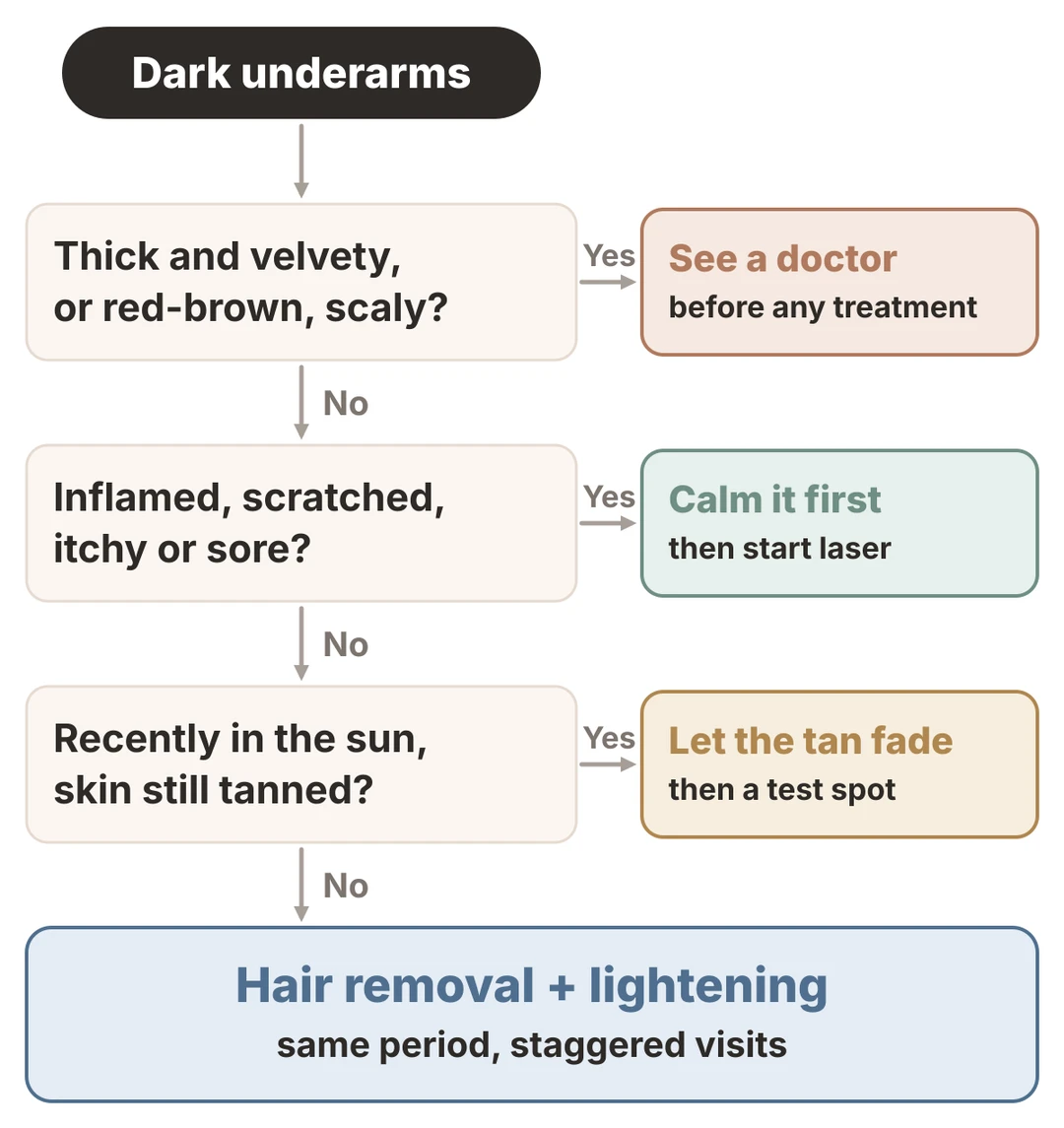
For the most common kind of underarm darkening, post-inflammatory marks from years of shaving, plucking or waxing, you usually don't have to choose. Laser hair removal stops the repeated irritation, lightening treats the pigment that has already built up, and the two can run in the same period if the appointments are staggered. The order matters in three situations only: when the skin is inflamed, when it is freshly tanned, and when the darkening is not post-inflammatory at all.
What kind of darkening is it?
"Dark underarms" covers several conditions with different causes. The question of laser versus lightening only really applies to two of them: post-inflammatory hyperpigmentation, flat marks that build up after repeated irritation from hair removal, and friction darkening. In both, laser and lightening each have a job to do.
The other two need a different route. Skin that has thickened and feels velvety may be acanthosis nigricans, which often travels with insulin resistance. A red-brown patch with fine scale, sometimes with odour, may be a superficial bacterial infection. A 2025 systematic review of underarm hyperpigmentation treatment notes that these conditions need treatment of their cause rather than lightening agents. How to tell the four apart by touch is covered in our guide to dark underarms and body folds.
Does laser hair removal clear dark underarms?
Not directly, and the reason lies in how the laser works. Laser hair removal relies on selective photothermolysis: melanin in the hair shaft and follicle absorbs the light and turns it into heat that disables the follicle. Pigment already sitting in the skin is not the target. None of the 10 studies pooled in that 2025 review involved a hair-removal laser. Reports of skin looking lighter after laser hair removal come from a handful of small, uncontrolled studies, such as one on razor bumps in the beard area.
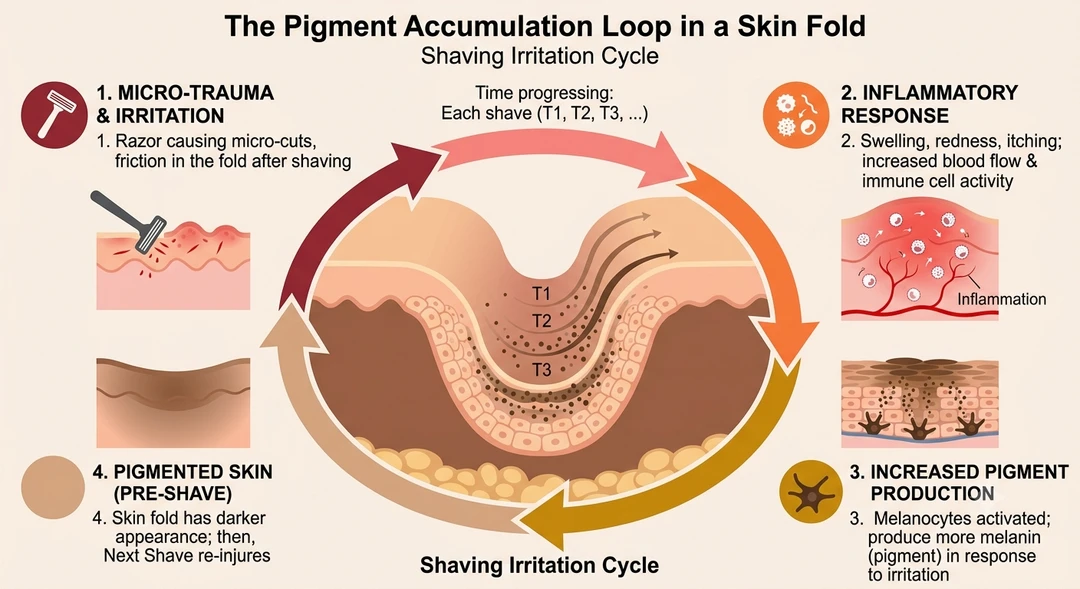
What laser hair removal does is take away the trigger, and in the underarm the trigger is usually the hair-removal habit itself. A histology study of underarm skin in Filipino women linked plucking to melanin granules dropping into the dermis. Pigment at that depth fades far more slowly than pigment in the epidermis, and sometimes persists for good. Shaving is gentler than plucking but happens more often.
Nor does the darkening appear after a single session. In a study of 64 Thai women, underarm skin reddened after shaving, plucking and waxing alike, yet no hyperpigmentation had appeared by the 48-hour check. The marks are the sum of hundreds of small irritations over years, and post-inflammatory pigment deepens further when inflammation keeps recurring or the skin sees UV.
That is why lightening while keeping the old habit rarely lasts: as soon as old pigment is treated, the next round of irritation adds more. Equally, once the trigger has stopped, epidermal post-inflammatory pigment can still take months to years to fade on its own. The two treatments complement each other:
Laser hair removal | Lightening | |
|---|---|---|
Works on | The repeated trigger: shaving, plucking, waxing, ingrown hairs | Pigment already built up in the skin |
Cannot do | Erase existing marks | Prevent new marks if you keep shaving or plucking every week |
Early changes | Finer, sparser hair; fewer bumps and less razor sting | A gradually more even tone over several sessions |
What remains is whether anything forces you to postpone one of them.
Is laser safe on skin that is already dark?
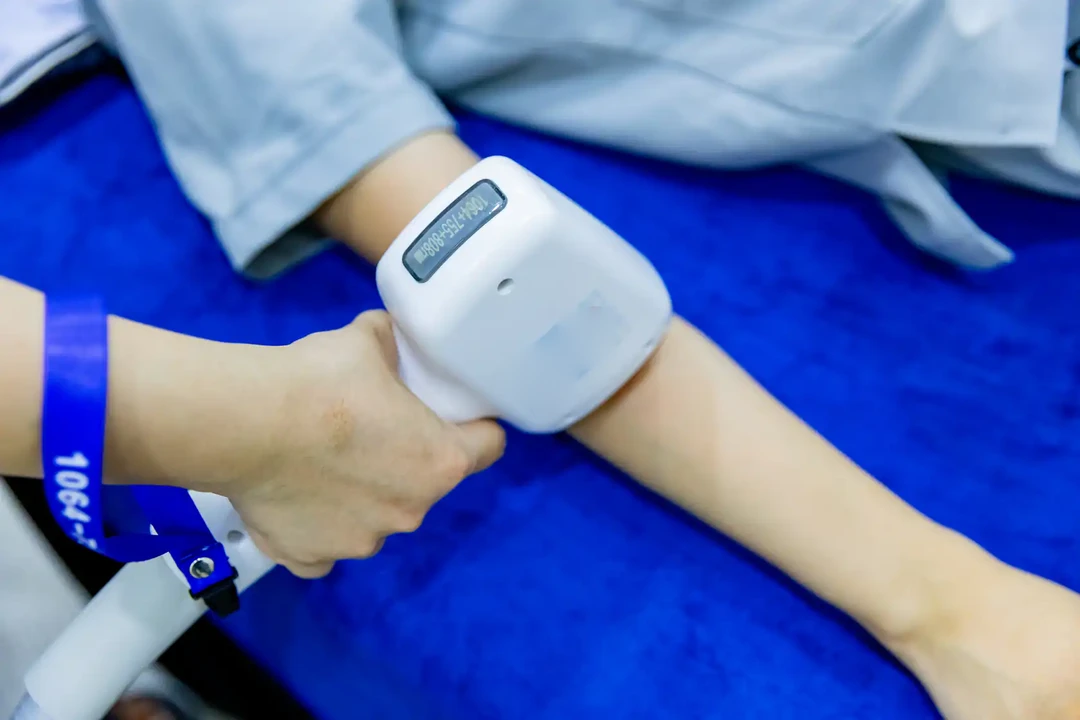
A laser cannot tell melanin in the follicle from melanin in the surface of the skin. The darker or more recently tanned the skin, the more energy the epidermis absorbs, and that is where the risk of superficial burns and post-laser hyperpigmentation comes from. The mechanism is explained in detail in our before-and-after care guide for laser hair removal.
For darker skin, specialist reviews agree on a few points: favour long-pulsed diode or the longer 1064nm wavelength, lengthen the pulse, keep energy conservative, cool the skin surface, test a small area first, and avoid high energy and short wavelengths. A short wavelength such as 755nm is absorbed more strongly by epidermal melanin. In a case-control study at a tertiary dermatology centre in Iran that followed 16,900 laser hair removal patients for a year, alexandrite laser use at 755nm and its energy setting were among the factors associated with complications.
The same study found an overall complication rate of 0.69%, with pigment changes making up 20% of those complications. These figures come from one centre with its own devices and patient mix, so they show that complications are uncommon when treatment is done properly; they are not a risk level that applies everywhere. The American Academy of Dermatology (AAD) notes that skin colour changes after laser hair removal usually return to normal with time, though some are permanent.
Should you lighten first to make laser safer?
It sounds logical: less melanin at the surface means less competition for the laser. The evidence does not support making it a required step. In a randomised trial of 100 people about to have CO₂ laser resurfacing, at least two weeks of a hydroquinone–tretinoin cream or glycolic acid did not lower the rate of hyperpigmentation afterwards compared with no preparation. That trial involved light-to-medium skin and a different laser, and no equivalent trial exists for hair removal. A 2025 systematic review of 14 studies on preventing post-inflammatory hyperpigmentation in skin of colour found consistent sunscreen use to be the most effective preventive measure studied.
So if the skin is calm and untanned, there is no reason to delay laser hair removal just to wait for the skin to lighten. Delay means more months of shaving or plucking, which is exactly what keeps feeding the marks.
Four situations, four orders
Flat marks from shaving, plucking or waxing, skin calm
This is the most common case, and the sensible order is to start laser hair removal early and lighten alongside it. In the first sessions the hair still grows back, so you will still shave between visits. Shaving is fine, but stop plucking and waxing altogether: both pull out the root the laser needs to target, and a published standard operating protocol for energy-based devices advises avoiding waxing and threading for about a month before treatment. As the hair thins, you shave less, and the irritation fades with it.
Inflamed, scratched, itchy or sore skin
Pus bumps around the follicles, razor nicks, or skin that has become itchy and sore after a new deodorant or after trying home remedies such as lemon or baking soda are all signs of active inflammation. Neither laser nor lightening actives belong on that skin. Standard protocols advise against energy-based procedures when the treatment site is infected or eczematous, and lightening products applied to irritated skin can cause more marks themselves. Settle the inflammation first, which for folliculitis can mean prescribed treatment, then start laser and lightening once the skin is calm.
Recently in the sun, skin still tanned
The AAD is explicit: if you have a tan, wait until it has faded completely before laser hair removal is safe. Underarms rarely see direct sun, but a beach holiday or swimming in sleeveless tops can still tan them. While you wait, gentle care and sunscreen whenever you wear sleeveless tops are enough. When you start, test a small area first.
Thick and velvety, or red-brown and scaly
Here neither laser nor lightening is the first step. In acanthosis nigricans the main task is to manage the underlying medical condition; a superficial bacterial infection needs specific treatment. Find the cause first, and leave the question of how the skin looks until afterwards.
Beyond these four, a few cases need their own consideration:
Sparse underarm hair that rarely needs shaving: the darkening is more likely due to friction or hormones. Laser does little for the colour; lightening and reducing friction are the main levers.
Fair or grey underarm hair: laser works poorly because the hair carries little melanin to absorb the energy, as explained in our article on whether laser hair removal is permanent.
Pregnancy: experts advise postponing elective cosmetic procedures until after the birth.
Running both at once: how to schedule them
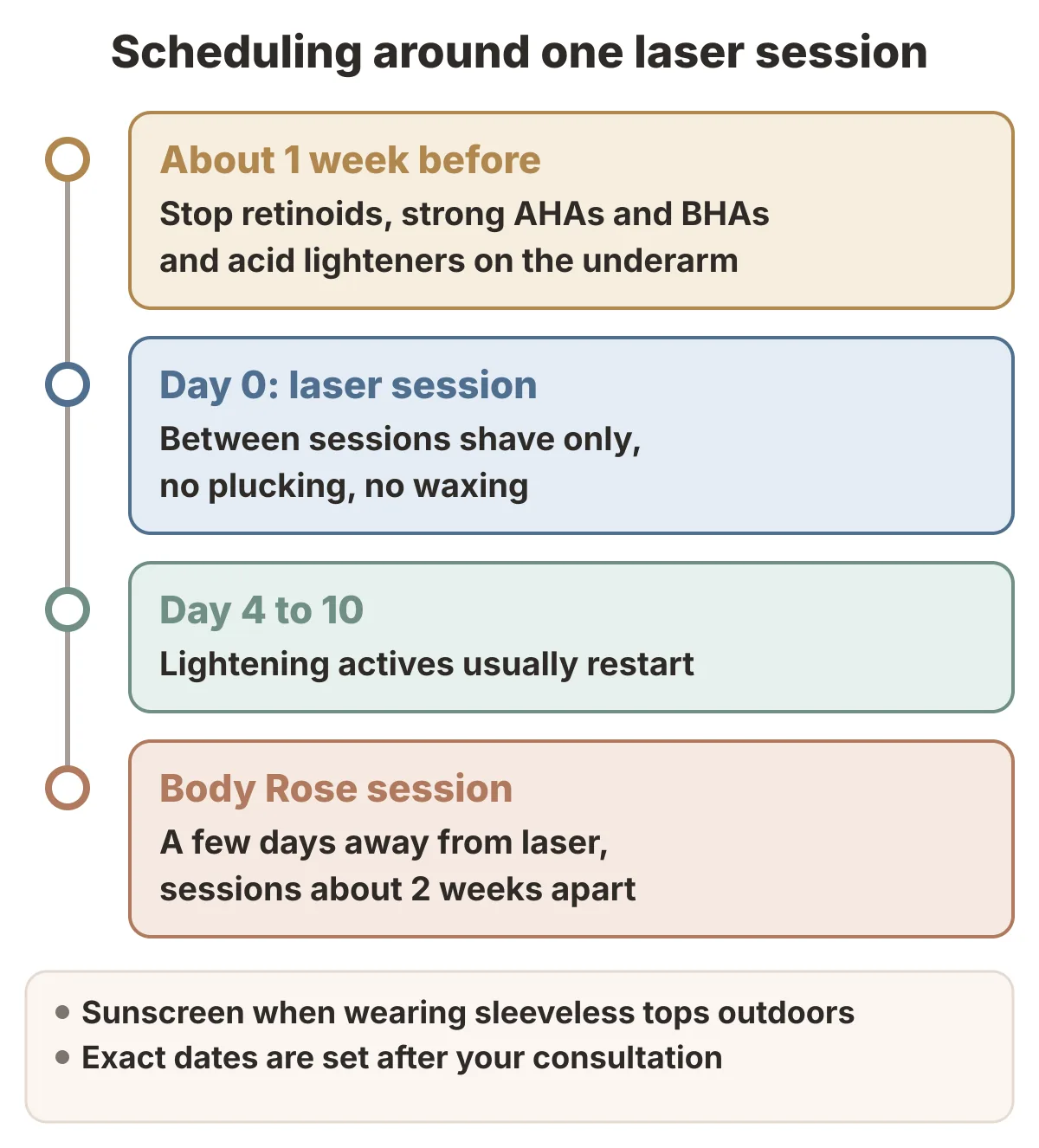
The two treatments run on different rhythms. Body Rose at Eternal is usually spaced about two weeks apart, while laser appointments are set by the technician according to how fast your hair grows back. They can usually be interleaved, with a few rules:
Keep a lightening session and a laser session on the same underarm a few days apart. A standard operating protocol for energy-based devices published in 2024 restarts depigmenting actives 4 to 10 days after a procedure.
Pause strong actives before laser. Retinoids, high-strength AHAs and BHAs and acid-based lightening products should be stopped on the underarm about a week before the appointment.
Between sessions, only shave. No plucking, no waxing.
Use sunscreen when you wear sleeveless tops outdoors, since it is the best-supported way to prevent post-inflammatory marks.
Bring the products you use on your underarms to the consultation so you can be told which to keep and which to pause.
The exact schedule is set by the doctor and technician after the consultation, based on your skin and how your hair is actually growing.
Assessment and planning at Eternal
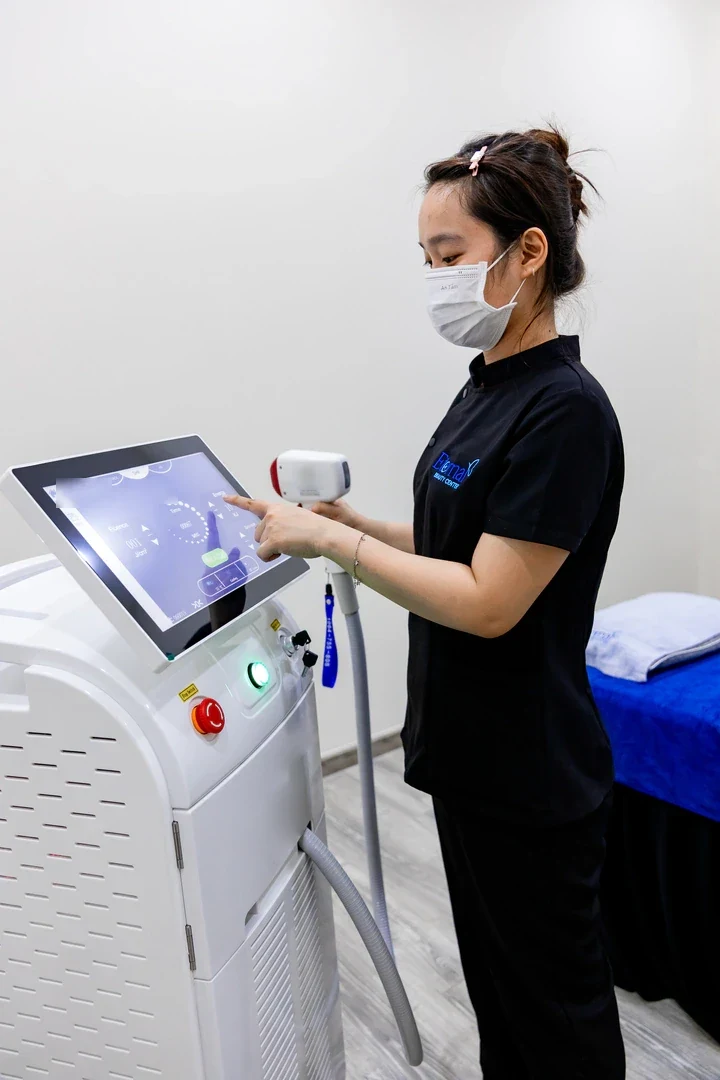
A 1:1 consultation with a doctor at Eternal settles the three things that decide the order: which kind of darkening you have, whether the skin is inflamed or tanned, and your skin tone. Triple-wavelength diode laser hair removal uses a system combining 755nm, 808nm and 1064nm with contact cooling, so the technician can choose the wavelength and energy for each area rather than one fixed setting. Body Rose is a non-invasive lightening course for underarms, groin, elbows and knees, typically 5–8 sessions about two weeks apart, depending on the area and the depth of pigmentation.
If the consultation points towards acanthosis nigricans or a superficial infection, you will be told plainly that medical assessment or medication comes first, because lightening the surface in those cases is the wrong order.
Hotline / Zalo: 0334 713 610
Address: 204 Đường Số 1, An Hội Đông Ward (formerly Gò Vấp District), Ho Chi Minh City (view map)
Opening hours: 10:00 – 20:00 daily