
No — freckles can be cleared almost completely, but they cannot be removed permanently. The reason is biological rather than a matter of skill or equipment: in freckles, the number of melanocytes is completely normal — those cells simply make more melanin. Lasers and IPL destroy that melanin, but they don't destroy the melanocytes, and they certainly don't change the genes that make those cells respond so strongly to sunlight. The entire factory is still standing; it just needs sunlight to start running again. DermNet puts it plainly: laser for freckles produces only "temporary lightening", and "the pigmentation is likely to recur the next summer".
This article doesn't re-explain what freckles are or how to tell them from melasma — that's covered in telling melasma, freckles and brown spots apart. Here we answer one question: how much can be achieved, how long it holds, and what you trade away. Written by the dermatology team at Eternal Beauty Center (Go Vap, Ho Chi Minh City), drawing on DermNet, Cleveland Clinic, StatPearls/NCBI and JAAD.
The short answer
Clearing them: yes, and usually very effectively. Removing them permanently: no. These are two different things, and almost all advertising collapses them into one.
| Question | Answer | Basis |
|---|---|---|
| Can freckles be cleared? | Yes — high clearance, often in just 1–2 sessions | 89% of epidermal pigment cases reached 80–100% clearance with QS 532 nm |
| Can they be removed "permanently"? | No | Melanocytes and genotype are untouched; DermNet: laser gives only "temporary lightening" |
| How soon do they come back? | On a sun-season cycle — the reference point cited is "next summer" | DermNet: "the pigmentation is likely to recur the next summer" |
| Do they have to be treated? | No. Freckles are benign and not a health issue | Cleveland Clinic: "extremely common and aren't a health threat" |
| Do they fade on their own? | Yes — they fade in low-sun months and usually become less obvious with age | DermNet: "often become less obvious in adult life" |
That last point is worth pausing on: treating freckles is a purely cosmetic decision, not a medical one. Choosing not to treat them is entirely reasonable. That's quite different from melasma, a chronic condition that tends to worsen if ignored (see melasma: causes and treatment).
Why freckles can always come back
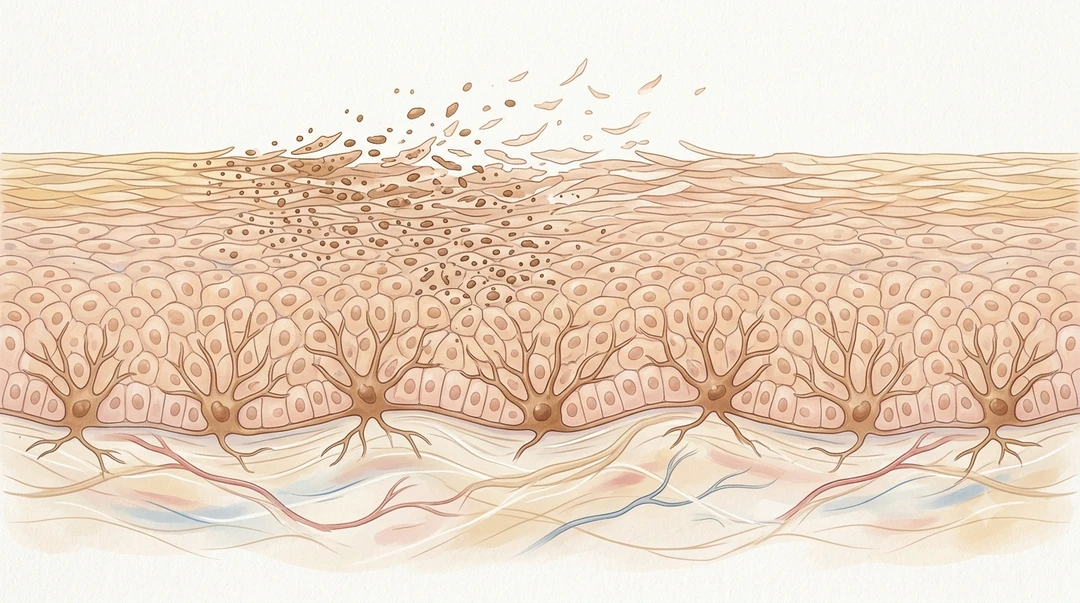
Because what gets destroyed is the pigment, and what makes the pigment doesn't. That's the whole answer, and it operates at three levels.
The histology. Under the microscope, a freckle is remarkably unremarkable: DermNet notes such lesions "may easily be overlooked histopathologically — the only finding is a mild basal hypermelanosis". Melanocyte numbers are not increased — unlike solar lentigines, which do show a mild increase in melanocytes plus elongated rete ridges. The pigment sits entirely within the epidermis.
The device. Pigment lasers work by selective photothermolysis: melanin is the target, not the melanocyte. The beam shatters melanin granules and the pigment-loaded keratinocytes holding them; those cells shed as fine microcrusts over about a month. The melanocytes — normal in number, sitting deeper in the basal layer — are not the target, and there is no mechanism by which a pigment laser eliminates them.
The genetics. Freckling is inherited. In fair-skinned populations MC1R is the principal gene: carrying one variant raises risk 3-fold, two variants 11-fold, with a population attributable risk of 60%. In Asian populations the mechanism differs — the classic "red hair" variants don't explain Asian freckling — but a GWAS of 4,813 Chinese individuals identified 59 new SNPs and 13 associated genes. The numbers most relevant to Vietnamese readers: among 9,697 Han Chinese students, 19.0% had freckles (26.1% of women, 12.1% of men), mean onset around age 12.4–12.9, and having an affected first-degree relative raised the odds 5.75-fold.
Put the three levels together: you can clear the pigment at the surface, but the cells that produce it are still there, still carrying the same genotype, and still responding to UV exactly as before. DermNet's conclusion is brief: because freckles are "an inherited characteristic, they cannot be prevented".
What the literature says about recurrence — and the data gap
The most-cited answer comes from DermNet: "Continued careful sun protection is essential, because the pigmentation is likely to recur the next summer." In other words, the realistic horizon is measured in sun seasons, not years.
But there's a point here that very few sources mention, and you should know it before reading any advertisement that cites a study:
Almost every published laser-for-freckles trial follows patients for only 8–12 weeks. The longest follow-up we could find was 6 months, in just 5 patients. No trial follows patients through a full summer.
That means when a study — or an advertisement quoting one — reports "no recurrence", the figure describes the immediate post-treatment window, not the durability of the result. It doesn't contradict DermNet; it simply hasn't measured as far out as recurrence is expected to occur.
This is why we recommend framing expectations seasonally: clear the pigment in a low-sun period, and accept up front that how much you keep depends almost entirely on photoprotection over the following 6–12 months.
Treatment options and realistic expectations
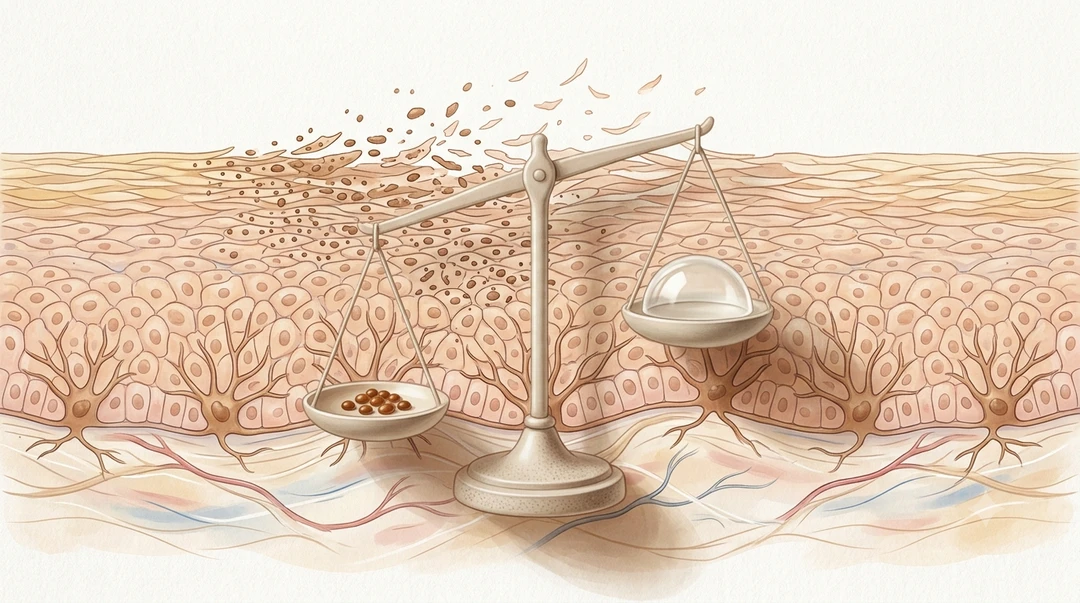
For freckles, pigment lasers are the only category with strong clearance data; topicals perform considerably worse here than they do for melasma. The published figures:
| Method | Reported efficacy | Sessions | Downtime | Notes |
|---|---|---|---|---|
| QS 755 nm alexandrite | 100% improved at 12 weeks; 63.3% good/very good | 2 sessions, 4 weeks apart | Microcrusts shedding over ~1 month | Data from 30 Vietnamese patients (Fitzpatrick III–IV); PIH 6.7%, resolving within a month |
| QS 532 nm | 89% of epidermal cases reached 80–100% clearance | Mean 1.2 sessions | Redness 1–2 days, full healing ~30 days | Highly effective for superficial pigment |
| Picosecond laser | ~85% of Asian patients reached at least 50% clearance at 3 months | 1+ sessions | Similar to QS, often milder | Not automatically better for freckles: a split-face trial favoured QS 755 nm over pico 532 nm |
| IPL | Inferior to QS laser for freckles (p=0.04) | 3–6 sessions, 2–4 weeks apart | Mild | But 0% post-inflammatory hyperpigmentation in the head-to-head trial — safer, slower |
| Cryotherapy | Used | 1 session per lesion | Crusting | Risk of hypopigmentation (white spots) on darker skin — weigh carefully |
| Topical lighteners | Limited for freckles | Long-term use | None | Hydroquinone is approved for dyschromias, but StatPearls notes plainly: "repigmentation may occur following sun exposure" |
Three conclusions:
Q-switched lasers give the highest and fastest clearance — usually a clear difference within 1–2 sessions.
IPL is safer but weaker for freckles specifically, and needs more sessions. That efficacy-versus-safety trade-off should be decided per skin tone.
Topicals are not the main answer for freckles. Because melanocyte numbers are normal and the issue is how much melanin they produce, lightening actives work considerably less well here than for melasma. Agent-by-agent detail is in actives for pigmentation.
Risks on Vietnamese skin (Fitzpatrick III–IV)
The main risk isn't scarring — it's post-inflammatory hyperpigmentation (PIH), and the rate depends heavily on the device. Figures from Asian patients:
QS alexandrite: 22% versus long-pulsed alexandrite at 6% (study of 20 Chinese patients)
In a 40-patient retrospective across four devices: long-pulsed alexandrite 20%, QS Nd:YAG 532 nm 10%, long-pulsed dye laser 0%, long-pulsed KTP 0%
The Vietnamese QS 755 nm study: 6.7%, resolving within a month
Picosecond 532 nm reduced PIH to 5% versus 30% for nanosecond QS on Fitzpatrick III–V skin (solar lentigines)
Two things to remember about PIH:
First, epidermal PIH takes 6–12 months to fade. So a "temporary" complication can outlast the result you just paid for.
Second — and this is counterintuitive — a network meta-analysis found sunscreen alone was no better than placebo at preventing PIH. Photoprotection is necessary and non-negotiable, but it is not a shield that compensates for the wrong device or over-aggressive settings. Real PIH prevention is: a test spot first, conservative fluence, topical preparation before and after, and never treating recently sun-exposed skin.
Who should NOT have freckles lasered
The most dangerous scenario is someone with freckles sitting on top of underlying melasma who doesn't know it. This is common on Vietnamese skin: two pigmentary problems coexisting on the same cheek, looking broadly similar to the naked eye.
The problem is that the two respond to the same laser in opposite directions. Freckles respond well; melasma rebounds — excess heat triggers an inflammatory response and the pigment comes back darker than before. In trials, laser toning for melasma showed 64–100% recurrence at 3 months, along with cases of rebound hyperpigmentation and mottled hypopigmentation. Put bluntly: you can pay to remove freckles and receive a darker patch of melasma in return. The mechanism and indications are covered in laser for melasma: when it helps and when it doesn't.
This is exactly why a diagnostic skin assessment before any intervention isn't a formality — it determines whether you should proceed at all.
Other cases to postpone or avoid:
Recently sun-exposed or tanned skin — an explicit contraindication; burn and PIH risk rise sharply
Active inflammatory lesions in the treatment area
A history of keloids or severe PIH after previous procedures
Current photosensitising medication or recent isotretinoin
Children — freckles in children are normal, peak in adolescence and usually fade with adulthood; there is no medical reason to intervene
Anyone not ready to commit to long-term photoprotection — the pigment will return quickly and the money is wasted
After clearance: how to maintain
Because freckles recur on a sun cycle rather than a fixed timeline, the maintenance plan should be seasonal too.
Photoprotection is the whole game. The AAD's guidance for darker skin tones: a tinted sunscreen containing iron oxide, SPF 30 or above (SPF 50+ for treated areas), broad-spectrum, water-resistant, reapplied every two hours and after swimming or sweating.
Physical cover in strong sun: a wide-brimmed hat, avoiding the 10am–2pm window. How to choose and apply the right amount is in sunscreen done properly.
Schedule any intervention for a low-sun period (roughly November to February in southern Vietnam), so your skin gets several months of low light pressure afterwards.
Maintenance actives slow the return: azelaic acid, glycolic acid, kojic acid and retinoids are among those the AAD lists. Set expectations correctly — the realistic timeline to see a difference is 6–12 months, and deeper pigment is measured in years.
Plan for repeat treatment, typically after a few sun seasons — this is a recurring cost, not a one-off.
When a "freckle" isn't a freckle
Genuine freckles are harmless. But there are situations where a brown spot that looks like a freckle needs a doctor — and this is the most important section of this article.
1. A spot appearing for the first time in adulthood. True freckles begin at age 2–3 and are never present at birth. A brown macule that first appears in adulthood is by definition not a freckle — it's more likely a solar lentigo, melasma, or something requiring exclusion.
2. Lentigo maligna — the melanoma that impersonates a freckle. Typically in people over 40 (peak 60–80), on sun-damaged facial skin. Features: larger than 6 mm and often several centimetres, irregular shape, uneven colour (light brown, dark brown, pink, red or white), growing very slowly over 5–20 years. One published case: a 51-year-old man with a "regular" light-brown 0.5 × 0.8 cm macule on his cheek, who had been reassured it was nothing — dermoscopy showed it was lentigo maligna.
Use the AAD's ABCDE rule for any spot you're unsure about: Asymmetry (one half unlike the other) · Border (irregular, scalloped or poorly defined) · Colour (varying shades across the spot) · Diameter (usually over 6 mm) · Evolving (changing in size, shape or colour).
3. Freckling before age 2 with severe sunburn from minimal sun — a presenting sign of xeroderma pigmentosum, an inherited condition carrying over 10,000-fold increased risk of non-melanoma skin cancer. A toddler with freckles is not normal and needs specialist review.
4. "Freckles" in the armpits or groin (Crowe's sign) — not sun-induced freckling at all, but close to pathognomonic for neurofibromatosis type 1, present in over 90% of NF1 patients by age 7. These areas get no sun, so freckling there always needs an explanation.
5. Heavily freckled people need regular skin checks. Freckles themselves aren't cancerous, but a densely freckled phenotype is a risk marker: a meta-analysis of 60 studies found a relative melanoma risk of 2.10. The response is sun protection and skin surveillance — not freckle removal.
Where to start
The first step isn't choosing a device — it's establishing what you actually have. On Vietnamese skin, freckles, solar lentigines, melasma and post-acne marks frequently coexist, and as noted above they respond to the same intervention in opposite directions.
At Eternal Beauty Center, the first visit is a diagnostic pigment assessment — identifying which type you have, at what depth, whether there's underlying melasma, and only then discussing direction and what to avoid. We'll say this plainly so you don't waste a trip: Eternal does not offer pigment laser or IPL for freckles. If the assessment shows a pigment laser is the right route for you, the doctor will say so directly.
What we can do, and what suits many cases:
Distinguishing freckles from melasma — the most important step, because it determines what's safe and what could make things worse
Mela Peel — a peel targeted at superficial pigment and post-acne marks, no visible peeling and no downtime, a course of 4–6 sessions 2–4 weeks apart
E-Mela — if what you actually have is primarily treatment-resistant melasma rather than freckles: a next-generation Resorcinol protocol, no heat, no laser
Building a photoprotection and maintenance plan that fits your work and daily routine
Frequently asked questions
Can freckles be removed permanently? No. They can be cleared almost completely, but not removed forever. Lasers destroy melanin, not the melanocytes, and they don't change the genes behind freckling — so when sun exposure resumes, pigment can re-form. DermNet describes laser results for freckles as "temporary lightening".
How long after laser do freckles come back? The reference point usually cited is the following summer — measured in sun seasons rather than years. Worth noting: nearly all laser-for-freckle studies follow patients for only 8–12 weeks, so "no recurrence" reports haven't measured as far out as recurrence is expected.
Do freckles go away on their own? Not completely, but they fade noticeably in low-sun months and usually become less obvious with age. That's also the diagnostic clue: a spot that fades substantially out of season is a freckle; one that stays the same year-round is more likely a solar lentigo.
How many sessions does freckle treatment take? With Q-switched lasers, 1–2 sessions about 4 weeks apart usually produce a clear difference — a study of 30 Vietnamese patients recorded 100% improvement after 2 sessions. IPL needs more, roughly 3–6 sessions 2–4 weeks apart.
Does laser for freckles cause dark marks? It can. On Vietnamese skin (Fitzpatrick III–IV), post-inflammatory hyperpigmentation rates vary by device: 6.7% in the Vietnamese QS 755 nm study, up to 20–22% with some other devices, and 0% with IPL in the head-to-head trial. Epidermal PIH takes 6–12 months to fade.
What if I have both freckles and melasma? This is the situation demanding most caution. The same laser can clear the freckles while causing the melasma to rebound darker. A diagnostic assessment first is essential, and the usual approach is to control the melasma with non-thermal methods before considering any light-based intervention.
Do topical treatments work for freckles? Much less well than for melasma, because melanocyte numbers here are already normal. Agents such as azelaic acid, glycolic acid, kojic acid and retinoids can slow and soften them, on a realistic 6–12 month timeline. StatPearls also notes hydroquinone results can repigment after sun exposure.
Should children be treated for freckles? There is no medical indication. Freckles in children are normal, most prominent in adolescence, and usually fade into adulthood. The right response is sun protection. One exception: freckling before age 2, or freckling in the armpits or groin, needs specialist review to exclude underlying conditions.
Quick summary
Clearable, yes. Permanent, no. Lasers destroy melanin, not melanocytes — and nothing changes the genes.
In freckles, melanocyte numbers are completely normal; those cells simply produce more melanin. That's the biological reason permanent removal isn't achievable.
Recurrence runs on a sun cycle — DermNet: pigment is likely to return the next summer. Every laser-for-freckle study stops at 8–12 weeks, well short of that.
Efficacy: QS 532 nm gave 80–100% clearance in 89% of epidermal cases; QS 755 nm gave 100% improvement after 2 sessions in 30 Vietnamese patients. IPL is safer but weaker for freckles.
The main risk is post-inflammatory hyperpigmentation, 6.7%–22% depending on device on Asian skin, taking 6–12 months to fade. Sunscreen alone doesn't prevent it.
Most dangerous scenario: freckles over underlying melasma. The same laser clears one and worsens the other — a diagnostic assessment first is essential.
Freckles are benign and don't need treating. But a spot appearing first in adulthood, one over 6 mm that's changing, freckling before age 2, or freckling in the armpits or groin all need a doctor.
Start with a pigment assessment, not a device: Mela Peel for superficial pigment · E-Mela if the main issue is melasma.
Book a pigment assessment at Eternal Beauty Center
Not sure whether you have freckles, solar lentigines or melasma — or have lightened them before only to watch them darken again? The dermatology team at Eternal Beauty Center will assess your skin to identify the pigment type and depth, and tell you what's safe and what could make things worse for your particular skin, with an honest forecast of results — including when the answer is that nothing needs doing.
Hotline / Zalo: 0334 713 610
Address: 204 Street 1, An Hội Đông Ward (formerly Go Vap District), Ho Chi Minh City
Opening hours: 10:00 – 20:00 daily
Our services: Mela Peel – Pigmentation Peel · E-Mela – Resistant Melasma Treatment
Read more: Telling melasma, freckles and brown spots apart · Laser for melasma · Sunscreen done properly
This article is for information only and does not replace diagnosis or prescription by a doctor. Eternal Beauty Center does not offer pigment laser or IPL services; the laser methods described here are presented so you can understand them and set accurate expectations, not as an offer of treatment. Any pigmented spot that changes in size, shape or colour should be examined by a dermatologist.
References
DermNet NZ — Ephelis; Brown spots, lentigos and freckles; Lentigo pathology; Lentigo maligna and lentigo maligna melanoma (dermnetnz.org)
Cleveland Clinic — Freckles: benign, cannot be completely removed, tend to fade with age (my.clevelandclinic.org)
Bastiaens M et al. — The melanocortin-1-receptor gene is the major freckle gene (PubMed 11487574)
MC1R Val92Met and Arg163Gln variants in Japanese subjects (PubMed 17371441); GWAS of 4,813 Chinese individuals (PubMed 38970458)
Prevalence and familial risk of ephelides in Han Chinese adolescents (PubMed 17968568): 19.0% prevalence, familial OR 5.75
Successful Treatment of Freckles by Alex TriVantage 755 nm in Vietnamese Patients — 30 Vietnamese patients, Fitzpatrick III–IV
Wang CC et al. — Journal of the American Academy of Dermatology 2006;54(5):804–810: QS alexandrite versus IPL in Asian patients
StatPearls / NCBI Bookshelf — Intense Pulsed Light Therapy (NBK580525); Hydroquinone (NBK539693); Xeroderma Pigmentosum (NBK551563); Neurofibromatosis Type 1 (NBK459358)
Gandini S et al. — Meta-analysis of risk factors for cutaneous melanoma: III (PubMed 16125929): high freckle density, RR 2.10
American Academy of Dermatology — What to look for: ABCDEs of melanoma; How to fade dark spots in darker skin tones (aad.org)